

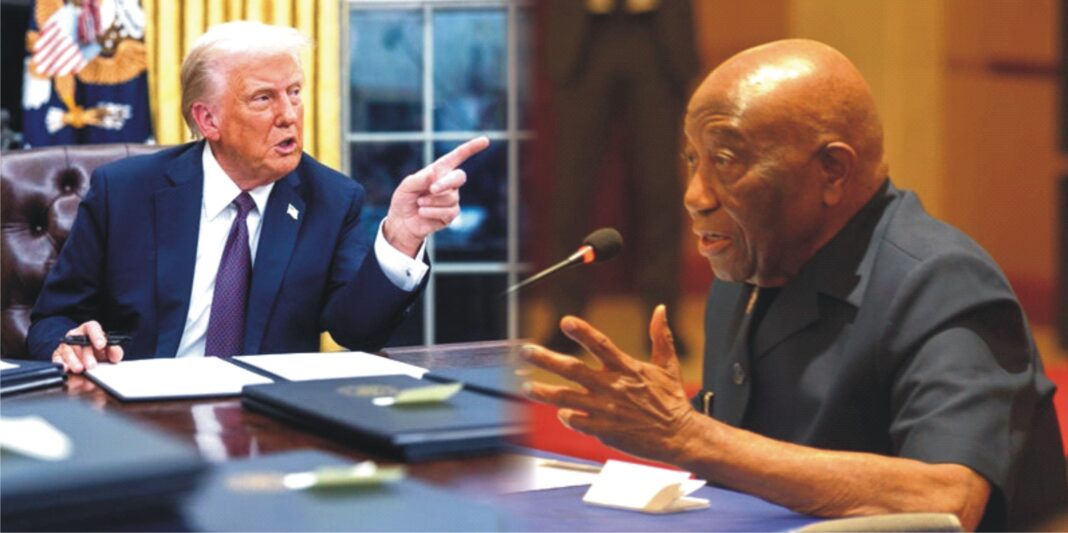
The Liberian government is actively assessing the ramifications of a recent announcement by the United States regarding global deportation crackdowns and the suspension of USAID activities, Information Minister Jerolinmek Piah said Thursday in Monrovia.
The U.S. has indicated its intent to review immigration policies, which may lead to the deportation of undocumented immigrants.
Piah said President Joseph Nyuma Boakai’s administration has commenced proactive discussions with U.S. authorities regarding the potential negative impacts of its policies.
The Ministry of Foreign Affairs has reached out to Secretary of State Michael Rubin, seeking dialogue on alternatives to deportation. Collaborations with U.S. Congress members are ongoing, with particular emphasis on maintaining the welfare of Liberians living abroad, he announced.
The role of the Liberian diaspora is pivotal to the economy, with remittances significantly contributing to national revenue. Statistics indicate that the estimated 1.5 million Liberians residing in the U.S. send home around $300 million annually, directly supporting families and local businesses.
These funds play a vital role in sustaining Liberia’s economy, especially in the wake of challenges following the civil war.
Since the end of Liberia’s civil conflict in 2003, U.S. financial assistance has been instrumental in rebuilding the economy. Annual USAID contributions, which have averaged around $100 million, have supported essential programs in health, education, and governance, helping to foster stability and infrastructure development. The suspension of these funds could have dire implications, particularly in sectors heavily reliant on U.S. aid.
See Full text of The Liberian Government Response to the United States Government Global Deportation Announcement and Suspension of USAID Activities
The United States has commenced crackdowns and deportation of illegal aliens and ‘criminals’. In addition, there has been a suspension of all USAID activities around the world. USAID is a major contributor to key sectors of Liberia such as health, education, rule of law and others.
To date, the Liberian government has not been informed of any deportations in line with the new immigration policies of the American government. The Government of Liberia is informed of only 4 deportees, 3 of whom are expected in Liberia this week. It is important to note that processing of those deportees began before the Trump Administration’s recent pronouncement of mass deportations and is totally unrelated to same.
In consultation with the President of Liberia, H.E. Joseph Nyuma Boakai, the Ministry of Foreign Affairs has been engaging the US authorities proactively. The Minister of Foreign Affairs has written to her counterpart, the American Secretary of State, for a meeting to dialogue on alternatives to deportation.
Meanwhile, the Government is also engaging with the US Congress at state and federal levels to seek alternatives to deportation. Backdoor diplomacy is also ongoing. At home, the Ministry of Foreign Affairs remains engaged with the US Ambassador whom the government thanks for his openness in these engagements.
To ensure a proper response to the concerns of Liberians in the US through our engagement with the Liberian Embassy in Washington, DC, the government convened a zoom call meeting with major Liberian diaspora organizations to solicit their views and input on these important issues.
The Liberian Ambassador to the United States, Al Hassan Conteh and the Minister of Foreign Affairs Mme. Sara Beysolow Nyanti moderated the call and took all questions from the 100 participants on the call respectively. There were many recommendations made including the following:
- The embassy should open a hotline for Liberians to call. This is being worked on immediately with thanks to a Liberians in the US who have offered technical assistance and support.
- Liberian associations should all coordinate but nobody should take any action contrary to the diplomatic engagements.
- That we should engage Liberians in leadership positions in the US government such as Mayor Wilmot Collins, Representative Naquetta Ricks and others as they have offered their support and do have a critical role to play.
- The ULAA leadership should proceed with engaging legislators who are supportive of Liberia such as Senator Jack Reed of Rhode Island.
An inter-agency task force has been activated to plan for the possible mass deportation. Chaired by MOFA, task force includes the Minister of Justice, Immigration, Police, LRRRC, Ministry of Internal Affairs, and Ministry of Finance. The task force met on February 5, 2025 and is continuing its work to ensure preparedness. Meanwhile an impact analysis is being conducted regarding the loss of funding from USAID.
President Boakai has tasked all sector leads including health, education, agriculture, rule of law agencies and others to ensure an impact analysis as well as their plans for mitigation.
President Boakai is concerned about the welfare of its citizens whether at home or abroad, and is doing everything possible to work with our traditional partner, the United States, to form a common ground on the deportation issue and suspension of USAID activities in Liberia.
It is important to note that Liberia has no authority over and above policy decisions of the United States. Liberia can only engage, dialogue and negotiate strategies and approaches in the best interest of Liberians.

