

We the people of the Republic of Liberia, in order to form a perfect Nation, establish justice, insure domestic tranquility, provide for the common defence, promote the general welfare and the goodness of our people, and secure the blessings of the love of Liberty that brought us together as a nation and our posterity, it is our duty to respect the constitution of the Republic of Liberia.
The true administration of justice is the firmest pillar of good government. It is the responsibility of the government to enforce the criminal law.
Law enforcement officers at every level are guided and limited by legislation, court orders, and codes of conduct.
Courts adjudicate criminal cases, deciding whether criminal defendants are guilty or not guilty. A prosecutor works for the government and brings cases against defendants. Judges decide what laws and procedures apply, leaving juries of private citizens to decide what the facts are in each case. Finally, a system of corrections handles those people convicted of crimes, jails and prisons house offenders (Marshall Croddy).
According to the Sage dictionary of criminology: crime is not a self-evident and unitary concept. Its constitution is divers, historically relative and continually contested. As a result an answer to the question what is crime? Depends upon which of its multiple constitutive elements is emphasized. This in turn depends upon the theoretical position taken by those defining crime.
In recent days, the new management team of the Liberia Drug Enforcement Agency (LDEA) announced that all agents of the agency will be subjected to drug testing. At first glance, this directive appears to be a progressive reform aimed at enhancing accountability and credibility within the LDEA. After all, an agency tasked with combating drug abuse cannot afford to have its own officers compromised by the very substances they are sworn to fight. However, while the principle is noble, the practicality and timing of such a policy raise serious questions.
The LDEA faces a host of structural and operational challenges that threaten the effectiveness of any reform. Many of its agents are serving as volunteers, with only a small portion on the government’s payroll. Added to this, the majority of agents lack adequate professional training. These realities beg the question: How can an agency impose drug testing when its own workforce remains largely informal, underpaid, and undertrained?
The Issue Behind Drug Testing
Globally, law enforcement agencies often conduct drug testing to ensure discipline, integrity, and trustworthiness. In the United States, for instance, police recruits and serving officers are routinely tested for drug use as part of maintaining professional standards (U.S. Department of Justice, 2016). This practice fosters public trust and reassures communities that those enforcing the law are not themselves in violation of it.
For the LDEA, the idea is the same: drug testing would reinforce the message that no officer is above the law. It would send a strong signal that the agency is serious about integrity and is willing to hold itself accountable to the same standards it imposes on the public.
LDEA Workforce
While the principle is commendable, the context in Liberia paints a different picture. The LDEA is operating in a fragile institutional environment. According to reports from civil society and local media, a significant number of LDEA agents are volunteers. These individuals dedicate their time and energy to fighting drugs but do so without the financial support that comes with formal employment. This lack of remuneration undermines morale, creates financial vulnerability, and in some cases, exposes agents to corruption and compromise.
In addition, the majority of these agents have not received comprehensive professional training. Unlike their counterparts in other jurisdictions, they lack consistent exposure to modern law enforcement practices, drug interdiction techniques, and professional ethics. This deficiency not only weakens their operational effectiveness but also undermines the credibility of reforms such as drug testing. What good is it to test an officer for drug use when the same officer has not been adequately trained in the law, in rights-based policing, or in community engagement?
The Symbolic Reform
Without addressing the deeper issues of workforce stability, training, and resourcing, the drug testing policy risks becoming a symbolic gesture in Liberia and its environ . Symbolism is not inherently negative—it can inspire confidence and signal change—but it must be backed by tangible reforms. Otherwise, it can breed cynicism among both officers and the public.
Imagine a volunteer officer, unpaid and untrained, being subjected to drug testing. If such an officer tests positive, dismissal may follow. But what happens next? Without counseling or rehabilitation, that individual becomes another statistic in Liberia’s growing drug problem. Moreover, the agency loses manpower without addressing the root causes of drug abuse.
The government of Liberia (LDEA) needs to address the root causes of drug abuse before thinking about doing drug test of its agents.
Regularization of the workforce
If the LDEA is serious about professionalizing its workforce, the government must first address the problem of volunteerism. Law enforcement is not volunteer work; it is a specialized and high-risk profession that demands stable employment conditions. The government should prioritize placing more agents on the payroll. A well-compensated officer is less likely to succumb to corruption, drug use, or other forms of misconduct.
The role of international partners is also critical here. Liberia has historically benefited from support by the United Nations, ECOWAS, and bilateral donors in rebuilding its security sector (Adebajo, 2002). Similar partnerships could be leveraged to regularize the LDEA workforce, ensuring that those entrusted with combating drugs have the financial security and institutional support they need.
Capacity Building and Training
Beyond pay, training is essential. The LDEA must prioritize the professional development of its officers. This includes not only training in drug interdiction but also in areas such as human rights, investigative techniques, and community policing. According to the United Nations Office on Drugs and Crime (UNODC, 2021), successful drug enforcement depends as much on professional standards and ethics as it does on operational tactics.
A trained officer is better positioned to resist the lure of drugs, corruption, and misconduct. Drug testing without training is like treating symptoms without addressing the disease. If the LDEA is to be credible, it must invest in the intellectual and ethical development of its agents.
Rehabilitation and Counseling
Another area of concern is the fate of agents who test positive. Will they simply be dismissed, or will they be offered counseling and rehabilitation? If the LDEA wants to lead by example, it must balance discipline with compassion. Agents who test positive should not simply be discarded; they should be given the opportunity to seek treatment and reintegration.
The World Health Organization (WHO, 2019) emphasizes that drug use disorders are health issues, not just criminal matters. By offering rehabilitation to its own officers, the LDEA would be modeling a humane and holistic approach to drug enforcement.
Resources Support for Reform
For a work to begin good there must be a financial resources support. Reforms of this magnitude require financial resources. The Government of Liberia must increase budgetary allocation to the LDEA to ensure that reforms are not just policies on paper but realities on the ground. International donors, too, should see this as an opportunity to strengthen Liberia’s fight against drugs through capacity building, technical assistance, and funding.
Without financial backing, drug testing will collapse under the weight of logistical challenges. Testing itself requires resources—kits, laboratories, personnel, and administrative systems. A poorly funded drug testing initiative will only frustrate officers and create further mistrust.
Moving from Symbolism to Reality
The fight against drugs in Liberia cannot be won by symbolism alone. It requires reality: well-paid officers, comprehensive training, rehabilitation programs, and robust funding. Drug testing can play a role, but only within this broader framework. The new management of the LDEA must recognize that credibility is not built by isolated reforms but by systemic transformation.
In conclusion, while drug testing for LDEA agents is a step in the right direction, it cannot stand alone. It must be accompanied by efforts to regularize the workforce, provide training, offer rehabilitation, and secure funding. Without these, the policy risks being an empty gesture in a context that demands far more.
Liberia is at a crossroads in its fight against drugs. The choices made now will determine whether the LDEA becomes a symbol of integrity or a casualty of its own contradictions. The new management has signaled its intent to reform, but intent must be matched with substance. Only then will the agency command the trust and confidence it so desperately needs.
Drugs and drug use in Liberia
Drugs: the term drug refers to any substance, use as a medicine or as an ingredient in a medicine that kills or inactivates germs or affects any body function or structure.
Drug Use: is an all-encompassing term to describe drug taking in the most general way.
Drug misuse: is the inappropriate use of legal drugs intended to be medications. The issue of drug misuse happen when a person or persons fails to use a drug in the approved manner.
Drug Abuse: any use of illegal drug or the use of a legal drug when it is detrimental to one’s health or the health of others.
In this context, the Drug Enforcement Agency (DEA) use the term drug abuse for any use of an illegal drug, or any use of a legal drug when it is detrimental to one’s physical, emotional, social, intellectual, spiritual or occupational health.
The issue of drinking alcohol in excessive quantities (by getting drunk) is an example of drug abuse because it places one’s health in jeopardy.
Before the Liberian civil war the only drug that most Liberian known was marijuana or opium and it was mostly taken by adults. The history of drug use is as old as the human history.
Today, new drugs are reaching the market place almost daily. In Liberia new illegal drugs seem to appear on the street each year as well (LDEA). The drug market intervention in Liberia is the next step beyond ceasefire and this cannot be done by the Liberia Drugs Enforcement Agency (LDEA) alone but with the corporations of the communities and all law enforcement institutions. The aims of LDEA at shutting down the drugs market is to help keep our neighborhoods free from high crime not drugs alone.
To be effective, the LDEA need all the supports of the communities through the community outreach units or each chairman of the community should help to connect the LDEA to the drugs market.
After the Liberian civil war, drug abuse occurs almost everywhere, in homes, Junior and Senior High Schools, Universities, communities and in executive’s suites. There is no place that is not affected by drugs in Liberia.
It is also alleged that some Liberian and other foreign nationals are now cooking marijuana or opium in their home foods and other foods items that they are selling such as: peanut butter, bennyseed-candy, ground-pea candy, morning-kalama, milk-candy, egg-nut, and kanyan among others.
Drugs which, in the government of Liberia view, are without medical value and dangerous can be declared illegal: heroin, cocaine, marijuana or opium, LSD (lysergic acid diethylamide).
In Liberia drugs are classify into so many ways such as, legal and illegal, natural and synthetic, addiction and non-addiction .
Some important words and definitions to know according to drugs issues for today:
Nonprescription drugs: drugs that can be legally purchased without a physician’s prescription.
Over-the-counter (OTC) drugs a term interchangeable with nonprescription drugs.
Prescription drugs: drugs and medications dispensed by pharmacist on orders from a physician or dentist.
Social drugs: Legally available psychoactive drugs that are used by a large proportion.
Cocaine: A potent peripheral and central nervous system stimulant found in the leaves of the coca plant.
Drug cartels: Groups of illegal independent drug dealers who join forces for the purpose of controlling the production, distribution, and marketing of illegal drugs.
About the Author
Professional Profile Summary
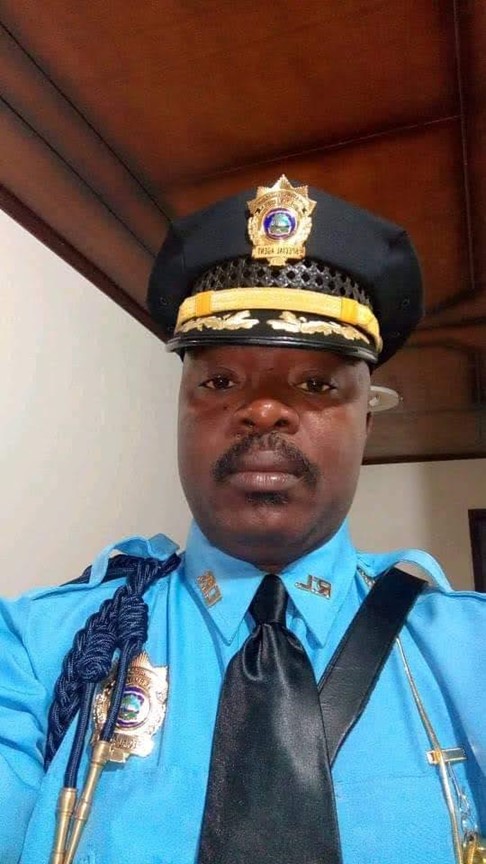
Tarpeh L. U-sayee, Jr. is a seasoned Liberian law enforcement professional, criminal justice professor, and police training expert with a solid foundation in international relations, theology, and public service. With over a decade of experience in both law enforcement and criminal justice education, he currently serves as a trainer at the Liberia National Police Training Academy and lectures at various private universities in Liberia.
He holds a Master’s Degree in Foreign Service Leadership (International Relations), a Master of Divinity, dual Bachelor’s Degrees in Sociology and Criminal Justice, and an Associate Degree in Management. He is also a prospective doctoral graduate in Church Growth and Ministry.
Mr. U-sayee is a graduate of the Liberia Police Academy, the Louisiana State Police Academy (USA), and the Lagos State Police Academy (Nigeria). As an Apostle and spiritual leader, he brings a unique combination of ethical leadership, academic excellence, and practical field experience. His lifelong mission is centered on peacebuilding, unity, and the advancement of the rule of law in Liberia.
References
Adebajo, A. (2002). Liberia’s Civil War: Nigeria, ECOMOG, and Regional Security in West Africa. Boulder: Lynne Rienner Publishers.
U.S. Department of Justice. (2016). Drug Testing in Law Enforcement Agencies: A National Perspective. Washington, D.C.
United Nations Office on Drugs and Crime (UNODC). (2021). World Drug Report 2021. Vienna: United Nations.
World Health Organization (WHO). (2019). International Standards for the Treatment of Drug Use Disorders. Geneva: WHO.

