

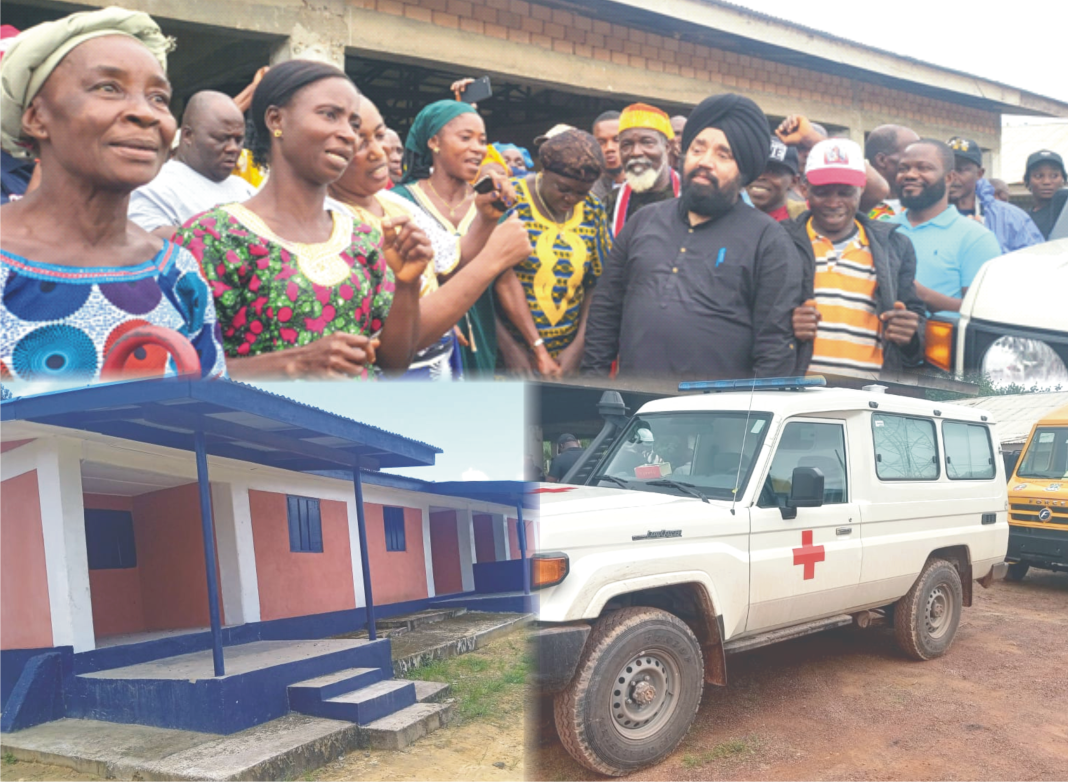
When an ambulance rolled into Margibi County District #5 in late July, it carried more than oxygen tanks and other lifesaving medical devices. For many residents around the sprawling Salala rubber plantation, it symbolized a rapid shift in how the estate’s new owners, Jeety Rubber LLC and Salala Rubber Corporation (SRC) under CEO Upjit Singh Sachdeva are engaging with workers and surrounding communities.
“This ambulance will save lives,” Sachdeva told a ceremony attended by local officials and community leaders. The vehicle is fully equipped, staffed by trained personnel, and intended to reduce the hours-long delays in reaching hospital care that residents often face, especially during the rainy season.
The donation came alongside a raft of other interventions the company has implemented since acquiring SRC: rehabilitation of schools and a new senior high classroom, daily school meals and a 24-seat school bus, clinic restocking and lab diagnostics, a program to renovate and build housing, installation of boreholes and tap water systems, and 58 solar streetlights across 56 communities.
Beyond modern infrastructure there’s alo labor changes: formalizing the employment of roughly 120 cup washers with “substantially improved pay and regular hours,” rehiring roughly 900 workers, cancelling punitive interest on salary advances, and implementing a bonus system developed after consultation. The company says 120 homes have been completed, with a much larger housing program planned over the next 24 months.
Taken together, those initiatives appear to align with key elements of the IFC’s Management Action Plan (MAP), issued in March 2025 after the CAO (the World Bank’s inspection arm) validated a number of legacy grievances from the plantation’s prior era of ownership.
The MAP calls for community development programs, women’s economic empowerment, improved health services, protection of culturally important sites, restitution where warranted, and better grievance mechanisms and monitoring.
“You can see the difference when children no longer walk miles in the rain,” said Irene Darwolor, chairlady of Baypolou, praising the new school bus and a renovated town hall that the company says will bolster civic life and local dispute resolution.
“Having a proper town hall means our community can organize better, hold meetings with dignity, and have a space where our voices can be heard.”
Yet those developments have become the center of a contentious campaign of misconception and falsehood. Several Liberian NGOs have publicly asserted that “no tangible differences” exist on the ground since the change in ownership.
However, evidence-based facts have forcefully rejected that characterization, rendering such blanket assertions inconsistent with “a range of independently reported and verified documented interventions.”
Independent verification is precisely the remedy many stakeholders say is needed.
The reality for many residents may lie between these poles: a mix of immediate, tangible improvements alongside unresolved historical grievances that require careful, multi-stakeholder remediation.
What seems clear is that both greater transparency and a shared fact-finding process would reduce polarization and speed practical solutions.
For example, court records and government historical concession documents show expansion of the plantation was legal.
Salala’s plantation, a 4,577-hectare (11,310-acre) rubber concession in Margibi county was once owned by Socfin, a Belgian and French agribusiness giant.
Socfin took over majority ownership of Salala from the Weala Rubber Company, a Dutch-German enterprise that in 1959 signed a deal with the Liberian government for 40,000 hectares (100,000 acres).
What seems clear is that both greater transparency and a shared truth telling would better serve the people in the concession communities.
For communities around Salala, the stakes are not debates in the press but access to health, water, education and livelihood improvements that have real consequences for daily life.
Matching IFC MAP commitments to Jeety/SRC actions
(Evidence-based mapping)
| MAP Commitments | Jeety/SRC Actions | Outcomes |
| Community development programs to improve livelihoods
|
Renovation and operation of schools (including senior high), daily school meal programmer, school buses to transport pupils, scholarship scheme (A+/A tier scholarships), vocational school feasibility review for District 5, Independence Day distributions to thousands of children and other beneficiaries.
|
Improved education access, retention, nutritional support and future opportunities. |
| Women’s economic empowerment | Formal employment of 120 cup washers (rubber cup cleaners) formerly informally contracted; substantial pay increase (from the prior $15 per pat to $120 monthly) and regularized five-hour shifts. | Formal wages, labor rights, and greater income stability for women workers.
|
| Measures to end gender-based violence / harassment
|
Company has publicly stated reforms to employment practices and engaged workers in meetings; improvements in worker housing and clinic services increase safety and health access. Jeety continuously engage with workers and hold meetings. | Risk reduction through better oversight, improved worker support structures and presence of functioning clinics and emergency transport.
|
| Compensation for crops, land grievances, protection of water
|
: Drilled boreholes, installed tap water systems in Weala, and installed 58 solar street lights across 56 communities; these improve access to clean water and public infrastructure.
|
water quality tests, records of borehole locations and maintenance, collaboration with CAO to address legacy land claims |
| Employment, decent work, and housing improvements
|
Rehired approximately 900 previously laid-off workers, canceled punitive 25% interest on salary advances, initiated renovation/new construction of worker housing (120 homes completed with a plan for 500+ within 24 months), implemented a bonus system after consultation, and increased basic pay and benefits for key categories.
|
Restoration of jobs, improved housing, removal of exploitative financial practices, and improved livelihoods.
|
| Health services and emergency response | Restocked medical clinic, hired a qualified doctor and staff, opened a lab with diagnostic capacity, donated a fully equipped ambulance and trained local medical personnel.
|
: improved primary and emergency health care for workers and surrounding communities.
|
| Implementation, monitoring, and stakeholder engagement
|
Multiple consultations with workers and community stakeholders; company-led initiatives (routine community charity outreach, town hall renovations, and community meetings) indicate active engagement.
|
Ongoing engagement with communities, but the MAP’s call for independent third-party monitoring and coordination with IFC/CAO remains an important next step.
|

