

Truth in Ink:
From the Pen of Sidiki Fofana
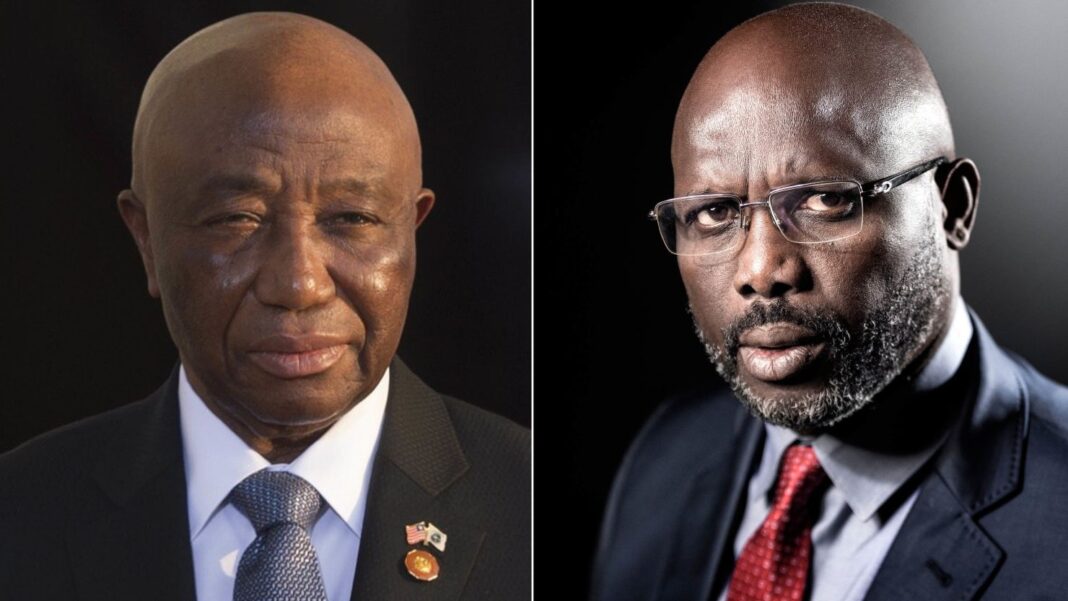
Since taking power nearly 15 months ago, President Joseph Boakai’s Unity Party (UP) government has found itself entangled in a heated debate: Is it genuinely delivering on its development promises, or merely riding the coattails of projects initiated by its predecessor, the Coalition for Democratic Change (CDC) under former President George Weah?
At the heart of this political standoff lies a fundamental question: who truly owns Liberia’s major national projects? The Accusation: No Innovation, Just Inheritance
The CDC, now the country’s main opposition party , has repeatedly accused the Unity Party of lacking innovation and capacity. CDC partisans argue that the only tangible projects being implemented under Boakai’s leadership are those born during the Weah administration. They claim the current government is simply overseeing ongoing developments, offering little that is new or original.
This narrative was sharply advanced by CDC stalwart and former Representative Acarous Gray. Speaking on Spoon TV, Gray derided the Unity Party as a “projects rogue,” arguing that most initiatives under the Boakai administration are just recycled CDC efforts. His comments were a direct jab at Mo Ali, head of the Liberia Water and Sewer Corporation and a close Boakai ally, whose projects in water expansion have been widely promoted by the government.
Ali, in response, fired back with documentation dating back to the Ellen Johnson Sirleaf era, showing that financing for some of the water projects had been negotiated under then-Finance Minister Amara Konneh. His point: these projects predated the Weah government, suggesting a lineage that spans multiple administrations—not solely the CDC’s.
Ports, Partners, and Political Memory
The contest over project ownership doesn’t stop at water. The Managing Director of the Freeport of Monrovia, Sekou H. Dukuly, recently showcased what he called a “national milestone”: a partnership with Tanger Med Engineering of Morocco to overhaul Liberia’s major ports. Dukuly hailed the agreement as a mark of Boakai’s forward-thinking leadership.
But almost immediately, former port Deputy Director for Security Saboto Dennis undercut the announcement. He pointed out that the agreement was in fact the result of groundwork laid by the Weah administration, specifically former Freeport head Diana Nebo, and had been tied to Weah’s official state visit to Morocco. A 2023 article from the Oracle Newspaper appears to support Dennis’ claim, quoting Nebo expressing gratitude to the Moroccan government on behalf of President Weah.
CDC’s Push for Credit
This wave of pushback culminated in a viral Facebook post by former Information Minister Eugene Nagbe, who released a comprehensive list of projects initiated under President Weah—including the Robertsfield Highway and major road works in Nimba and Lofa. His argument: these projects didn’t just appear under Boakai—they had deep roots in CDC-era governance and should be acknowledged as such. And he’s not wrong.
While governments change, national interests don’t. For example, a Public works project might span multiple administrations. One leader secures the funding, another manages implementation, and another might finish construction.
The CDC says it accepts the principle that “government is continuity.” But it also insists that recognition be given to those who initiated these efforts—namely, George Weah. The party views the Unity Party’s reluctance to do so as both intellectually dishonest and politically opportunistic.
Yet the Unity Party has its own narrative. In opposition, it long claimed that the Ellen government- a product of the Unity Party created the “blueprints” for the projects Weah implemented. This rivalry gave birth to the CDC’s mocking campaign slogan: “You can keep the blueprints while we do the work.” Now, the tables have turned.
And just when the Unity Party thought it had firm control of the narrative, came a moment of unexpected honesty—one that stirred internal unease. On The Closing Arguments, panelist Sarah Dopoh didn’t mince words. “This is too bad, mehn,” she said with clear frustration. “Does the UP not have brains? Stealing all of Weah’s projects?” Her statement reflected growing public cynicism about the government’s approach to project attribution.
But the moment that truly shook the Unity Party base came from none other than Mohammed Sheriff, the newly appointed Managing Director of the Liberia Electricity Corporation. Widely praised for the improved consistency in electricity supply under his leadership, Sheriff broke from the partisan script. In a rare act of statesmanship, he publicly acknowledged the “vast investments and efforts” of the Weah administration in the power sector—crediting them for laying the groundwork that has allowed him to deliver results today.
That didn’t sit well with everyone.
Some UP partisans lashed out on Facebook, calling him a “betrayal.” One commenter asked, “How can he be praising Weah for what JNB is doing?” Another wrote, “So if Weah did all that, why was current not regular during his time?”
Their frustration is revealing of how the push to politically weaponized development in Liberia is a common practice. It highlights a painful truth: progress in Liberia is often not judged by “facts, but by factions.” says Fahgon.
Who Really Owns these “Projects “?
While the back-and-forth has observers increasingly worried about the level of political weaponization of Liberia’s development , a study by the Organization of American States and Georgetown University, states that failure to acknowledge the contributions of past governments undermines transparency, accountability, erode trust and democratic continuity.
The research emphasizes that crediting a predecessor for initiating projects isn’t just an ethical obligation—it’s a good governance imperative with long-term benefits for institutional historical context, political stability and cooperation , best project management practices, legal and contractual safeguards .
So, is the Unity Party truly a “project rogue,” as the CDC claims? It’s noticeable reluctance to give credit in any forms only intensifies the allegation of being a ” project rouge .” Or is the CDC simply trying to insert itself into Liberia’s ongoing development narrative after failing to effectively communicate its achievements to voters—voters who ultimately turned them out in favor of the UP based on what the CDC termed as ” propaganda.”
Perhaps the real answer lies not in who gets the credit, but in how Liberia can build a political culture where development isn’t weaponized.

