

By Sidiki Fofana | Truth in Ink
This article reflects my over two decades with the party as a founder, leader, and one of its most loyal members.
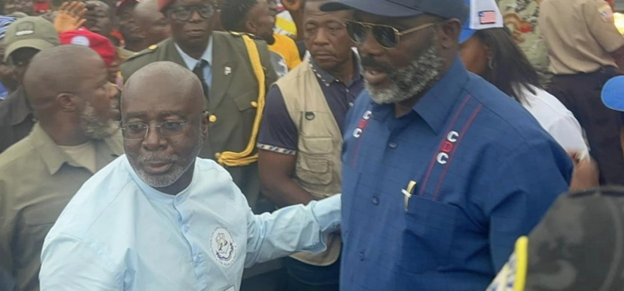
On August 25, the very day schools reopened in the United States, the Congress for Democratic Change (CDC), through its beloved son and political leader, former President George Weah, announced the formation of a 23-member committee tasked with constructing a new national headquarters.
Headed by Speaker J. Fonati Koffa and coordinated by Eugene Nagbe, the announcement was more than the mere naming of individuals. It was a statement of resilience, a determination to rebuild after the party’s invasion and forceful removal from a home it had occupied for nearly two decades.
“This is not just a building,” an ordinary CDC member told me with tears in his eyes. “It is our dignity restored. They thought CDC would disappear after that humiliation. But we are still here.”
This moment transcends joy. It wipes away humiliation and stands as a potential turning point. For the CDC, this project could set a new political precedent, a demonstration of grassroots power and collective sacrifice.
The funding, unlike Liberia’s usual tales of patronage, will likely come not only from the “haves”, those who amassed wealth during CDC’s years in power, but also from the “have-nots,” the vast majority who have always been the party’s backbone.
In this, CDC mirrors a broader Liberian reality; just as churches erect massive cathedrals from the widow’s mite, so too do partisans willingly give, however poor, to keep alive the vision of their movement.
As one political pundit noted: “CDC’s survival has never been about money, it has been about spirit. But spirit without reform becomes noise. If they build walls without changing their ways, they will still collapse from within.”
If accomplished, this will be historic. Liberia has rarely seen a political party build its own headquarters while out of power. The True Whig Party and Charles Taylor’s National Patriotic Party both did so only under the advantage of state power and public influence. For the CDC to achieve this feat now would be both monumental and unprecedented.
But brick and mortar alone will not define the CDC’s rebirth. Its greater challenge lies in reconstructing its mentality. The party must evolve a new political culture, one that reconciles its grassroots authenticity with the responsibilities of a former ruling party. It must demonstrate tolerance, openness, and a readiness to engage the “new Liberia” where political spaces are more contested and alliances more fragile.
A senior politician close to the process confided: “CDC’s biggest enemy has never been Unity Party or any opposition; it has been itself. If it cannot learn tolerance, expansion, and inclusion, even the strongest headquarters will stand as a monument to failure.”
A critical step toward this rebirth may be an early convention, not merely to assess, adjust, or confirm county and national leadership, but to create a new internal political culture aligned with Liberia’s external political realities. That culture must preserve CDC’s originality as a grassroots movement while shedding the exclusivity, arrogance, and narrow survival instincts that once alienated allies and weakened its hold on power.
“Bricks are easy,” another ordinary partisan put it, “but mentality is harder. If we change our mentality, then no one can ever evict us again because our home will be the people.”
Truth in Ink now believes that The CDC must learn walls do not protect a party, values do. The eviction took away a building, but it cannot take away a vision. Now we stand at a crossroad; to build not just with cement, but with conscience.
To raise not only walls, but wisdom. To prove that the CDC is not a tenant of structures, but the landlord of Liberia’s democratic future.

