

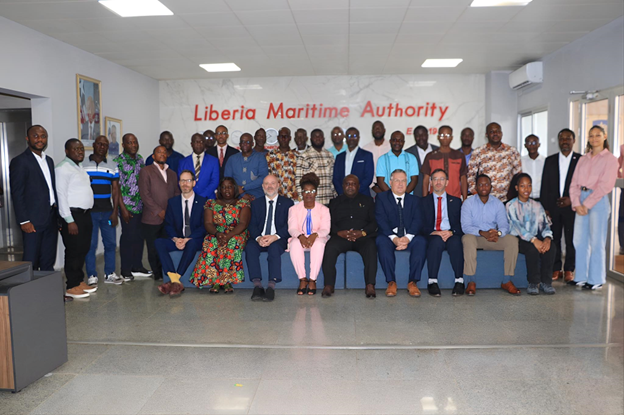
The Liberia Maritime Authority (LiMA) has welcomed a high-level technical delegation from the International Hydrographic Organization (IHO) for a follow-up assessment visit, marking a significant step in Liberia’s bid to join the global hydrographic body. The mission, held on January 15, 2026, at LiMA headquarters in Congo Town, Monrovia, focused on evaluating Liberia’s progress toward meeting membership requirements and the broader benefits of accession.
Opening the inception meeting, LiMA’s Deputy Commissioner for Domestic Vessels Registration and Safety, John F. Harvey, described the visit as a continuation of earlier engagements between Liberia and the IHO. He emphasized that Liberia’s stature in global shipping makes its membership in the IHO both timely and necessary.
“The IHO technical team is here to assess what has been done since the last recommendations were proffered to Liberia regarding the importance of joining the International Hydrographic Organization, given the country’s stature in the global maritime environment,” Harvey stated.
He noted that several recommendations made during the IHO’s 2016 visit have since been addressed, despite lingering challenges. Progress, he said, has largely been achieved through a multi-stakeholder approach adopted by the Government of Liberia in managing maritime affairs. Harvey encouraged the IHO delegation to support Liberia in areas aligned with the organization’s mandate, particularly those that can contribute meaningfully to national maritime development.

Delivering remarks on behalf of the delegation, Dr. John Nyberg, Director of the IHO, underscored the strategic importance of Liberia’s accession. He highlighted Liberia’s global maritime role, particularly as host of the world’s largest ship registry, and stressed the need to improve navigational safety through effective hydrographic data collection and dissemination.
“Liberia’s membership in the IHO is imperative, given its position in the global maritime space and the need to improve navigational safety through effective hydrographic data collection and transmission to seafarers,” Nyberg said.
He recalled that the IHO conducted its initial assessment visit to Liberia nearly a decade ago, providing guidance on steps necessary for membership. “This visit is a follow-up to assess what has been done since 2016 regarding Liberia’s preparedness to join the organization, as well as to ascertain the challenges that remain,” he added.
Nyberg also emphasized the need for greater West African participation in the IHO, noting that regional representation remains limited. “In West Africa, only a few countries are members of the IHO. We need more participation from the region, particularly Liberia, because we need you to help guide the organization and ensure the region is well represented,” he concluded.
Liberia’s maritime sector is a cornerstone of its global identity. Through LiMA, the country regulates vessel registration, port state control, maritime safety, and training, while actively participating in international conventions under the International Maritime Organization (IMO). Liberia’s ship registry is the largest worldwide, underscoring its influence in global shipping governance.
Accession to the IHO would reinforce Liberia’s leadership role in international maritime institutions and strengthen its commitment to navigational safety within its territorial waters. Membership would also provide access to technical expertise, hydrographic data-sharing platforms, and collaborative opportunities with other member states, enhancing Liberia’s capacity to manage its maritime domain.
Despite progress since the 2016 assessment, Liberia continues to face challenges in hydrographic capacity, including limited technical infrastructure and the need for sustained investment in data collection systems. Addressing these gaps will be critical to meeting IHO membership standards.
Observers note that Liberia’s accession would not only benefit national maritime governance but also contribute to regional integration. With West Africa underrepresented in the IHO, Liberia’s membership could serve as a catalyst for broader regional participation, strengthening collective efforts to improve navigational safety and maritime development.
Liberia’s pursuit of IHO membership aligns with its broader national agenda of institutional reform and global engagement. By joining the IHO, Liberia would reinforce its reputation as a responsible maritime nation, committed to international standards and cooperative governance.

The assessment visit thus represents more than a technical exercise; it is a strategic dialogue about Liberia’s place in the global maritime order. For LiMA, the challenge lies in translating recommendations into concrete reforms, while for the IHO, Liberia’s accession offers an opportunity to expand its footprint in a region critical to global trade routes.
As discussions advance, Liberia’s prospective membership in the IHO stands as both a national priority and a regional necessity. With the world’s largest ship registry and a strong presence in international shipping governance, Liberia is well positioned to contribute to the IHO’s mission of improving navigational safety and hydrographic standards worldwide.
The outcome of this assessment will determine how quickly Liberia can move from prospective candidate to full member, a transition that would mark a milestone in the country’s maritime journey and strengthen its voice in shaping global hydrographic policy.

