


Climate-Smart Farming
UNDP/Irene Seme
The clouds offer no sanctuary; the sun’s heat pierces through the gray haze, stinging the skin as if the skies were clear. Yet this sweltering humidity hasn’t slowed the mission. Deep in the forest fringe communities of Grand Gedeh, River Gee, and Sinoe, a joint team is on the move.
Driven by a commitment to Liberia’s ‘green lungs,’ representatives from the Forestry Development Authority (FDA), Partners In Development (PADEV), the Swedish Embassy, Ministry of Agriculture (MOA), FAO, and the United Nations Development Programme (UNDP) are trekking into the heart of these regions to meet the people living at the heart of the world’s most critical ecosystems – the people whom their work aims to uplift.
In communities spanning Grand Gedeh, River Gee, and Sinoe counties, a quiet revolution is taking place. Farmers are moving beyond traditional methods to embrace Climate-Smart Agriculture, beekeeping, and Village Savings and Loan Associations (VSLA).
Working under a piercing sun or through soothing forest rains, these beneficiaries are doing more than just earning their “daily bread.” They are building a legacy. While their primary goal is to secure a better future for their children, their labor provides a global service, the preservation of one of the world’s most critical carbon sinks.
Do they understand their global importance? One look at their faces says yes. Their pride when discussing the project is clear evidence of the empowerment brought by this intervention.
The Faces of Change

In Dweh Town, Victoria Young and her husband, Daniel, manage a one-acre family farm. They didn’t wait for the rain; during the dry season, they manually drew water from nearby streams to sustain their plantain and pepper crops.
“With the way I see the plants growing now, I am hopeful that I will harvest way more than I usually do,” Victoria explains. “PADEV taught us how to plant in straight lines and use nurseries for the pepper before transplanting them. It makes all the difference.”
In nearby communities, the sentiment is the same. Oretha Krayou plants cocoa and notes that they previously “scattered” their crops, unaware of modern preservation techniques. “Now we know how to make natural fertilizer to keep the soil fertile,” she says with a beaming face. “We are going to make good money.”
From Hunters to Stewards
Perhaps the most profound shift is seen in those who once relied on the forest’s wildlife. Randall B. Naigow, a former hunter, now looks at the forest with different eyes. “Now we know we can farm in the forest and let the animals live free,” he says with a smile. “We do not have to finish them through hunting.”
This sentiment is echoed by Victor Tarley Wulu, Chairman of the beekeeping initiative. “We never knew that bees could stay in a forest,” he laughs. “With the resources provided, we’ve learned that we can do beekeeping alongside our crops. This is more than a livelihood; it’s now a lifestyle.”
The Project interventions

The Community-Based Forestry Management (CBFM) project—implemented by UNDP and FAO with support from the Swedish Embassy—aims to alleviate pressure on forest ecosystems by offering viable, sustainable alternatives.
Through the dedicated groundwork of PADEV, the project has introduced several key interventions:
- Climate-Smart Farming: By teaching row-planting and nursery management, the project optimizes space, improves plant health, and reduces soil erosion.
- Beekeeping: Beneficiaries receive modern equipment and training, turning the forest canopy into a source of “liquid gold” without cutting down a single tree.
- Small Ruminant Husbandry: Communities are raising sheep and goats in animal shelter for night-time security and health management to prevent overgrazing.
- Cane Rats: In Gbalawein Town, Sinoe County, the community is pioneering “ground hog” (cane rat) farming. While the initiative is new and faces challenges, 19 healthy rats currently serve as a pilot for sustainable, protein-rich livestock development.
- VSLA:These social support networks provide access to small loans, allowing families to jumpstart small businesses and reinvest in their farms.
Monitoring for Success
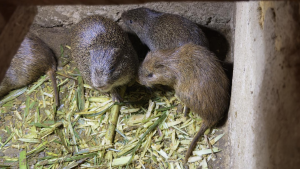 The journey isn’t always easy. Some livestock (cane rats) were lost to initial challenges, but the partnership ensures no farmer struggles alone. PADEV’s regular outreach ensures that skills are applied correctly and challenges are addressed before they escalate.
As these forest fringe communities continue to grow, they prove that the protection of Liberia’s natural heritage doesn’t have to come at the cost of human prosperity. In the heart of the forest, they are planting the seeds of a future where both the people and the trees can thrive.
-UNDP

