

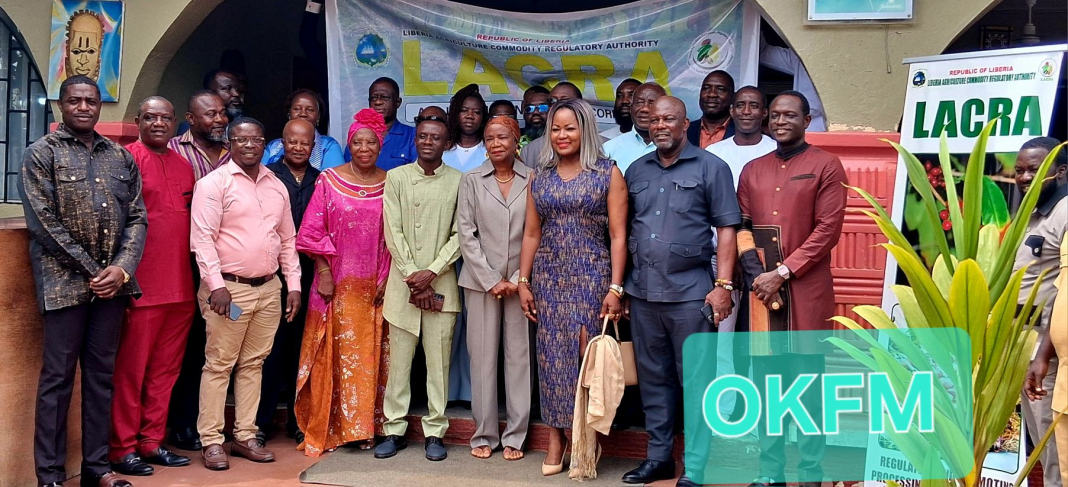
The Liberia Agriculture Commodity Regulatory Authority (LACRA) has unveiled a five-year strategic plan designed to cut rice imports by 25 percent by 2029 and reposition the country’s agriculture sector as a driver of economic growth and food security.
The 2025–2029 roadmap, launched Tuesday in Monrovia, outlines measures to decentralize operations, modernize farming systems, and strengthen value chains in key commodities including cocoa, coffee, oil palm, and rice.
Acting Director General Dan T. Saryee described the initiative as a turning point. “Our vision is to position Liberia’s commodity sectors as globally competitive, transparent, and sustainable engines of inclusive growth,” he said. “We are committed to fair pricing, quality assurance, and market systems that build resilience against climate shocks.”
A central pillar of the plan is decentralization. LACRA intends to construct a modern headquarters and establish five regional hubs to bring services closer to farmers. “LACRA cannot remain Monrovia centered,” Saryee stressed. “Regional hubs will enable communities to transition from subsistence to mechanized farming.”
The Authority also aims to recruit up to 340 Liberians across technical, commercial, and field operations, while digitizing 80 percent of its systems by 2029 to improve efficiency and transparency.
On food security, Saryee expressed confidence in the plan’s ability to reduce rice imports. “By 2029, we are prepared and confident that we can reduce rice importation by 25 percent,” he said, estimating the total cost of implementation at US$2.7 million. Achieving this, he added, will require intensive farmer training and community engagement.
Government officials welcomed the initiative. President Joseph Boakai’s Senior Political Advisor, Macdella Cooper, speaking on behalf of the Minister of State, underscored the urgency of building a self-reliant agricultural system. “No nation can truly stand while depending on others to feed its citizens,” Cooper declared. “Liberia must invest in itself and build its future with its own hands. A food secure Liberia is a strong nation.”
She reaffirmed the administration’s commitment to empowering local farmers through access to quality seeds, tools, and training, while expanding markets and promoting private sector investment. “We are focused on creating jobs, supporting rural communities, and strengthening value chains in rice, maize, coffee, cassava, and oil palm,” Cooper said.
Infrastructure development and mechanization centers, she added, will be critical to making farming more productive and profitable, particularly for rural communities. “This plan provides the structure to regulate, monitor, and support Liberia’s agriculture sector, ensuring that every farmer and entrepreneur can contribute to building a more prosperous future,” Cooper noted.
Analysts say the plan’s success will hinge on effective implementation, sustained funding, and farmer buying. Liberia has long struggled with dependence on imported rice, a staple that consumes millions in foreign exchange annually. Past efforts to boost domestic production have faltered due to weak infrastructure, limited mechanization, and inadequate support for smallholder farmers.
By committing to decentralization, digital transformation, and capacity building, LACRA’s plan signals a decisive shift in strategy. Its emphasis on inclusivity and resilience reflects broader government priorities to reduce poverty, create jobs, and stabilize the economy.
If successful, the initiative could mark a milestone in Liberia’s agricultural history, reducing reliance on imports while positioning the sector as a cornerstone of national development.

