

By George K. Werner (former education minister)
Governments are rarely tested by one crisis at a time. More often, they are tested by convergence. Liberia now faces two pressures at once: tensions along the Guinea border, and a tightening economic environment driven by global shocks. Both deserve attention. But they are not equal in reach, consequence, or staying power.
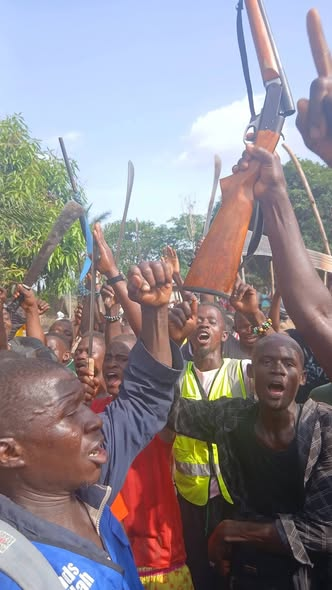
The Guinea situation is real. It requires vigilance, diplomacy, and calm. Sovereignty concerns cannot be dismissed, and citizens in border communities deserve reassurance. These are visible pressures. They must be handled with firmness—and restraint.
But even at the border, the anxiety is telling. As one listens to residents in those communities, the first concern is not abstract geopolitics. It is land. It is farming. It is trade. It is whether they can plant, harvest, cross, sell, and survive. In other words, even where the issue appears political or military, the lived reality is economic. The fear is not only about flags and territory. It is about livelihoods.
History also counsels’ perspective. Guinea has not experienced prolonged civil conflict on the scale Liberia endured between 1989 and 2003, a period in which an estimated 250,000 people were killed and the Liberian state nearly collapsed. That memory remains embedded in Liberia’s institutions and public consciousness. It shapes how this country reads risk and why it should avoid escalation.
Liberia also carries diplomatic depth that should not be underestimated. This is an old republic with a long international memory, and that matters in moments of regional tension. The answer to Guinea, if the matter persists, is not noise. It is disciplined diplomacy, strategic restraint, and credible statecraft.
In that sense, Guinea is a challenge. But it is a manageable one.
The economy is the larger test.
I listened to President Boakai’s address. It was measured, diplomatic, and appropriately calm. But as I listened, my thoughts went beyond the border. Because the more consequential pressure on Liberia today is moving through global markets, through shipping lanes, and through the price system. It is not only what may happen in Lofa. It is what is already happening across the world and quietly arriving in Liberian homes.
We have seen this pattern before.
Ebola began as a health crisis, but its deeper damage was economic. Borders closed. Trade slowed. Prices rose. Livelihoods shrank.
COVID-19 followed a similar path. Supply chains fractured. Shipping costs surged. Imports became more expensive. Inflation followed. Again, the source was external, but the pain was domestic.
Today, the trigger is different. The mechanism is the same.
The conflict centered on the Strait of Hormuz is putting pressure on one of the most critical arteries of the global economy. Reuters reports that roughly 20% of the world’s oil and gas shipments move through that corridor, and renewed disruption there has already pushed prices sharply higher. On March 24, Brent crude was reported above $103 a barrel, with analysts warning prices could rise much further if disruption persists.
That matters enormously for Liberia.
Liberia imports its fuel. So, when global oil prices rise, domestic fuel prices follow. What appears locally as a pump-price adjustment is often just the transmission of an external shock into the domestic economy.
But fuel is only the first layer.
The same Gulf disruption is now affecting agriculture. Reuters reported on March 24 that about one-third of global urea shipments pass through the Strait of Hormuz, and that urea prices have surged by nearly 50% since the conflict began. That means the crisis is not only about gas and oil. It is also about fertilizer, farming costs, and food prices.
This is how a distant conflict becomes local hardship.
Higher fuel prices increase transport fares. Electricity becomes more expensive. Businesses pass on rising costs. At the same time, higher fertilizer prices raise farming costs globally and push food prices upward. A country like Liberia, already vulnerable because of its import dependence, gets hit from both sides: energy and food.
Then comes the second wave.
As prices rise, real incomes fall. Families spend more on essentials and cut back elsewhere. Disposable income shrinks. The economy tightens from within.
Restaurants begin to lose customers. Saloons slow down. Small businesses that depend on everyday spending start to struggle. Revenues fall. Margins tighten. Jobs become uncertain. Some enterprises hold on. Others quietly disappear.
A fuel shock becomes a livelihoods crisis.
There is also a fiscal danger—less dramatic, but potentially more damaging over time.
If tensions with Guinea continue, government may be forced to spend more on defense and security. Those are often unplanned expenditures. In a country with limited fiscal space, that money must come from somewhere. And when money is shifted under pressure, it rarely comes from comfort. It comes from the core.
Payroll can come under strain. Health spending can be delayed. Education projects can slow down. Human development suffers. The implication is serious: in trying to secure the state in the short term, the government may weaken the very sectors that secure the nation in the long term.
That is why this moment must be read correctly.
Guinea is a challenge. The economy is the test.
And the economic test is not only about stability. It is also about morale, confidence, and patriotism. When citizens see that hard moments are being handled with seriousness, fairness, and competence, morale rises. Confidence deepens. National resolve strengthens. Sound economic management does not merely protect markets. It reinforces the emotional bond between citizens and the state.
The reverse is also true.
What discourages people is when serious moments are reduced to performance. Unnecessary trips to the border. Public movement without public value. Political visibility mistaken for national service. At a time when resources are tight, citizens will understandably resent the impression that some officials see crisis as opportunity—especially if such travel is viewed mainly as a route to additional daily subsistence allowances rather than meaningful engagement.
That is not a small matter. It erodes trust.
This is a moment that requires discipline, not theatre; management, not motion; seriousness, not spectacle.
Government must therefore think in layers.
At the household level, adaptation is already necessary. Less waste. Less fuel use. More pooling. Tighter budgeting.
At the workplace level, flexibility matters. Commuting is now a cost issue, not a lifestyle issue. Hybrid arrangements and fewer commuting days are practical responses to a harder economy.
At the government level, the response must be both immediate and structural. There may be a case for short-term relief, but it must be fiscally disciplined. The deeper task is resilience: more efficient transport, more reliable energy planning, and less long-term vulnerability to imported shocks.
And communication matters. Citizens must understand that some of these pressures are not homemade. They are globally transmitted. Trust depends on clarity.
I was reminded of all this recently when I ran into the Minister of Finance and Development Planning—a man I have known in and out of government. We exchanged a few words, laughed briefly, and went our separate ways. But I found myself thinking about him afterward. Because for now, he is one of the men and women carrying a heavy burden: finance and development planning together, at a moment when global uncertainty is no longer abstract.
How Liberia navigates this period will depend, in no small measure, on the quality of thinking within that team—on the advice they give the President, and on how clearly, they read what is coming. These are not easy decisions.
But history will not judge this government by the pressures it inherited or the shocks it could not control. It will judge it by whether it understood the hierarchy of threats—and responded with discipline. Because in the end, borders may command attention. But economies determine endurance.

