

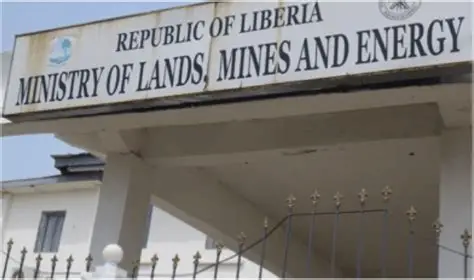
By D. Wa Hne, Jr.
The Ministry of Mines and Energy has always been a Government and Investors Thing in terms of economic benefits, and decision making. Liberians have always been below the first step of the ladder gathering falling crumbs that make them hungrier than filled with no voice to speak.
But Article 7 of the 1986 Constitution is very clear on this matter. The economy and the natural resources of Liberia are so strategic to the wellbeing of Liberians that the organic law of the state makes specific mention of them.
Article 7 reads: “The Republic shall, consistent with the principles of individual freedom and social justice enshrined in this Constitution, manage the national economy and the natural resources of Liberia in such a manner as shall ensure the maximum feasible participation of Liberian citizens under conditions of equality as to advance the general welfare of the Liberian people and the economic development of Liberia”.
Present realities show that this provision of the Constitution has been, in practice, rewritten to suit and benefit investors to the exclusion of the masses of Liberians. Not only has the economy and natural resources been dominated by foreigners, but they are also controlled, managed by them, and operate in their interest.
Liberia governments of the past have not only succeeded in given excessive powers and privileges to foreigners in economic activities, they have further succeeded in designing and operating weak laws which oppressed the rise of citizens in economic activities, and kept them below the first step of the ladder to beg for crumbs from those who do not own the land and resources.
It is grossly unfair and unconstitutional that the natural resources of the people are managed and controlled by foreigners with no attempt to mitigate. No Liberian citizen has been able to have equity share participation in concession agreements because that right seems to be only for the Government. Besides, Liberians are too poor to have equity shares, because governance methods and strategies have made them poor. Even leaders of counties in which concessionaires operate have no say and cannot protect their counties against concession oppression, exploitation, and bad labor. They are silenced by the very law and concession agreements.
UNFAIR MINING PRACTICES
There has been a massive rape of our resources by foreign investors with the nodding of political leaders, policy designers and policymakers to the extent that investors extract and export minerals not negotiated for in the concession area, nor declared to the Liberian Government because they are not part of the concession agreement. The extent of this rape is so devastating that investors become super rich and counted amongst the richest of the world, while Liberians are counted as one of the poorest people of the world.
Very strange and vexing is that we own the natural resources which calculation places Liberia as one of the richest nations of the world in terms of mineral and natural resources, yet we are listed as one of the poorest. This is indeed contradictive. How did a rich nation give its riches to foreigners and turn back to beg for loans and grants? How did we arrive to this Destination?
The mismanagement of our natural mineral resources and careless decisions are largely the reasons for intense poverty and internal crisis because social and economic justice that Article 7 is supposed to ensure has been recklessly abused, oppressed and there has been no political Will by past governments to fix it. Will this UP Government fix it?
INADEQUATE CARTOGRAPHIC SURVEYS
Concession laws on mining activities have been weak, flawed, and contained loopholes that promote unfair and exploitative mining practices, theft of resources, and gross exploitation with the face of the devil.
Cartographic surveys are meant to determine the extent of mineralization in a concession area applied for. It is meant to determine quality and types of minerals contained within an-applied-for-mining area so that minerals not applied for will be declared and their economic values determined and made a part of concession agreement. But there have been inadequate cartographical surveys.
Over Liberia’s mining years, governments concentration has always been the mineral an investor applies for, and their economic values calculated and government royalties paid, while other minerals remained undeclared, unvalued, and smuggled out of the country without a dime to Liberia This is an unfair mining practice that has to stop. It is theft. But who will fix it, and what policies will guide a new generation mining practices that will bring the unfair practices to an end?
- MATENOKAY TINGBAN APPOINTED TO LEAD REFORMS
President Joseph Nyumah Boakai, in his bid to Rescue Liberia and introduce reforms that strikes at the heart of Liberia’s mining and energy problems, has appointed former Lawmaker R. Matenokay Tingban, a mining engineer with over 20 years’ experience in mining operations, administration and natural resource governance as Minister of Mines and Energy to steer his Administration reforms in the Mining and Energy Sectors of Liberia.
Minister Tingban is currently running with reforms plans – though they might take time to become visible and might require political Will. If successful, he might stand out as generation emancipator from bad and exploitative mining practices in Liberia. He might change the direction of mining and energy to deliver back to the citizens what have been discretionally taken from them over the years of mining operations in Liberia. But will he pay attention to the importance of detailed cartographic surveys?
The Minister has promised Equity Participation which might give Government 10%-15% stakes in mining projects with long-term ambition of hitting the 25% mark. He seeks a new mining code that will address licensing, state participation, and revenues management also.
For the first time, Liberians might have their own mining company run by the state like public corporations and ensure fair representation in concession deals if his reform becomes a reality.. He wishes, according to sources, to introduce online mining application and licensing system to eliminate corruption and discretion.
Within in the Energy Sector, he promises renewable energy through investment in solar power to produce 100% megawatts for Bong County and will prioritize reliable and affordable energy for industrial growth and national competition and plans to strengthen regulations that will enhance the Liberia Electricity Regulatory Authority and Rural Renewable Energy.
Minister Tingban intends to strengthen enforcement of anti-illicit mining laws and address the smuggling of gold out of the country. To make his reforms possible, he would place emphasis on capacity building by training geologists, engineers and other professionals. He further seeks to build partnerships with Saudi Arabia and Isreal to implement value additions such as mineral processing and renewable energy investments.
The key reform policy which has generated my interest is what he refers to as modernizaton. This speaks of updating mining laws to boost government equity participation in mining and energy projects to benefit local communities.
Unfortunately, there is no mention of citizens equity share participation and laws to ensure fair mining practices. I think the Minister needs to add to his modernization plan a cartographic law that will determine the extent of mineralization within a proposed concession application area.
To help achieve a comprehensive and result oriented policies, I suggest that a detailed cartographic report accompany the Mineral Development Agreement to give the Legislature a fair understanding of the different minerals also discovered within the proposed concession area so that they are declared by the investor. We need to stop this industrial rape of our country by taking our destiny into our hands through intentional and wise decisions. We must change the rules.
One big question: Will Minister Tingban succeed? Would political and industrial establishments endorse his reforms? Will the powerful men behind the curtain crush his resolve? We are on the watch.

