

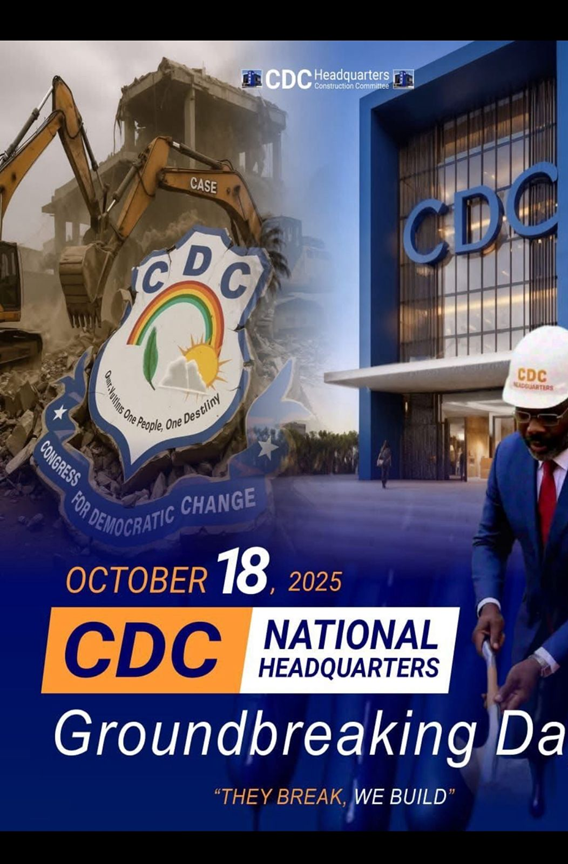
The Coalition for Democratic Change (CDC) is pressing ahead with construction of its long anticipated national headquarters, describing the initiative as a “legacy investment” intended to reshape Liberia’s political infrastructure. Party leaders say the project, once slowed by administrative hurdles, has regained momentum and is now visibly advancing.
Fonati Koffa, Chairman of the CDC Headquarters Project, acknowledged that early challenges—particularly permit related delays—temporarily stalled progress. Those issues, he said, have now been resolved, allowing construction to move forward at pace.
“Within less than six months, the structure has moved from the basement level to the first floor and is now reaching the second floor,” Koffa noted, presenting the rapid build as evidence of renewed coordination and support.
Koffa emphasized that the headquarters is more than a physical structure, calling it a defining legacy project for the CDC and its supporters. Designed to meet modern architectural standards, the facility is expected to integrate advanced technological systems unprecedented for a political party headquarters in Liberia.
Although details remain limited, insiders suggest the complex could feature digital coordination centers, modern conference halls, and enhanced communication infrastructure. Analysts say such innovations reflect a broader continental trend toward digitized political operations, positioning Liberia’s parties to adapt to new organizational demands.
The project has been closely tied to former President George Weah, who remains the CDC’s political leader. Koffa credited Weah for initiating and sustaining momentum, noting that his involvement has been instrumental in mobilizing resources and maintaining confidence among party loyalists.
Party officials argue that Weah’s continued support underscores his commitment to strengthening the CDC’s institutional foundation, even after leaving office. His role, they say, has ensured the headquarters remains a priority despite shifting political dynamics.
Beyond leadership, grassroots supporters—commonly referred to as “CDCians”—have played a critical role in sustaining the project. Their financial contributions and mobilization efforts have provided the backbone of the initiative.
Mr. Sofia, another party figure, commended supporters for their unwavering commitment and urged continued participation until completion. He described the headquarters as a collective achievement, reflecting the determination of ordinary members to secure the party’s future.
With construction back on track, the CDC has set an ambitious target to dedicate the headquarters in April 2027. Party leaders remain optimistic that the building will be completed within the projected timeframe, presenting it as a milestone in Liberia’s evolving political landscape.
Observers caution that meeting the deadline will require sustained financial and organizational discipline, but the CDC leadership insists the project is firmly on course.
Political analysts view the headquarters project as a calculated move to consolidate the CDC’s institutional presence following its tenure in government. In a competitive political environment, such infrastructure investments are seen as essential to strengthening party organization, outreach, and long term relevance.
If completed as envisioned, the CDC headquarters could set a new benchmark for political party facilities in Liberia. Analysts suggest it may signal a shift toward more structured and technologically equipped political institutions, potentially influencing how parties engage with supporters and manage campaigns.
For the CDC, the headquarters represents both a physical anchor and a symbolic statement of resilience. Party leaders argue that the facility will embody the organization’s identity, serving as a hub for strategy, coordination, and political education.
As Liberia’s democracy matures, the project highlights the growing importance of institutional infrastructure in shaping political competition. Whether the CDC’s headquarters becomes a model for other parties remains to be seen, but its ambition reflects a broader aspiration: to leave a lasting legacy on the nation’s political landscape.

