

By Emmanuel Koffa/Grand Kru
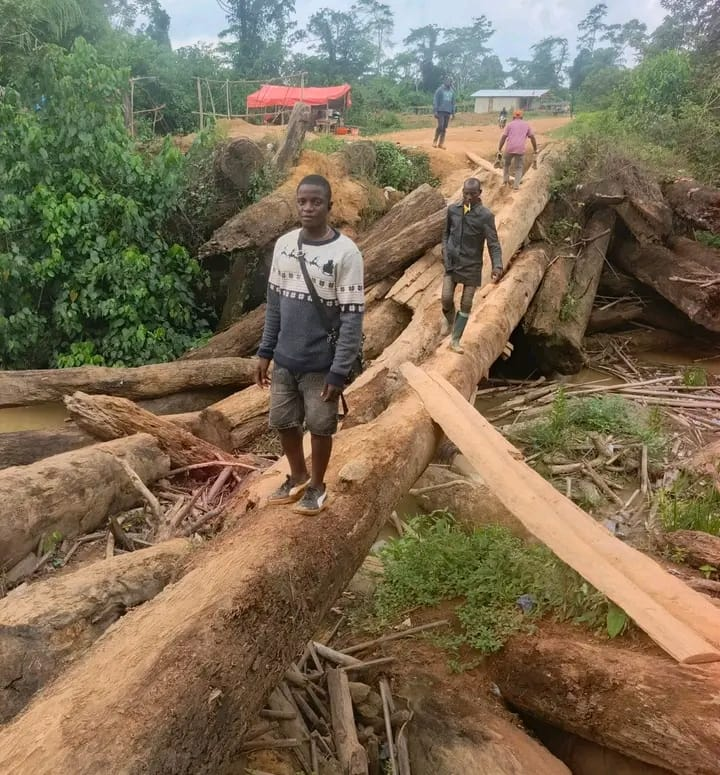
The collapse of the Chengbetee Bridge, a key transport link between Grand Kru County and Sinoe County, is disrupting trade, mobility, and access to essential services, leaving thousands of residents increasingly isolated.
Once a vital corridor for vehicles and commerce, the bridge is now impassable to cars, motorcycles, and trucks. In its absence, residents have resorted to makeshift floaters to move people and goods across the waterway—an improvised solution that poses significant safety risks, particularly for vulnerable groups.
Local accounts describe growing concerns over accidents and delays, as well as the broader implications for daily life. Access to markets, schools, and healthcare facilities has become more difficult, with travel times extended and costs rising.
“The bridge is not just a route; it is a lifeline connecting communities,” said Nelson S. Swen, a native of Gblebo City and student leader at William V.S. Tubman University. “Without it, people struggle to reach markets, schools, and health facilities. Lives are at risk every day.”
The disruption has also dealt a blow to local economic activity. Farmers and traders who rely on cross-county movement are facing delays that reduce the quality and marketability of their goods. Increased transport costs—driven by the need for alternative routes or manual crossings—are further squeezing already limited incomes.
Business owners warn that if the situation persists, the region could experience longer-term economic setbacks, including reduced market supply and declining commercial exchange between the two counties.
Despite the severity of the situation, residents say there has been limited visible intervention to address the damaged infrastructure. Community leaders are calling on the Government of Liberia and county authorities to prioritize the repair or reconstruction of the bridge, describing it as critical to restoring normalcy.
Beyond immediate economic concerns, the bridge’s collapse underscores broader infrastructure challenges facing rural Liberia, where single access points often serve entire regions. The lack of redundancy in transport networks leaves communities highly vulnerable when key structures fail.
Residents argue that restoring the Chengbetee Bridge would not only improve safety but also reestablish a critical economic lifeline. Improved connectivity, they say, would facilitate trade, enhance access to education and healthcare, and strengthen social ties across county lines.
For now, communities on both sides of the river remain dependent on unsafe alternatives, as uncertainty grows over how quickly authorities will respond.
The situation highlights the urgent need for durable infrastructure investment in underserved regions—where the failure of a single bridge can halt movement, disrupt livelihoods, and isolate entire populations.

