


By Sidiki Fofana/ Truth In Ink
Power is not lost in a day. It is eroded by perception, quietly at first, then decisively.
When news broke that former President George Weah had constructed a modern condominium complex, allegedly up to 48 apartments, and rebuilt his long-neglected 9th Street residence during his presidency, the reaction across Liberia was immediate and unforgiving. It was not simply about wealth. Liberia has never condemned personal success. It was about timing, judgment, and sensitivity.
A nation struggling. A leader building. That contrast became the story.
The opposition seized it as evidence of corruption and misuse of power. But what made the moment even more telling was what happened within Weah’s own ranks. While many CDC supporters defended him publicly, projecting loyalty and political discipline, in private there was disappointment, there was even shame. It was a quiet but powerful indication that, beyond party lines, many Liberians place country above individual loyalty. Public defense did not erase private truth and hurt.
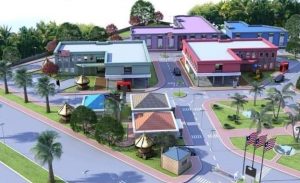
The question that echoed across the nation was simple but piercing: why now? If President Weah had the resources long before becoming President, why were these developments not undertaken long before the presidency? Why did personal transformation align so precisely with political power?
And so, perception overtook every attempt to defend this act of distraction and outrightly poor political calculation.
This is not to ignore what Weah’s administration accomplished. Roads were constructed in long-neglected communities like Clara Town. Tuition was eased at public institutions. WAEC fees for thousands of students were covered. Nearly 3,000 health workers were absorbed onto government payroll at a critical moment. The RIA Road expansion began. Housing initiatives and public recreational spaces emerged across Monrovia.
Yet none of it could silence the symbolism of those private developments.
They became the center of national conversation. So much so that even elements within his own party felt compelled to distance themselves publicly, cautioning that the pursuit of personal wealth, real or perceived, was overshadowing the purpose for which the Liberian people had entrusted Weah with power.
If the internal voices were loud, the opposition was louder. And no voice cut through more sharply than that of Joseph Boakai.
Boakai did not merely criticize, he moralized. He labeled those developments as “fruits of corruption,” drawing a moral boundary between leadership and indulgence. He presented himself as the alternative, humble, restrained, a man who would choose sacrifice over excess.
Liberians believed him. And at the ballot box, they acted on that belief.
But power has a way of testing conviction.
Today, President Boakai stands in a moment that feels uncomfortably familiar. Reports of expanding personal properties, the normalization of costly private travel once condemned, and a growing perception of disconnect from the daily struggles of ordinary Liberians are beginning to shape a narrative he once weaponized against another.
This is no longer about Weah. It is about consistency.
If the cost of losing the presidency included, among other things, the insensitivity of acquiring personal wealth, whose appearance alone invites questions of dubious origin, while the nation is struggling, then the president must share the fate of his predecessor.
The lesson is larger than any one man. It speaks to all who will hold this office, and to the nation itself: that the presidency is not a platform for personal elevation, but a responsibility to place the country first, especially when it has entrusted you with everything.
The same moral standard that was used to judge one leader cannot be abandoned when applied to another. If building personal wealth in the face of national hardship was once considered a “forbidden fruit,” then its definition cannot change simply because the hands have changed.
Liberia today faces real strain -rising commodity prices, land disputes, national security concerns, and economic pressure felt in every household. In such times, leadership is not only judged by policy, but by posture. By restraint. By awareness.
And increasingly, that awareness appears absent.
There is a dangerous symmetry forming. Weah was judged not only on governance, but on the belief that leadership had drifted from the people. That belief hardened into rejection. Boakai risks repeating that trajectory.
Liberians did not remove Weah simply to replace him with a reflection of the same contradictions. They voted for a correction. And if that correction begins to resemble what it replaced, then the outcome is no longer uncertain, it is inevitable.
Because in a democracy, the rules do not bend for individuals. If the “forbidden fruit” was reason enough to reject one leader, it remains reason enough to judge another.
And if President Boakai continues down this path, then like his predecessor, his fate will not be decided by noise or rhetoric, but by something far more powerful: The quiet, disciplined judgment of the Liberian people at the ballot box.

