

By: Alhaji Kromah and Austin S Fallah
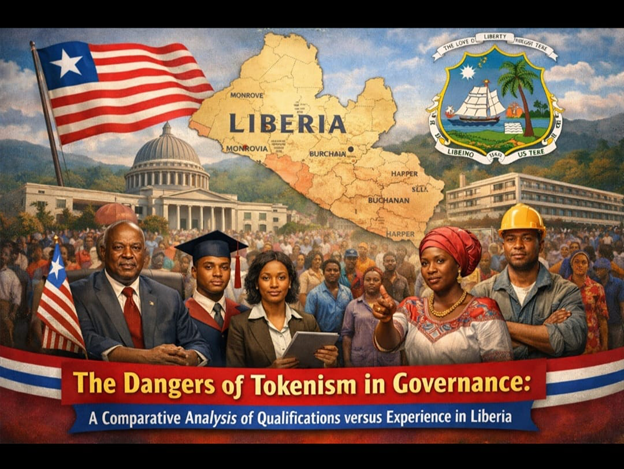
Tokenism in governance, particularly in a post-conflict context like Liberia, substitutes genuine empowerment with superficial representation, often prioritizing unqualified political appointees over experienced professionals.
This practice risks undermining institutional credibility, maintaining systemic inequality, and stalling development by replacing merit with performative inclusion.
The Dangers of Tokenism
On Superficiality and Stalled Development: “Just as the criminals like money-eating hyenas have no real feelings for the health, education, nutrition, and economic development of the downtrodden, so also have the so-called self-serving, self-styled, self-calling political elites of Liberia continue to render tokenism as their effort and mediocre outcomes to the development.”
On Perpetuating Inequality: “Tokenism is, therefore, a superficial solution that fails to address the systemic issues of inequality and discrimination that prevent… women from reaching leadership positions. “
On Performance Over Substance: “Tokenism is one significant danger of this complex renegotiation of diversity and inclusion, it’s the mismatch between an organization’s performative effort and its actual record on inclusive behavior”.
On Preserving Stereotypes: “Tokenism does not change stereotypes of social systems but works to preserve them, since it dulls the revolutionary impulse” — Mary Daly.
On Loss of Legitimacy: “Representation without inclusion is tokenism. With systemic exclusion, it perpetuates structural violence. ” Unknown
Qualifications vs. Experience in Liberian Governance
The tension between formal education (qualifications) and practical capability (experience) is central to ensuring effective governance in Liberia.- Lund University Publications.
The Danger of Superficial Inclusion: In Liberia, strategies to enhance women’s representation must go beyond simply placing women in positions (tokenism) and focus on granting real authority to dismantle male-dominated structures.
The “Wasted Education” Risk: As noted in Liberia, “Education without wisdom is a wasted education,” emphasizing that academic qualifications without practical application or moral integrity do not guarantee good governance.
Institutional Failure: Relying on token appointments rather than merit-based experience creates a “weak ruling system” that fails to harness the full potential of citizens, resulting in poor decision-making and stalled progress. creates – Lund University Publications.
Consequences for Liberia
Increased Political Instability: Excluding truly qualified individuals, sorting through using the lead leads to “conflicts within communities and political groups, weakening the state.
Missed Development Opportunities: When positions are filled by token representatives rather than those with substantive experience, it leads to a “weak ruling system” and missed opportunities. Unknown.
In the modern world, navigating complex governance challenges requires more than academic qualifications alone.
It demands critical thinkers, innovators, and individuals with practical experience who can translate their knowledge into effective solutions.
The situation in Liberia highlights the deleterious effects of nepotism and the prevalence of empty credentials in governance.
Despite possessing the theoretical knowledge signified by degrees, many Liberian politicians lack the hands-on experience needed to drive the nation’s progress.
This disconnection between paper qualifications and real-world capabilities can hinder productivity, economic growth, and the overall quality of governance.
As Liberia aspires to participate competitively on the international stage, a paradigm shift is essential.
By examining successful nations that prioritize expertise and innovation, Liberians can glean valuable lessons for Liberia’s political landscape.
The Dilemma of Credentialism in Liberia:
Credentialism, or the reliance on degrees as benchmarks of competency, can often mislead government hiring practices, particularly when hiring a person through the ballot box to represent the people in the national legislature and in organizations.
In Liberia, political appointments frequently reflect social and political connections rather than expertise or innovation.
This practice results in a governance system daunted by inefficiencies and a lack of forward-thinking strategies.
Most glaringly, it neglects the urgent need for individuals with critical thinking skills and innovative ideas, instead opting for those who fit a predetermined mold based on social standing or educational pedigree.
Consider the analogy of hiring a carpenter for surgery. While a carpenter may possess considerable woodworking skills, they lack the extensive training and technical knowledge required to perform a life-saving operation.
Similarly, electing or appointing political leaders with degrees but little relevant experience is a recipe for failure.
These appointed(elected) leaders may make uninformed, detrimental decisions due to their lack of practical insight into the mechanisms of governance and policy-making.
For example, many Liberian politicians are unable to understand the implications of their political decisions because they lack adequate preparation for the responsibilities they assume.
Their focus may lie in preserving political alliances and personal interests rather than developing sound policies to move the country forward.
As a result, Liberia’s challenges, economic stagnation, healthcare issues, educational deficits, and infrastructure decay persist unabated.
The Impact of Effective Governance in Other Countries:
Countries such as Singapore and Estonia serve as prime examples of how critical thinkers and innovators can transform governance.
In Singapore, visionary leadership, particularly under Prime Minister Lee Kuan Yew, focused on bringing in skilled individuals into government roles, regardless of their academic backgrounds.
The government actively sought professionals in various fields to contribute to national development.
This approach not only diversified leadership expertise but also injected fresh ideas into the country’s governance.
Consequently, Singapore transitioned from a struggling port city to a thriving global financial hub within a few decades.
Similarly, Estonia redefined its governance through digital innovation.
A small nation in the Baltic region, Estonia, leveraged technology to enhance its efficiency and citizen engagement.
Post-Soviet economic challenges prompted the government to recruit tech-savvy individuals to devise creative solutions.
Today, Estonia is a model of e-governance, where citizens can vote online, access government services digitally, and enjoy efficient public offerings.
Their transition from a controlled economy to a vibrant democracy underscores the importance of appointing individuals who are equipped not only with formal education but also with innovative thinking and practical skills.
Both cases illustrate how a governance system grounded in critical thinking and innovation can yield remarkable results, but not by seating warmers with no policy-making or leadership backgrounds or experience.
When governments prioritize meritocracy and practical knowledge, they develop policies that resonate with their citizens’ needs, fostering an environment conducive to sustainable development.
The Call to Action for Liberia:
Liberia stands at a crossroads. The nation has the potential to harness its youthful/young population, abundant resources, and strategic geographical position.
However, to capitalize on these advantages, it must overhaul its current governance system.
Political leaders must seek out advisors and team members with real-world experience who can contribute innovative ideas and practical solutions, rather than those with impressive degrees or connections alone.
A significant wave of reforms is essential to dismantle the harmful effects of nepotism and credentialism. These reforms must include:
- Transparent Hiring Practices: Implementing rigorous and transparent hiring practices that prioritize skills, experience, and track records over social connections will ensure that capable individuals fill positions. This could involve establishing meritocratic systems in which potential candidates are evaluated through performance-based assessments.
- Capacity Building: Investing in capacity building and continuous education programs for current leaders can instill much-needed critical thinking and innovative capabilities. Government workshops, mentorship programs, and partnerships with educational institutions can equip politicians with the skills they need to govern effectively.
- Embracing Technology: With the world becoming increasingly digital, Liberia must also invest in technology as a tool for governance. Utilizing digital platforms can enhance communication and service delivery while attracting tech-savvy personnel who can drive innovation.
- Engaging the Diaspora: The Liberian diaspora consists of individuals with considerable expertise and innovation. Engaging this group can provide mentorship, investments, and leadership that would enhance Liberia’s governance framework. Programs that encourage their return or collaboration can reignite progress.
- Creating an Innovation Ecosystem: Supporting local entrepreneurs and innovators by providing access to funding, resources, and mentorship can stimulate economic growth. By nurturing homegrown talent, Liberia can establish a foundation that thrives on innovation and critical thought.
The urgent need for critical thinkers, innovators, and experienced leaders in Liberian governance cannot be overstated.
The nation has witnessed the consequences of political decisions driven by connections rather than competence, leading to stagnation and inefficiency.
By learning from the experiences of other nations that have prioritized expertise over mere credentials, Liberia can set a trajectory towards effective governance and national development.
In positioning itself on the international stage, Liberia must embrace a governance model that values critical thinking and innovation, thereby departing from the outdated practice of hiring solely on academic achievements.
The transformation of Liberia’s governance system is not just a dream; it is an imperative for the country’s future.
Encouragingly, if the right steps are taken, Liberia can become a beacon of hope and progress, drawing upon its own strengths to build a better tomorrow.

