

By Festus Poquie
Liberia’s headline consumer inflation accelerated to 4.5% year-on-year in March from 3.1% in February, driven by renewed food-price gains and a sharp rise in transport costs, the Liberia Institute of Statistics and Geo-Information Services (LISGIS) said in a report posted on its website.
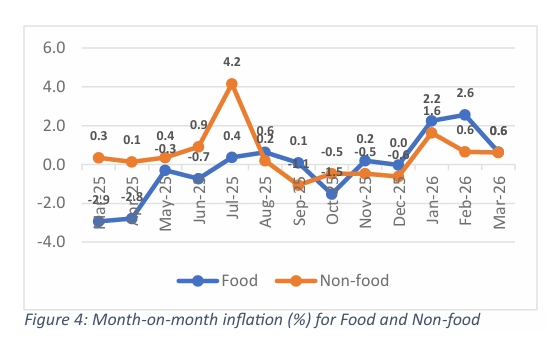
Month-on-month inflation slowed to 0.6% in March from 1.2% in February, but key cost pressures emerged within the basket.
Food and non-alcoholic beverages recorded a year-on-year rise of 1.3% — the first positive food inflation reading since November 2025 — and a 0.6% monthly increase, according to LISGIS.
Transport was the standout non-food mover, with year-on-year inflation of 7.4%, the highest since May 2023. LISGIS said the transport division accounted for roughly 14% of the March headline increase, with petroleum products and public transport the main drivers.
Petroleum prices rose 5.7% year-on-year and surged 12.4% month-on-month, while public-transport costs were up 13.2% year-on-year and 9.1% month-on-month.
Other non-food categories showed uneven trends: Restaurants and hotels posted a 14.8% year-on-year increase — led by food-away-from-home — while clothing and footwear remained deflationary for a third straight month at -7.5%.
Breakdowns for domestic versus imported goods highlight divergent dynamics. Imported items showed near-zero year-on-year inflation (0.1%) in March, with imported food up 3.3% year-on-year.
Domestically produced items recorded a 5.8% year-on-year rise, although domestically produced food was down 1.2% year-on-year.
LISGIS noted some volatility within food classes: meat posted the largest food-class increase at 12.3% year-on-year, while broader food products showed deeper declines in annual terms. On a monthly basis, vegetables were the fastest rising food item (+3.9%) while oils and fats fell (-6.2%), partly due to a steep drop in palm-oil prices.
The data underline renewed cost pressures for households and businesses as transport and food-away-from-home costs climb.

