

Abstract
Recruitment into the armed forces is a foundational process that shapes the operational effectiveness, ethical orientation, and public legitimacy of military institutions. In post-conflict societies such as Liberia, recruitment processes assume even greater importance, serving as instruments of state rebuilding and trust restoration.
This article critically examines the recruitment practices of the Armed Forces of Liberia (AFL) in the post-Security Sector Reform (SSR) era, with particular focus on emerging concerns regarding public exposure, professionalism, and candidate dignity. Anchored in the historical framework established following the Accra Comprehensive Peace Agreement, the study evaluates deviations from SSR principles and their implications for institutional integrity.
Through comparative analysis with international military standards and grounded in legal and human rights frameworks, the article argues that recruitment practices that expose candidates to public scrutiny—especially via social media—undermine both individual dignity and institutional credibility. The article concludes with policy recommendations aimed at restoring professionalism and safeguarding the integrity of the AFL.
Introduction
Military institutions are critical pillars of state sovereignty, entrusted with the defense of territorial integrity and the maintenance of national security. Beyond their operational mandate, they symbolize discipline, order, and national pride. Recruitment into such institutions is therefore not merely procedural but deeply symbolic, representing the state’s commitment to meritocracy, fairness, and professionalism.
In Liberia, the restructuring of the AFL following fourteen years of civil conflict marked a turning point in national recovery. The role of the United Nations Mission in Liberia and the United States Government in rebuilding the military through SSR established a globally recognized model of post-conflict security reform.
However, recent developments in recruitment practices—particularly the public display of candidate assessments—raise critical concerns. These practices, often amplified through social media, appear inconsistent with the principles of dignity, confidentiality, and professionalism that guided the original SSR process.
This article seeks to:
Examine the historical foundations of AFL recruitment under SSR
Analyze current recruitment practices and their implications
Evaluate these practices against international standards
Propose reforms to enhance professionalism and institutional credibility
Historical Foundations: SSR and the Reconstitution of the AFL
The End of Conflict and the Need for Reform
Liberia’s civil war, culminating in the Second Liberian Civil War, left state institutions weakened and public trust eroded. The Accra Peace Agreement mandated comprehensive reforms, including the complete restructuring of the military.
Disbandment and Vetting
The pre-war AFL was disbanded between 2004 and 2005. A new force was to be built from the ground up, guided by principles of:
Political neutrality, Professional competence, and Respect for human rights.
Candidates underwent rigorous vetting processes, including:
Background investigations, Medical examinations, and Literacy assessments
Training and Institutional Development
Formal training began in 2006 under the leadership of DynCorp International, with oversight from international partners. Training emphasized:
Discipline and command structure, Civil-military relations, Ethical conduct and human rights, and Functional literacy.
Notably, recruitment and training processes were conducted in controlled environments, shielded from public exposure. This ensured:
Candidate confidence, Objective assessment and Institutional credibility
Conceptual and Legal Framework
Military Professionalism
The concept of military professionalism is extensively articulated by Samuel P. Huntington, who identifies expertise, responsibility, and corporateness as its defining characteristics. Recruitment processes must therefore reflect:
Objective standards, Merit-based selection and Institutional discipline
Human Dignity and Rights
The principle of human dignity is enshrined in the Universal Declaration of Human Rights, which guarantees respect for the inherent worth of every individual. Recruitment practices must avoid:
Public humiliation, Psychological harm and Discriminatory exposure
Liberian Legal Context
Liberia’s constitutional framework emphasizes:
Equality before the law, Protection of individual rights, and Due process
Although not explicitly addressing military recruitment publicity, these principles imply that state institutions must conduct processes in ways that respect individual dignity and fairness.
Contemporary Recruitment Practices: Emerging Concerns
Public Display of Recruitment Activities
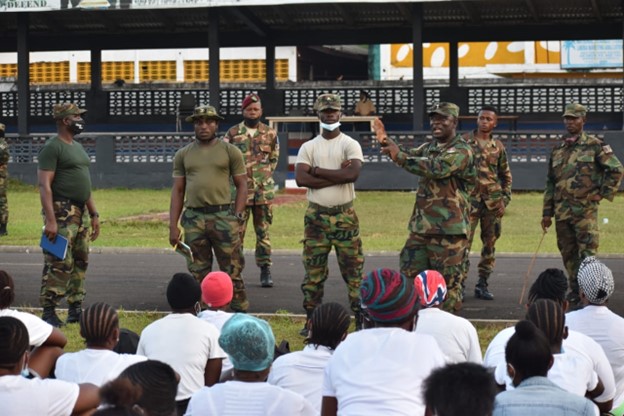
Recent recruitment exercises have increasingly incorporated public demonstrations, including:
Reading exercises conducted before large audiences
Physical assessments recorded and shared publicly
Social media broadcasting of candidate performance
While intended to enhance transparency, these practices introduce significant risks.
Psychological and Performance Implications
Public performance environments can negatively affect candidates through:
Anxiety and stress, Reduced cognitive performance, and Fear of embarrassment
Research in criminology and behavioral psychology suggests that individuals under public scrutiny may not accurately demonstrate their true capabilities.
Social Media and Institutional Risk
The use of social media amplifies these concerns by:
Permanently recording candidate performance
Exposing individuals to ridicule beyond the recruitment setting
Undermining institutional seriousness
Rather than promoting transparency, such exposure may create perceptions of sensationalism.
Comparative Analysis: International Best Practices
United States
The United States Army employs structured recruitment processes characterized by:
Confidential assessments, Standardized testing and Controlled evaluation environments.
Public engagement is limited to recruitment campaigns rather than individual assessments.
United Kingdom
The British Army utilizes assessment centers where candidates are evaluated privately by trained professionals. Public exposure is avoided to maintain dignity and objectivity.
ECOWAS Context
Within the Economic Community of West African States, post-conflict states such as Sierra Leone have adopted similar approaches, emphasizing:
Confidential recruitment processes, and Professional evaluation standards
Key Lessons
Across these jurisdictions:
Transparency is institutional, not individual
Professionalism requires controlled environments
Candidate dignity is non-negotiable
Implications for Institutional Integrity
Erosion of Public Trust
Recruitment practices that appear unprofessional can:
Reduce confidence in the military
Raise questions about selection standards
Discouragement of Qualified Candidates
Potential recruits may avoid applying due to fear of:
Public embarrassment, and Social stigma
Long-Term Institutional Consequences
Over time, such practices may:
Lower the quality of recruits, Undermine discipline, and Affect operational effectiveness
Reaffirming SSR Principles
The SSR process in Liberia was guided by:
Professionalism, Accountability, and Respect for human dignity.
These principles remain relevant and should guide current practices. The structured and discreet approach of SSR recruitment contributed significantly to the AFL’s initial success.
Policy Recommendations
Institutionalize Confidential Recruitment
All assessment stages should be conducted in controlled, private environments.
Regulate Social Media Use
Develop clear policies limiting the exposure of recruitment activities.
Strengthen Assessment Frameworks
Adopt evidence-based evaluation methods, including:
Written examinations, Structured interviews, and Practical assessments
Capacity Building
Train recruitment officers in:
Ethical standards, Candidate management, and Psychological sensitivity.
Oversight and Accountability
Establish independent oversight mechanisms to ensure compliance with professional standards.
Conclusion
The recruitment of the Armed Forces of Liberia is a critical process that must reflect the highest standards of professionalism, dignity, and institutional integrity. While transparency is essential, it must not be pursued at the expense of candidate dignity or institutional credibility.
Liberia’s SSR experience provides a strong foundation upon which to build. By reaffirming these principles and adapting them to contemporary challenges, the AFL can strengthen its reputation and ensure the continued trust of the Liberian people.
About the Author
Apostle Dr. Tarpeh L. U-sayee, Jr. is a highly accomplished Liberian law enforcement professional, criminal justice scholar, police training expert, and ordained Apostolic minister with over two decades of combined experience in security services, higher education, leadership training, and ministry.
He currently serves as an Instructor with the Executive Protection Service (EPS) and the Liberia National Police Training Academy, while lecturing in Criminal Justice, Forensic Science, and Physical Education at several private universities in Liberia.
His professional career is distinguished by extensive international exposure, including advanced police and counter-terrorism training in the United States and Nigeria.
Dr. U-sayee holds a Doctor of Ministry (DMin) in Church Growth, a Master’s Degree in Foreign Service Leadership (International Relations), a Master of Divinity, dual Bachelor’s Degrees in Sociology and Criminal Justice, and an Associate Degree in Management.
As an Apostle, academic, and security practitioner, he integrates ethical leadership, faith-based values, and practical expertise to advance peacebuilding, institutional development, and the rule of law in Liberia.
References
Accra Comprehensive Peace Agreement
United Nations Mission in Liberia Reports (2003–2018)
United States Department of State (2009). Security Sector Reform in Liberia
DynCorp International Training Reports
Samuel P. Huntington (1957). The Soldier and the State
United Nations (1948). Universal Declaration of Human Rights
International Crisis Group (2009). Liberia: Uneven Progress in SSR
Economic Community of West African States SSR Framework Documents.

