

By George K. Werner (former education minister)
This morning, driving along UN Drive past Antoinette Tubman Stadium and just beside the Barclay Training Center, I slowed down.
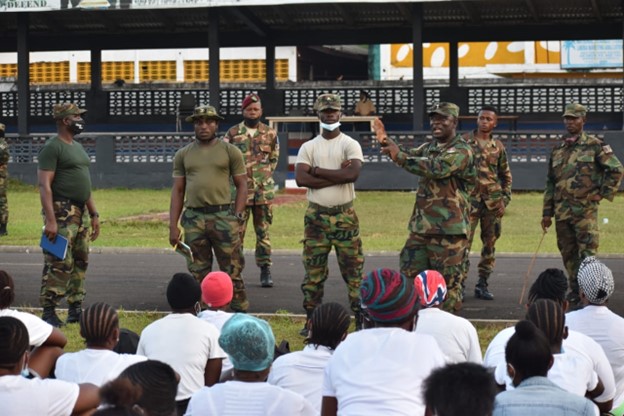
Along the walls of the barracks, under the punishing Monrovia sun, stood scores of young Liberians—young men and women, mostly between 18 and 35—lined up for the Armed Forces of Liberia recruitment drive.
They stood with folders and plastic files in their hands. Some had clearly spent the night there. Their clothes were not polished interview suits. Many looked rugged, tired, dusty, and unkempt. Around them, plastic bottles and paper littered the roadside, the physical evidence of long waiting, hunger, and hope.
But what struck me most was not the disorder.
It was the dignity.
There they were, standing in the scorching heat, not begging, not protesting, not rioting—simply waiting for a chance. Waiting for work. Waiting for purpose. Waiting for a uniform that might give them not just a salary, but identity. Not just employment, but belonging.
It brought tears to my eyes.
Because in that line was the real story of Liberia’s youth.
Liberia is one of the youngest countries in the world. More than 60 percent of the population is under the age of 25, and nearly 70 percent is under 35. Every year, thousands of young people leave schools, universities, garages, farms, fishing communities, and street corners looking for one thing: a dignified livelihood.
Too often, we describe them with lazy language: “idle youth,” “at-risk youth,” “unemployed youth,” as though they are a social problem to be managed rather than human potential waiting to be unlocked. We speak of them like statistics instead of citizens.
Yet there, outside Barclay, was the truth.
These are not young people unwilling to work. They are young people desperate to contribute.
The Liberia Institute of Statistics and Geo-Information Services (LISGIS) and World Bank data have repeatedly shown the strain: youth unemployment and underemployment remain among the country’s deepest structural challenges, while most young Liberians survive in the informal economy—selling in markets, riding motorbikes, fishing, building houses, fixing generators, braiding hair, cooking food, or pushing wheelbarrows. Formal wage employment remains the exception, not the rule.
Coming in the wake of heightened border tensions with Guinea, the recruitment drive inevitably carries deeper national meaning. Communities along the border—especially young people—have been at the center of national conversations about sovereignty, vigilance, and the defense of Liberian territory. In those tense moments, patriotism was not an abstract word spoken in conference halls. It was lived by ordinary villagers who understood that borders matter because nations matter.
Now, many young people across the country are lining up to formally serve.
They know the Liberian army. They know its strengths and its weaknesses. The soldiers are their brothers, sisters, cousins, neighbors. They know the salaries are not glamorous. They know the barracks are not luxurious. They know service is hard.
And still—they came.
That matters.
Many of these applicants were children during Liberia’s civil wars, and the youngest were born just after. Liberia’s second civil war ended in 2003. A 22-year-old applicant today was born after the guns fell silent; a 30-year-old was a child when the country was still bleeding. They did not fully live the madness, but they inherited its memory.
They know the war through family stories whispered at night. Through mothers who still fear loud sounds. Through fathers who still refuse to discuss certain years. Through bullet holes in walls that remain unrepaired. Through broken institutions and broken trust.
Through their peers, they search for their parents; through old stories, they search for memory; through the broken walls of this city, they search for meaning. As Mon Rovia sings in the haunting refrain, “Whose Face Am I?”—a question that echoes far beyond music. It is the question of a post-war generation born into inheritance without instruction, carrying surnames heavy with silence, trying to understand who they are in a country still recovering from who it was.
Many of these young people standing outside Barclay are asking the same question—not only of family, but of nation:
Who are we, and where do we belong?
They see the evidence of what violence did to this country.
And yet, instead of running from the idea of national service, they are stepping toward it.
That is patriotism.
That is maturity.
That is hope.
We should pay attention.
Because this line outside Barclay is not only about military recruitment. It is a national referendum on youth unemployment.
It is a reminder that beneath every policy paper, every donor conference, every government speech about “empowerment,” there are real young people standing in real heat asking one simple question:
Is there a place for me in this country?
They know, too, that some of their fellow countrymen and women are mocking them on social media—laughing at their reading skills, circulating videos of applicants struggling through simple words, turning a national failure into public entertainment. They know the cameras are watching. They know some people see them not as patriots, but as punchlines.
They know they may never make it to the end of the recruitment process. Many will be turned away. Some will fail the literacy screening, others the physical tests, and others the final selection. They understand the odds are not in their favor.
And still—they came.
They came with everything they had: a plastic folder, a borrowed pen, worn shoes, and hope stitched together by family prayers and personal determination. They came because trying matters. Because dignity sometimes begins with simply showing up. Because even rejection can be better than surrender.
In a country where too many doors remain closed, standing in that line is itself an act of faith.
That courage deserves more than mockery.
It deserves respect.
But the answer cannot only be the army.
A nation cannot recruit its way out of unemployment.
The same young person who can stand in line for the military can become a teacher, a plumber, a carpenter, a welder, a chef, a mason, a nurse, a farmer, a technician, an entrepreneur. Many already are.
Across Liberia, I know young plumbers whose literacy is weak but whose hands can solve problems faster than university graduates. I know carpenters building futures with tape measures and instinct. I know women managing fishing canoes and construction sites. I know barbers feeding families, chefs employing assistants, and young men in canoes financing entire households.
They are employable.
They are productive.
They are already carrying the country.
But when asked to write a formal invoice, prepare a bill of quantities, or complete basic documentation, many panic. Not because they lack intelligence, but because literacy and numeracy failed them.
That failure is ours.
According to national learning assessments and regional education indicators, far too many Liberian children leave primary school without foundational literacy and numeracy. Some can work brilliantly with their hands but struggle to read instructions, calculate profit margins, or prepare simple documentation for contracts and business growth.
It is the failure of schools, systems, and policy choices.
And it is fixable.
Programs like the Luminos Fund and similar foundational learning interventions remind us that literacy and numeracy are not luxuries; they are economic infrastructure. A young person who can read well, count accurately, and communicate confidently becomes exponentially more employable.
No one is inherently unemployable.
People are often simply underprepared.
There is a difference.
Outside Barclay today, I did not see desperation alone.
I saw discipline.
I saw citizenship.
I saw a generation saying, in the clearest possible language: Give us a chance, and we will show up.
The folders in their hands were not just application files.
They were applications for dignity.
Applications for adulthood.
Applications for Liberia itself.
Government should see that line and feel urgency. Universities should see that line and feel responsibility. Employers should see that line and feel obligation. Politicians should see that line and feel shame.
Because if thousands of young people can stand for hours in the heat for a chance to serve their country, then the least the country can do is build an economy worthy of their faith.
This morning, outside the Barclay Training Center, I did not just see a recruitment drive.
I saw Liberia asking itself a question:
What do we owe the young people still willing to believe in us

