

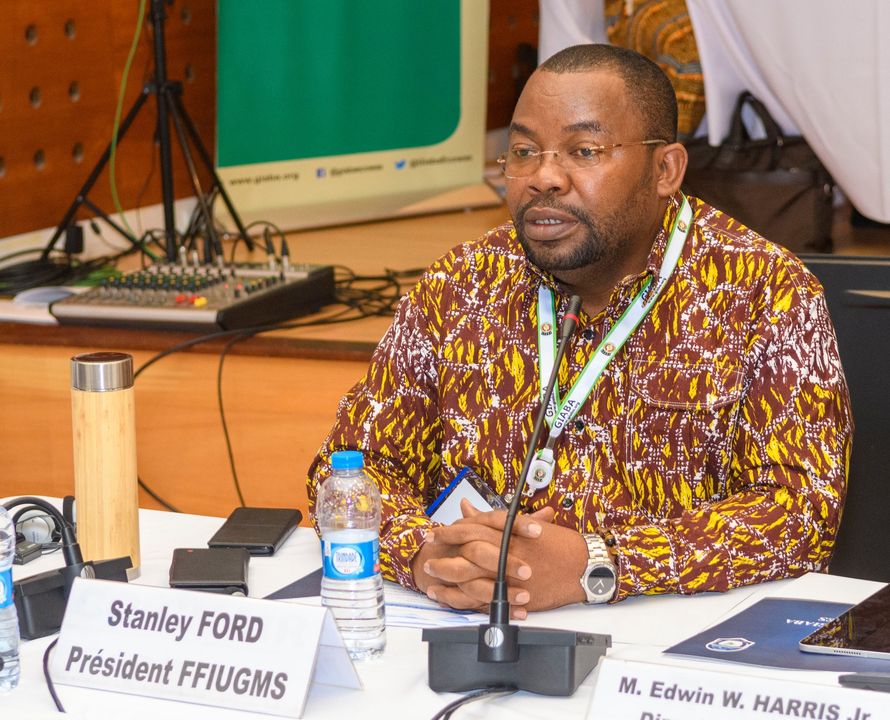
Stanley Ford- the ex-financial watchdog chief’s testimony Monday further eroded the prosecution’s case in the trial over allegedly misused national security funds.
Defense’s second witness argued that the Financial Intelligence Agency (FIA) was functionally part of the national security apparatus well before a contested July 2023 letter — a point that exposes procedural and evidentiary vulnerabilities in the state’s approach.
Ford, who followed former finance minister Samuel Tweah to the stand, told the court the Jefferson Kanmoh (ex-national security advisor) letter cited by the prosecution did not “admit” the FIA into the National Joint Security (NJS) but instead assigned a communications code — “800” — and remedial communications capabilities to the agency.
“Apparatus” and “membership” are, Ford said, legally and operationally distinct: the memo addressed equipment, coding and interoperability, not institutional admission into NJS decision-making structures.
That distinction cuts to the heart of the prosecution’s narrative, which relies on the July 2023 correspondence as the linchpin for alleging improper admission of the FIA into joint security operations.
Ford told jurors the agency had long coordinated with joint security actors — citing a pattern of interagency cooperation predating both the letter and the 2012 establishment of the country’s financial intelligence body — and described routine operational relationships with police, the Drug Enforcement Agency and other entities.
Evidence and procedural stumbles
Ford also spotlighted a January 2022 memo, earlier entered into the record by the prosecution, that requested institutional representation at an intelligence coordination center. This evidence, Ford said, points to preexistence of joint coordination.
Prosecutors objected on technical grounds to the memo’s admission when it was offered for witness identification. Judge Ousman Feika sustained the objection, keeping the document out of evidence.
Legal analysts in court said the objected material nonetheless likely reinforced the defense’s narrative in jurors’ minds despite the procedural ruling.
Ford pressed a second, potentially more damaging line of argument: investigative lapses. He testified that during his LACC (Liberia Anticorruption Commission) interview he got the impression investigators already understood the funds were for National Joint Security purposes — and that the lead investigator, Baba Borkai, had said he was “not interested in the operational details.”
Ford told the court that an investigator’s refusal to probe operational particulars — details often classified and examinable only through an authorized national security audit — undercuts the prosecution’s claim that the funds were “not accounted for.”
“That suggests they relied on conclusory statements rather than the lawful mechanism for examining classified expenditures,” Ford told jurors, arguing the prosecution should have escalated to the statutorily prescribed security audit under the National Security Reform Law of 2011.
He said the absence of that higher investigative standard meant the state reached conclusions about accounting without access to the operational records necessary to do so lawfully.
Across multiple exchanges, Ford framed the dispute as one about process and proof: whether interoperable communications and ad hoc cooperation amount to formal membership in joint security structures, and whether investigators followed statutory procedures to validate accounting for classified security expenditures.
The defense’s argument is that the prosecution’s case rests on semantic and procedural weaknesses rather than direct evidence of wrongdoing.
Prosecutors pushed back, at times forcefully, seeking to preserve the July 2023 letter as probative of institutional status. But by the close of testimony Monday, the prosecution had lost both evidentiary (the 2022 memo) and substantive ground, according to several courtroom observers.
The objections and exclusions may give the prosecution grounds for appeal or renewed evidentiary strategy, but they also create openings for the defense’s narrative to take hold with jurors.

