

By Festus Poquie
In the late, humid afternoons of southeastern Liberia, the forest exhales and the sound is not the hollow rustle of untouched canopy but the metallic rasp of chainsaws and the soft, persistent murmur of machetes taking down trunks.
Where once the forest stood as a living ledger of national memory—ancient trees, endangered chimpanzees, rain-gathering green—there are now grids of young cocoa trees stretching into the horizon like a new, invasive geometry.
The transformation has been fast enough to feel like theft, and slow enough that many officials, neighbors, and landowners insist they have been left only with paperwork and the smell of fresh-cut stumps.
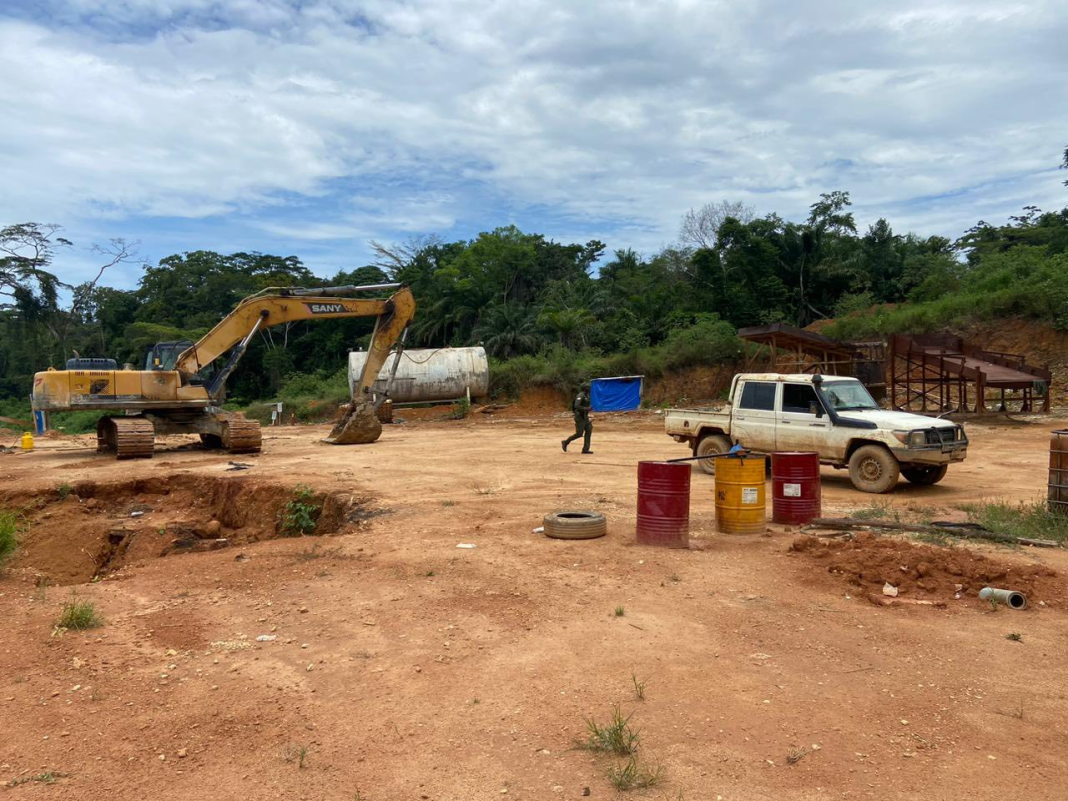
President Joseph Boakai, in a recent cabinet meeting, put a number to some of the unease: “There are reports that we have over 80,000 Burkinabes in this country, which is an alarming number. They are mostly involved in agricultural activities and mining. And what is mostly troubling is that they are mining in our national reserve. This is a situation we have to deal with.”
The remark acknowledged a problem whose contours everyone seems to know but no one has managed to stop cross-border migration of West African farmers and laborers into Liberia’s border regions, and the rapid, often illicit conversion of public and customary lands into commercial plantations and mines.
On the ground, the arithmetic of loss grows in decimal places. Grand Gedeh County, home to roughly 216,692 people per the 2022 census, and River Gee, with about 124,653, have become epicenters of change.
Environmental Protection Agency investigators, traversing eight districts in January 2025, estimated an annual loss of about 10,000 hectares of forest in Grand Gedeh alone—areas felled primarily for cocoa.
Global Forest Watch data suggests Liberia has already lost a startling 23 percent of its vegetation cover since 2000, with 150,000 hectares disappearing in 2022 alone—an area equivalent to more than 210,000 football pitches, according to Global Witness.
Much of this migration has a clear origin story: the soil of Côte d’Ivoire, long exhausted by intensive cocoa cultivation and heavy fertilizer use, no longer yields the returns it once did. Whole families and farming collectives have crossed invisible, porous borders in search of fertile ground, arriving in Liberia with seedlings, know-how, and, in many cases, the capital to clear large swaths of forest.
Investigators from the Ivorian NGO IDEF found plot sizes ballooning from neighborly 8–10-hectare plots to empires of 50–300 hectares per family. What was once subsistence frontier has become a commercial frontier—a factory of cocoa whose exports flow back across national lines.
The arrangements that facilitate this expansion are as informal as they are consequential. Community leaders and local landlords in some districts have entered what are called “gentlemen’s agreements”—60-40 profit-sharing pacts that parcel out customary land to migrant farmers.
Superintendents, who are meant to steward these lands for their communities, have been accused of signing leases under murky conditions.
In Grand Gedeh, an outcry over an alleged 500-acre “lease” signed by a county superintendent to a Burkinabé national turned, on investigation, into a different scandal: the land in question was already a 935-acre cocoa plantation operated since 2019 by Burkinabé nationals who reportedly ship harvests through Côte d’Ivoire. Local town chiefs, youth leaders, and a slim circle of beneficiaries are reported to receive most of the spoils.
Where formal governance is weak, shadow economies thrive. Illegal mining—another vector of national asset loss—has been reported inside protected areas such as Sarpo National Park. President Boakai’s reference to mining in national reserves points to a worrying fusion: migrants seeking livelihoods, landlords seeking cash, and, in some accounts, hidden enablers among local officials who convert short-term financial gain into long-term ecological and sovereign loss.
The consequences are not merely environmental. Liberia conserves roughly 40 percent of West Africa’s remaining primary forests and holds a key share of the Upper Guinean Rainforest, a biome critical to biodiversity and the regional climate.
When forests are cleared, watersheds are altered, rains are less reliable, and species displaced. The loss of primary forest is also a loss of national capital—carbon sinks that might have been monetized under international conservation schemes, biodiversity that might have underpinned sustainable tourism or research, and a long-term ecological inheritance traded for ephemeral cash.
Yet the narrative of culpability is complex. Many of the migrants are themselves victims of ecological dispossession in neighboring countries. Many Liberian landlords see offers they cannot refuse: immediate money to patch a roof, school fees paid, a tractor’s worth of diesel. National authorities speak in warnings and numbers. On the ground, enforcement is sporadic, and the legal apparatus for protecting customary land is entangled in custom, confusion, and weak capacity.
Investigators and activists say this combination amounts to a modern looting of national riches by outsiders and their local collaborators—an attrition not through a single headline-grabbing concession but through millions of tiny transactions that, in aggregate, hollow out public patrimony.
Global Witness’ Satellite imagery has made the scale inescapable: the largest cocoa-producing counties have lost an area of forest greater than Luxembourg between 2021 and 2024. Global Witness documented 250,000 hectares of forest loss across Bong, Nimba, and Lofa alone in recent years.
Liberia’s leaders have sounded alarms; they have not yet, however, stopped the levers that enable the loss. President Boakai’s warnings, while resonant, stopped short of a clear program of enforcement, eviction, or restorative policy.
For now, the plantations keep growing like new towns, and the forestry that could have been sold as a global public good continues to be cleared for private gain.
The story that unfolds in Liberia is not only about migrants or corrupt local officials—it is a tale of the geopolitics of scarcity, where depleted soils and porous borders reroute human desperation into environmental destruction.
It is also a story about how a nation’s slow-burning dispossession can be obscured by the immediacy of profit and the fragmentation of authority.
In the afternoons, when the chainsaws cease and the distant drums still beat, there remain pockets of forest, elders who remember the way the land was, and a country confronting the hard arithmetic of what it cannot afford to lose.

