

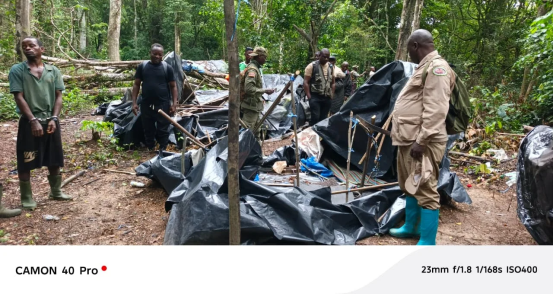
Grand Gedeh County is fast becoming the epicenter of a troubling clash between law enforcement and traditional authority, as Liberia’s fragile forest governance faces unprecedented threats. Despite mounting local and international pressure to curb illegal activities in protected areas, enforcement efforts are being undermined by powerful community interests, foreign incursions, and escalating tensions between government agencies and traditional leaders.
A recent report by Global Witness paints a grim picture of Liberia’s forests, warning that unchecked interference could derail national conservation goals. Yet, on the ground, Forestry Development Authority (FDA) officers are finding themselves not only obstructed but increasingly endangered.
On March 2, 2025, FDA enforcement officers Selma Kolako and Oliver Jelleh narrowly escaped what they described as an imminent arbitrary arrest by traditional authorities near the Krahn-Grebo National Park. The officers had been conducting awareness campaigns on forest preservation when they were accused of defying “traditional orders” that allegedly barred FDA activities in certain areas.
Kolako recounted the chilling moment: “I was in bed when I heard a persistent knock at my door. The visitor pleaded with me, saying, ‘Kolako, you must leave right now before the worst happens. You are no longer safe in Ziah Town.’”
The crisis deepened on June 15, 2026, when scores of FDA officials, including the Regional Forester, were detained in Druwoh Town, Konobo District. Their arrest followed a raid on alleged illegal miners—many reportedly Malian nationals—operating along the Cavalla River and within the Krahn-Grebo National Park.
Sources told RRNN that the officers were held from 9:00 a.m. Monday until 1:00 a.m. Tuesday, subjected to fines, and accused of destroying makeshift structures during the raid. Three weeks earlier, FDA patrols had discovered Malian miners inside the park, but most escaped across the border into Côte d’Ivoire. One Liberian national admitted to collecting fees on behalf of Druwoh Town residents, further implicating local actors in the illegal trade.
When FDA officers sought clarification from Druwoh authorities, tensions spiraled. Traditional groups mobilized against the enforcement team, erecting roadblocks and preventing their departure. Mediation attempts by Paramount Chief James Saylee and Electoral Committee Chairman Ashai Gaye failed, despite livestock and cash being offered to ease hostilities.
The situation worsened when cultural figure Youdy Beldy accused local officials of colluding with FDA operations, inflaming community anger. After hours of negotiation, the officers were finally released at 1:00 a.m., but the incident left scars of mistrust.
Community representatives later accused FDA personnel of destroying cocoa farms and burning structures used by foreign miners. FDA officials strongly denied the claims, insisting their actions were strictly tied to enforcing forestry and environmental laws. They clarified that the Community Forest Management Body (CFMB) was not notified because the operation targeted national park territory, not community forest land.
Meanwhile, allegations surfaced that traditional groups detained Electoral Committee Chairman Ashai Gaye and CFMB Secretary Bedell Krayou, humiliating them publicly for supporting FDA enforcement. Paramount Chief Saylee himself was reportedly caught in the crossfire of the dispute.
Residents describe an atmosphere of intimidation, with many unwilling to speak publicly for fear of reprisals. Divisions over forest management, illegal mining, and land allocation are deepening rifts between local leaders, community forest authorities, and government agencies.
Observers warn that the unrest threatens to derail development initiatives and discourage investment. Already, prospecting activities by a logging company in Konobo have been delayed due to the crisis.
The unfolding conflict underscores the fragility of Liberia’s forest governance system. With traditional authorities asserting power over national enforcement officers, the rule of law is being tested in ways that could have lasting consequences for conservation and resource management.
Unless urgent dialogue and decisive action are taken, analysts caution, Grand Gedeh could become a flashpoint for broader instability in Liberia’s forest sector. The stakes are high: the future of Liberia’s forests—and the livelihoods they sustain—hangs precariously in the balance.
—-By Rural Reporters News Network (RRNN

