

July 15, 2026
Mr. Joseph Zadrozny
Chargé d’Affaires
Embassy of the United States of America
502 Benson Street, Mamba Point
Monrovia, Liberia
Subject: Request for an International Investigation into Liberia’s US$19 Million Cocaine Trafficking Scandal
Your Excellency,
As a former Mayor of Monrovia, the current Secretary General of the Congress for Democratic Change, a patriot, and a professional with specialized knowledge in counter-terrorism, intelligence, and homeland security, I consider it my civic responsibility to communicate these grave concerns.
My professional understanding of national security, intelligence analysis, counter-terrorism, transnational organized crime, institutional governance, and homeland security has strengthened my appreciation of the serious threats that criminal networks can pose to democratic institutions, public safety, national sovereignty, and regional stability.
It is from this informed professional perspective, and from my profound love for Liberia, that I respectfully communicate these concerns. The patterns surrounding this matter raise legitimate national security and intelligence concerns that require an independent, credible, and internationally supported investigative response.
I write to respectfully request the attention of the Embassy of the United States regarding the unresolved US$19 million cocaine trafficking scandal in Liberia a matter that continues to raise profound concerns about the rule of law, institutional independence, corruption, and Liberia’s commitment to combating transnational organized crime. Viewed through the lens of national security and counter-narcotics enforcement, this case represents far more than an isolated criminal incident; it reflects a broader pattern in which organized criminal networks exploit institutional weaknesses to entrench themselves within the machinery of the state.
Part of my concern in raising this matter is that the United States has long been Liberia’s traditional partner, continuing to invest American taxpayers’ money in strengthening our democratic governance, peace, and stability. If this matter is not urgently and properly addressed and resolved, the United States’ presence and our peace could be threatened by a growing wave of cocaine trafficking syndicates whose reach extends well beyond Liberia’s borders.
Your Excellency, the magnitude of this case extends beyond a single criminal investigation. It has become a test of Liberia’s willingness and capacity to investigate powerful actors without political interference.
Unfortunately, the progress of the investigation remains uncertain and appears to be marked by political deception. Today, many Liberians fear that the truth may never be fully established through existing domestic processes, given the dangerous pattern of impunity within Liberia’s criminal justice system — a vulnerability that transnational trafficking networks are well-positioned to exploit.
Given the seriousness of this case and its regional and international implications, I respectfully call for the support of the United States and other international partners in advancing an independent international investigation, or an internationally supported investigative response. Such a process would help restore public confidence, strengthen accountability, and ensure that no individual is beyond the reach of the law.
I am deeply troubled by the manner in which the Liberia National Police is handling the reported US$19 million cocaine scandal. In my view, the investigation has lacked the transparency and independence that a case of this magnitude demands. I believe the repeated public briefings by the Inspector General of Police have failed to address the central questions surrounding the origin and ownership of the reported shipment of cocaine into Liberia. Instead of bringing greater clarity, the Police Inspector General has, in my opinion, left significant questions unanswered and weakened public confidence in the integrity of the investigation.
I am equally disturbed by what I believe to be the erosion of the operational independence of the Liberia Drug Enforcement Agency (LDEA). It is my view that the Inspector General of the Liberia National Police, Mr. Gregory O. W. Coleman, has exercised undue influence over the appointment and functioning of the Agency’s current leadership.
I believe this influence risks undermining the institutional autonomy of the LDEA, an agency established to investigate drug trafficking independently and without interference.
Given the importance of the Agency’s mandate, I believe it is imperative that an independent investigation determine the extent of the influence that has affected its operations, including the handling of the reported US$19 million cocaine trafficking case.
Evidently, in 2024, Abe Kromah became the victim of a political conspiracy orchestrated by Gregory Coleman, resulting in his dismissal from his position as Head of the Liberia Drug Enforcement Agency (LDEA). This was, in my view, a well-organized plot against Mr. Kromah to ensure that a well-established cartel of which Gregory Coleman is an integral member could flourish under his watch.
In short order, Gregory Coleman lured and manipulated President Joseph Boakai into appointing his deputy at the Liberia National Police (LNP), Fitzgerald T. M. Biago, as Officer-in-Charge of the LDEA another individual reportedly recruited by the cartel.
At the time of his appointment, Biago was an active employee of the Liberia National Police, where he served as Deputy Commissioner of Police under Gregory Coleman. His appointment came after the removal of Abe Kromah, a professionally trained criminal justice expert and graduate of John Jay College of Criminal Justice. All of this, in my view, was done to secure absolute control over the cartel’s operations.
I have argued that the repeated placement of senior Liberia National Police officers at the helm of the LDEA has blurred the Agency’s institutional independence and concentrated undue influence over Liberia’s security architecture.
These concerns have intensified following the subsequent exposure of a major narcotics case reportedly valued at approximately US$19 million. While these leadership changes may have contributed to weaknesses in institutional oversight and command, I believe these patterns reflect coordinated efforts to facilitate criminal activity a convergence of organized crime and political power that any credible threat assessment would flag as a serious risk to state security.
Even as the US$19 million worth of cocaine was discovered at Roberts International Airport, and while investigations were actively ongoing, Gregory Coleman was in the United Kingdom on June 18 and 19, 2026 — reportedly the intended destination of the cocaine. One can reasonably infer that Gregory Coleman was in the United Kingdom awaiting the arrival of the cocaine consignment (see attached image).
I am also informed that, prior to the discovery of the US$19 million cocaine shipment, Gregory Coleman received a number of gifts from a well-known cartel for distribution among top government officials. Ten Toyota Hilux vehicles were distributed to the Liberia Drug Enforcement Agency (LDEA) and the Liberia National Police without being registered or coded through the General Services Agency (GSA), as required under established Liberian government procedures.
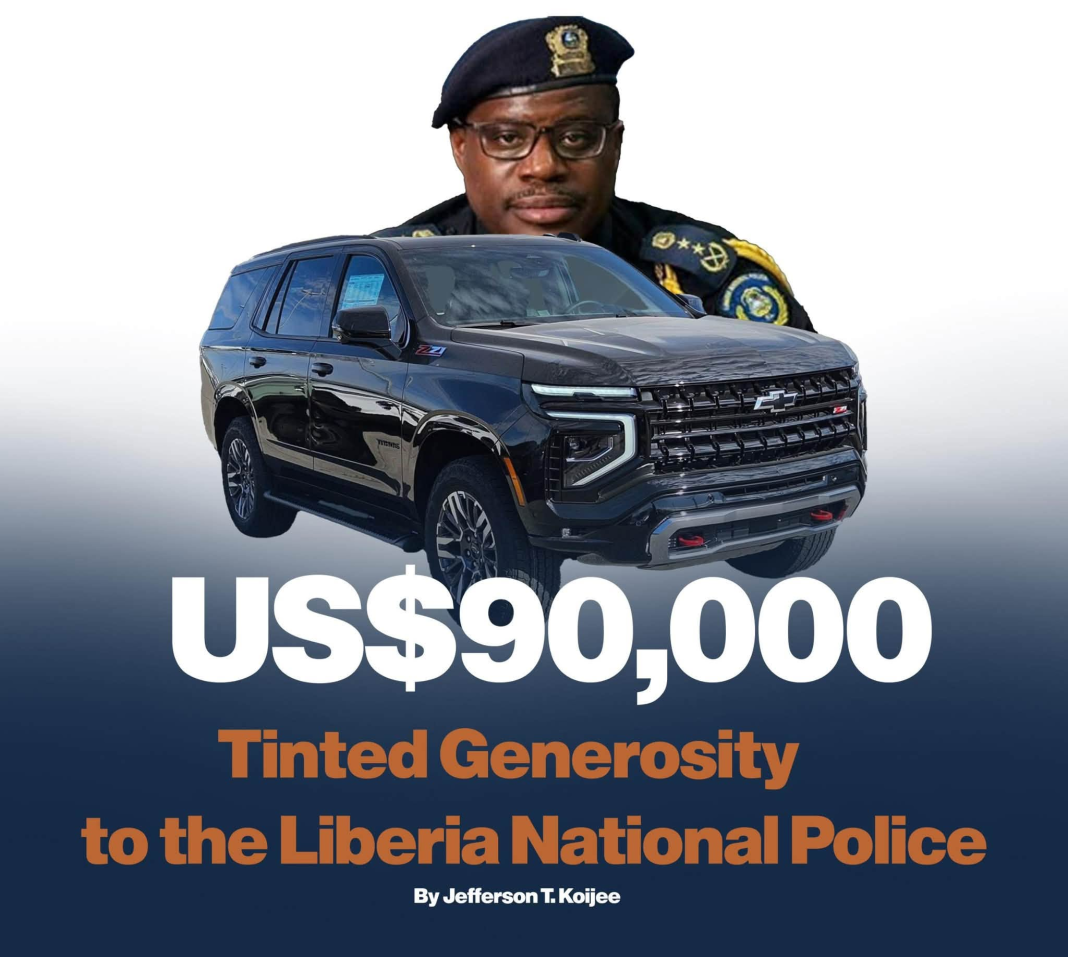
Furthermore, seven Chevrolet Tahoe vehicles, each valued at an estimated US$90,000, were reportedly given by the cartel to Gregory Coleman for distribution as follows: two to President Joseph N. Boakai, currently used in his presidential convoy; one to Senate Pro Tempore Nyonblee Karnga-Lawrence; one to Vice President Jeremiah Kpan Koung; one to Speaker of the House of Representatives Richard Kun; and two retained by Police Inspector General Coleman. In total, the commercial value of these vehicles is estimated at US$630,000. All of these vehicles are currently visible in the convoys of these public officials.
The Liberia National Police’s 2026 national budget stands at US$25.7 million, with compensation accounting for US$17.7 million and goods and services accounting for US$7.2 million. Meanwhile, Mr. Coleman earns a gross salary of US$4,436. This raises the question of how the Liberia National Police could distribute such a large quantity of vehicles when no such allocation exists within the national budget. This, in my view, only reinforces the suspicion that Mr. Coleman is being financially supported by the cartel.
I respectfully request that the investigation review the management and allocation of these ten vehicles, whose provenance is linked to the junta regime in Guinea.
We must determine whether all procurement, registration, transfer, and asset management requirements were fulfilled under Liberian law. Establishing the facts surrounding these matters is essential to strengthening public trust in Liberia’s security institutions and ensuring that public and donor-funded resources are managed transparently and in accordance with the law.
Mr. Ambassador, I do not present these allegations to portray the government in an unfavorable light. Rather, I believe they are sufficiently serious to warrant an independent and impartial investigation capable of confirming these claims through credible evidence.
The credibility of Liberia’s anti-drug institutions cannot be restored unless investigations are demonstrably independent, professionally conducted, and free from political influence. Public confidence requires that all allegations, regardless of the status or office of those implicated, be examined without fear or favor.
The Liberian people deserve institutions that are transparent, accountable, and capable of confronting organized crime without political interference. Ensuring justice in this matter will not only strengthen Liberia’s democracy but will also reinforce regional efforts to combat illicit drug trafficking throughout West Africa. If this matter is not taken seriously, our country’s peace and democracy stand at the verge of being undermined and descending into full-fledged chaos.
Thank you for your continued partnership with the people of Liberia and for your commitment to advancing justice, accountability, and democratic governance.
Respectfully,
Jefferson T. Koijee
Secretary General, Congress for Democratic Change

