

By: Ian Yhap
Proverbs 18:13: “He that answereth a matter before he heareth it, it is folly and shame unto him.”
I begin with Scripture because the Rev. Dr. Alexander Redd chose Scripture as part of the moral architecture of his commentary, and there is another biblical principle that seems even more directly applicable here: before we answer a man, correct him, assign motives to him, or characterize his argument, we must first make certain that we have accurately heard what he actually said.
That obligation should weigh particularly heavily upon a man of the cloth.
Rev. Redd writes elegantly. Unfortunately, his elegance does not rescue his faulty premise.
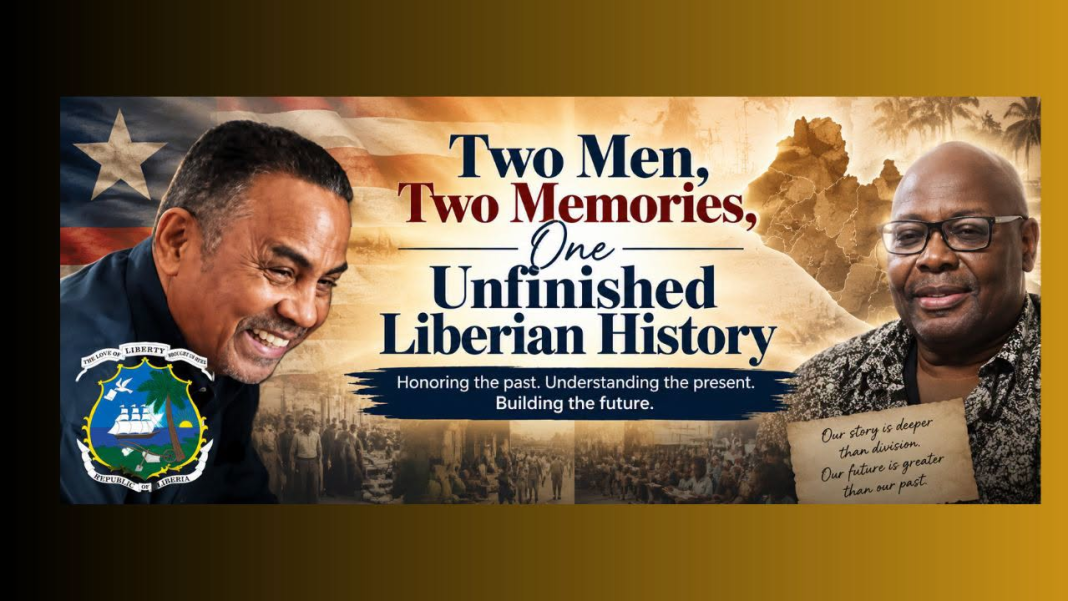
His entire essay, “Two Men, Two Memories, One Unfinished Liberian History”, begins by placing Henry Boima Fahnbulleh and Ian Yhap on opposite sides of an intellectual boxing ring, assigns each man a theory of Liberian history, and then proceeds to referee a contest that Ian Yhap never entered.
There is no debate!
I am not a historian. I have never claimed to be one. I have no historical thesis to defend, no school of Liberian historiography to establish, and no intellectual territory to protect from Dr. Fahnbulleh.
Dr. Fahnbulleh spoke and I listened. Then I placed some of what he said alongside other information already in the public domain and asked whether the pieces fit. That is all.
So, when Rev. Redd declares that “Yhap approaches the debate through relationships and recollection,” he attributes to me a methodology I have never advanced. I did not introduce relationships into this discourse. Dr. Fahnbulleh did.
He told the story of encountering Ian Yhap in an office. He described Yhap’s supposed sneer. He said he did not know Yhap. He asked who Yhap was. He was told Yhap was related to the Tolberts. And, by his own telling, that revelation apparently explained the sneer.
What exactly was I supposed to do with that?
Once Dr. Fahnbulleh used my genealogy to interpret my character and political disposition, I responded by supplying the missing context. That is not “approaching history through relationships.” That is correcting a story about my own relationship to the people he invoked.
There is another problem.
Rev. Redd writes: “Yet both arguments become weaker when disagreement becomes personal combat.”
Both arguments?
Then he supplies the evidence: “ignorance,” “hypocrites,” “falsifiers,” “political neophytes,” comments about attention span, and suspicions about proxies.
Before spreading those words conveniently across “both men,” perhaps Rev. Redd should tell his readers which man actually used them.
That is not civil. Civility does not require mathematical equality in the allocation of blame. If one man threw six stones and the other threw none, Christian charity does not require us to place three stones in each man’s hand so that your sermon comes out balanced.
And that brings me to the Scripture.
Rev. Redd invokes Ezekiel to remind us that “the soul who sins shall die.”
“Amen.”
But what proposition of mine is that verse answering? I have never argued inherited guilt. Indeed, the irony is almost exquisite: genealogy became relevant to this discussion precisely because Dr. Fahnbulleh himself invoked my relationship to the Tolberts to explain something supposedly objectionable about me.
If Ezekiel 18:20 belongs anywhere in this conversation, perhaps it should be read again with that fact in mind.
Then comes James: “swift to hear, slow to speak, slow to wrath.” Another excellent Scripture. But Bible verses cannot perform the work of evidence. They cannot transform two unequal behaviors into equal ones. They cannot create an argument I never made. And they certainly cannot turn an inquiry into a debate merely because Two Men, Two Memories makes a more attractive title.
Rev. Redd, as have many others, also informs us that Dr. Fahnbulleh has already spoken through his testimony before the Truth and Reconciliation Commission.
Wonderful! But that does not end inquiry. It begins the inquiry. Testimony is evidence to be examined, compared with other testimony, placed against chronology, and tested against the historical record. Appearing before the TRC did not confer historical infallibility upon anyone. And therein lies the real issue.
I brought very little that was new to this discussion. Dr. Fahnbulleh supplied much of the material himself. His writings, his recollections, his political history, his public statements, the testimony of others, and records already available to Liberians supplied the rest.
I only made public the inquiry that started people putting some of those pieces next to one another. Apparently, the picture that is emerging is making some people uncomfortable.
But something else rather fascinating appears to be happening. This exchange seems to be flushing out the Progressives, and perhaps more importantly the defenders of the Progressive narrative, out from every walk of Liberian life. Academics, clergy, former officials, eyewitnesses, family members, sympathizers, critics, and people who may never before have publicly identified themselves with that history are suddenly speaking. Some defend it. Some reinterpret it. Some challenge it. Others are supplying recollections and details that many of us have never heard before.
I welcome that.
In fact, perhaps that will prove to be the greatest value of this entire exercise. Not determining whether Ian Yhap or Henry Boima Fahnbulleh “won” some imaginary debate that you put together, but encouraging the people who lived this history, participated in it, supported it, opposed it, or witnessed it to finally put what they know into the public record.
Let them come.
Let them speak.
The more voices we hear, the less dependent future generations will be upon any single person’s version of what happened to Liberia.
But still there is something almost unsettling in the way some of this discomfort is being repackaged as moral equivalence, as though a careful reading of the public record is itself a kind of transgression. It has the feel of a “wolf in sheep’s clothing”: an appeal to fairness and balance that, on closer inspection, blurs rather than clarifies what was actually said and by whom.
That discomfort is not a historical thesis. It is certainly not a debate. I am simply one Liberian, among many, trying to understand how the country we inherited became the country we have today. When participants in that history speak, I listen. When their accounts raise questions, I ask them. When something does not appear to fit, I say so.
Anyone is free to evaluate Ian Yhap. But evaluate me on my actual record. Quote something I actually wrote. Challenge a conclusion I actually reached. Identify a fact I got wrong. Demonstrate a contradiction in my reasoning. I will gladly answer for those.
But do not manufacture an Ian Yhap, assign him a philosophy, place him opposite Henry Boima Fahnbulleh, hang boxing gloves around both men’s necks, and then solemnly announce that both fighters need to behave themselves.
There is no fight. There is no contest. And I am not competing with Dr. Fahnbulleh for ownership of Liberian history. History does not belong to either of us.
And now preacher, I return to the Scripture with which I began:
“He that answereth a matter before he heareth it, it is folly and shame unto him.”
That verse does not rebuke disagreement. It rebukes something much more fundamental: reaching a conclusion before accurately understanding the matter being judged.
That is precisely my objection to Rev. Redd’s essay.
Before constructing “Two Men, Two Memories,” he first had an obligation to establish that there were, in fact, two competing historical propositions.
Before distributing responsibility for personal invective between “both” men, he had an obligation to establish who actually uttered the words he cited.
Before telling his readers that Ian Yhap interprets Liberian history through relationships, he had an obligation to establish that Ian Yhap never proposed such a thing.
Those obligations become even more important when the writer invokes Scripture and speaks with the moral authority associated with the pulpit. A clergyman’s words carry weight. With that weight comes an obligation not merely to preach fairness, but to practice it in the construction of the argument itself.
And there is something larger at stake than Ian Yhap or Henry Boima Fahnbulleh. Young Liberians are reading us. If we leave them narratives in which positions are assigned rather than demonstrated, responsibility is artificially distributed for the sake of appearing balanced, and personalities are placed into imaginary contests because conflict makes a more compelling story, then we are reproducing the very problem we claim to be correcting.
Future generations do not need another carefully packaged Liberian narrative. They need the evidence, the contradictions, the competing recollections, the unanswered questions, and then they should be challenged and trusted to think.
That, Reverend, is why Proverbs 18:13 is important here.
First hear the matter.
Then answer it.

