

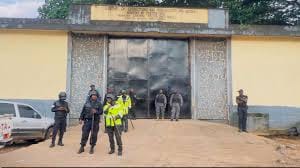
This was about three days after the Columbian drug cartel deadline for the release of their operatives in Monrovia Expired.
On the afternoon of August 1, 2026, two men arrived at Monrovia Central Prison wearing shorts, carrying no visible identification, and asking to speak with an inmate connected to Liberia’s largest recent drug case.
They said they were agents of the National Security Agency, Liberia’s top intelligence service. But offered no clear explanation of their mission and appeared to be operating outside the facility’s established procedures.
Jackson K. Kolako, the prison’s deputy superintendent for operations, refused them entry.
What happened next has become a dispute over prison authority, national security, and the government’s handling of a transnational cocaine investigation.
Kolako says that officials working with the Ministry of Justice tried to override prison safeguards and that his arrest, carried out in front of officers and inmates, could have provoked a riot and enabled a mass escape—including, potentially, the release of foreign drug traffickers held at the facility.
The Ministry of Justice rejects that account. It says Kolako was removed from the prison on the order of the attorney general and justice minister after intelligence suggested that he may have obstructed an investigation and had improper contact with a person connected to the drug case. The ministry has emphasized that the allegations remain under investigation and that Kolako has not been found guilty of wrongdoing.
The competing accounts have emerged as Liberia faces a widening narcotics scandal, one that has drawn in security agencies, senior officials, and the son of President Joseph Boakai.
The episode began publicly on July 25, when a video circulated on social media purporting to show members of a Colombian drug-trafficking organization. In the video, the speakers claimed that a shipment of ten tons of cocaine had been sent to Liberia, but that only four tons were publicly acknowledged after the seizure. The remaining six tons, they alleged, had been diverted.
The group further claimed that it had paid $2 million to facilitate the shipment and secure the release of two associates in Liberia. Unless the drugs were returned and the men released, the speakers threatened retaliation, including against Boakai’s son, Joseph Boakai Jr., known as “Jojo.”
The authenticity of the video and the cartel’s claims have not been independently established.
But the threat quickly became a national-security crisis, overshadowing Liberia’s 179th Independence Day celebrations and intensifying public anxiety over the country’s role as a transit point for South American cocaine bound for other markets.
Between June and July, Liberian authorities seized cocaine reportedly worth hundreds of millions of dollars. The operation involved the National Security Agency, the Liberia National Police, and the Drug Enforcement Agency. The arrests and seizures were presented as evidence that Liberia was confronting the trafficking networks that have increasingly used West Africa as a bridge between Latin America and Europe.
At the same time, the allegations of corruption and collusion raised a more troubling possibility: that elements within the very agencies responsible for protecting the country’s borders and prisons might be compromised.
Against that backdrop, the events at Monrovia Central Prison acquired an unusual significance.
In a statement posted on Facebook, Kolako said the two visitors arrived approximately thirty minutes before senior prison officials—who were not assigned to the facility—appeared and attempted to force through the visit. One of them, he wrote, repeatedly declared, “We make the law, and we can break the law.”
Kolako said he asked whether the prison’s chief superintendent, Colonel Roosevelt Varney, or the assistant minister for corrections, Gabriel Fayiah Ndupellar, had been informed. They had not, he said. Kolako then contacted both men by telephone. According to his account, each expressed surprise at the proposed visit.
The inmate sought by the visitors was, at that moment, outside his housing unit for fresh air and exercise. Kolako ordered him back to his cell block. The inmate complied.
Kolako said he then returned to supervising the prison’s approximately 1,800 inmates and nearly 100 officers.
A short time later, he noticed Siafa Bahn Kemokai, chief of staff in the office of the justice minister, entering the facility with several police officers. Kolako said he offered the customary paramilitary greeting. Kemokai did not return it. Instead, according to Kolako, he ordered the deputy superintendent’s arrest.
Kolako interpreted the arrest as a possible provocation. If his officers had resisted—or if inmates had understood that a senior prison official was being detained inside the facility—the situation could have deteriorated rapidly, he said. A disturbance at the central prison, he argued, could have allowed inmates to overwhelm guards and escape.
“With twelve years of experience at this prison,” Kolako wrote, “I recognized the provocation and the potential national consequences that accepting such provocation could have caused.”
He left the area rather than allow his arrest to unfold in front of his subordinates. Police later took him to their headquarters, where, he said, officers denied his colleagues access to him except for senior Ministry of Justice officials.
Kolako said he remained in custody from August 1 through August 7 and that police never took a formal statement from him. On August 3, he wrote, prison officials, NSA agents, and a police unit compelled him to surrender his mobile phones and passwords.
That night, he said, investigators accused him of being a cartel member and alleged that he had received significant payments from drug traffickers. He denied the accusations. The following day, he said, he was told to go home and return later. He refused, fearing for his safety.
On August 7, Kolako was released from police custody and presented with a suspension letter. The order accused him of disrupting an interview with an inmate by an external security agency. Kolako questioned why he had been handed over to police rather than referred to the Ministry of Justice’s disciplinary board.
“I have never consumed alcohol or smoked,” he wrote. “So, when did I become impaired enough to engage in such conduct?”
The Ministry of Justice issued its own statement on August 9, seeking to correct what it called an incomplete account.
The ministry said Kemokai had not independently ordered Kolako’s arrest. The order, it said, came from the justice minister and attorney general after information surfaced during the NSA investigation. Kemokai merely carried out the directive.
According to the ministry, NSA investigators went to the prison to interview the inmate. Information later provided to officials indicated that Kolako had interacted with him beforehand. When investigators attempted to speak with the inmate, the ministry said, he initially refused to cooperate and later reported feeling intimidated by Kolako.
The NSA had also received intelligence concerning alleged financial interactions between Kolako and an individual outside the prison, the ministry said. The information included claims that money had been provided to him. The ministry said that these were allegations, not established facts, and said investigators were working to determine whether they could be substantiated.
The ministry defended the decision to keep the operation confidential. Intelligence work, it said, is governed by the principle of “need-to-know.” A prison officer’s position does not automatically entitle him to advance notice of every operation inside the facility, particularly if disclosure could compromise an investigation.
“The Ministry has deliberately refrained from publicly discussing the details of the investigation because it remains active,” the statement said.
The disagreement has left unresolved the central question: Why were intelligence agents attempting to see a high-value detainee without following the prison’s ordinary access procedures, and why did the encounter culminate in the arrest of the officer who challenged them?
Kolako has called for inmates connected to the drug case to be transferred to a more secure facility abroad, preferably in Morocco, while they await trial. He has also urged senior Liberian officials, the United States Embassy, and President Boakai to protect the integrity of the case.
His appeal reflects a fear shared by many Liberians—that a prison holding foreign traffickers and local accomplices could become the weakest link in a national drug investigation. But his public accusation also places him directly inside the controversy he says he was trying to prevent.
The Ministry of Justice has declined to publicly address the details of the alleged cartel payments or the identity of the inmate investigators sought to interview. It has said only that Kolako will remain on stand-down while the NSA completes its work.
“No officer, irrespective of rank, assignment, tenure, or position, may interfere with, obstruct, or compromise a lawful investigation,” the ministry said. It added a qualification that may prove equally important: “No officer will be adjudged guilty merely because an allegation has been made.”

