

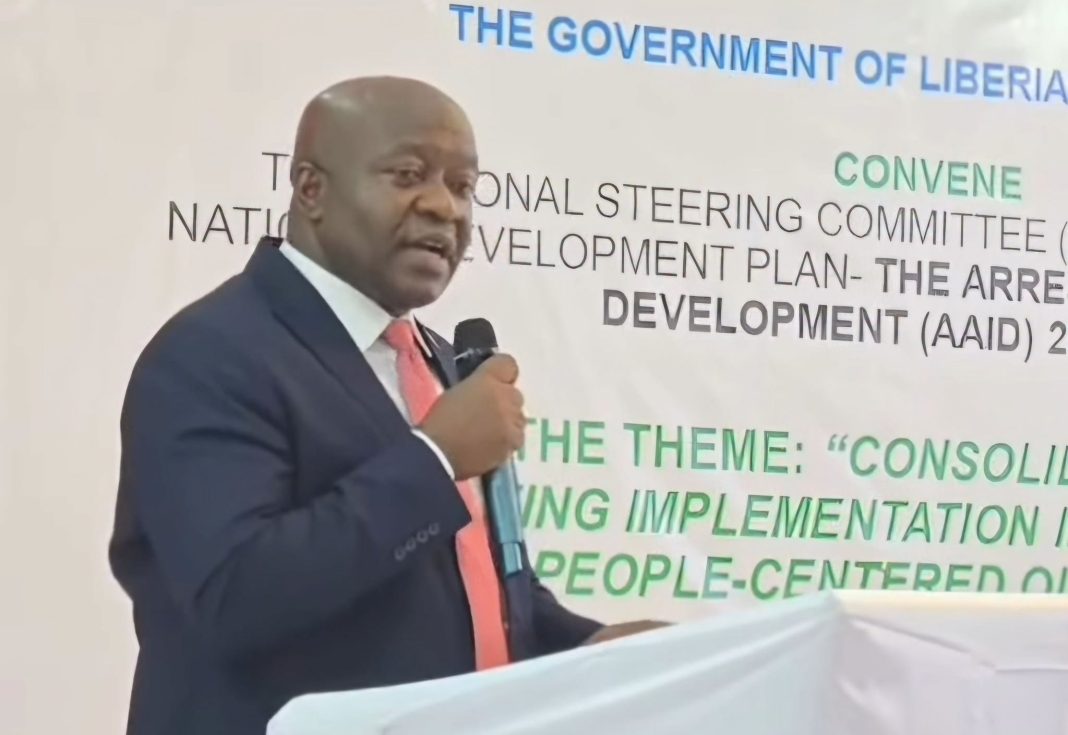
Finance and Development Planning Minister Augustine Kpehe Ngafuan projecting a 5.5 percent growth rate by 2027. The announcement, delivered at the ARREST Agenda National Steering Committee Meeting in Monrovia, signals renewed confidence in the government’s flagship development framework and a decisive push toward measurable result.
Ngafuan revealed that real GDP growth climbed from 4.0 percent in 2024 to 5.1 percent in 2025, and is expected to reach 5.5 percent in 2026, setting the stage for continued expansion into 2027. “Our objective is straightforward: to ensure that Government programs remain aligned with national priorities and that available resources are effectively translated into measurable development outcomes for our citizens,” he declared.
The figures mark a dramatic turnaround for a nation once battered by the Ebola epidemic, commodity price shocks, the COVID 19 pandemic, and structural constraints that throttled productivity. Today, Liberia’s economy is not only stabilizing but also charting a growth path that aligns with President Joseph Nyuma Boakai’s ARREST Agenda for Inclusive Development (AAID).
President Boakai, addressing the steering committee alongside Ngafuan, placed accountability and performance reporting at the heart of his administration’s development drive. Warning ministries and agencies against delays, he insisted: “Reporting is a must, and we must report on time at every level. Reports must be regular and of high quality, in line with MFDP guidelines. Any institution that fails to report will be punished.”
His stern message underscores the administration’s determination to ensure that public spending produces visible impact. For Boakai, accountability is not optional — it is the cornerstone of governance.
The AAID provides overarching policy direction, while the National Development Plan serves as the operational mechanism for translating priorities into programs, projects, and investments. Ngafuan pledged that the Ministry of Finance and Development Planning will tighten four critical levers: planning, financing, monitoring, and reporting.
This emphasis is particularly significant for Liberia, where limited fiscal space places pressure on government to maximize the impact of every dollar allocated to development. With competing demands for roads, electricity, healthcare, education, agriculture, water, and sanitation, the challenge is to ensure that external assistance and domestic revenues are aligned with nationally identified priorities.
Liberia’s financing landscape remains a blend of domestic revenue and external support from partners such as the World Bank, IMF, African Development Bank, European Union, and Millennium Challenge Corporation. Yet, the government faces the daunting task of aligning external assistance with national priorities while managing rising debt obligations and global price volatility.
The steering committee meeting, therefore, was more than a routine review — it was a test of whether Liberia’s macroeconomic gains can be converted into real improvements in citizens’ lives.
For Boakai’s administration, the challenge is clear: growth figures alone will not suffice. The government must prove that GDP expansion translates into better infrastructure, wider access to services, and improved living standards.
Ngafuan emphasized that Liberia’s economic performance during the first year of implementation and the first half of 2026 shows “encouraging results.” But the real measure of success will be whether those numbers translate into tangible benefits for ordinary Liberians — jobs, schools, hospitals, and roads.
As Liberia moves deeper into the ARREST Agenda, the combination of stronger growth, tighter planning, and tougher reporting requirements signals a decisive shift — from lofty policy commitments to measurable implementation.
The credibility of Boakai’s development vision, and ultimately his legacy, may hinge on whether Liberia’s projected 5.5 percent surge becomes more than a statistic, but a lived reality for its people.

