

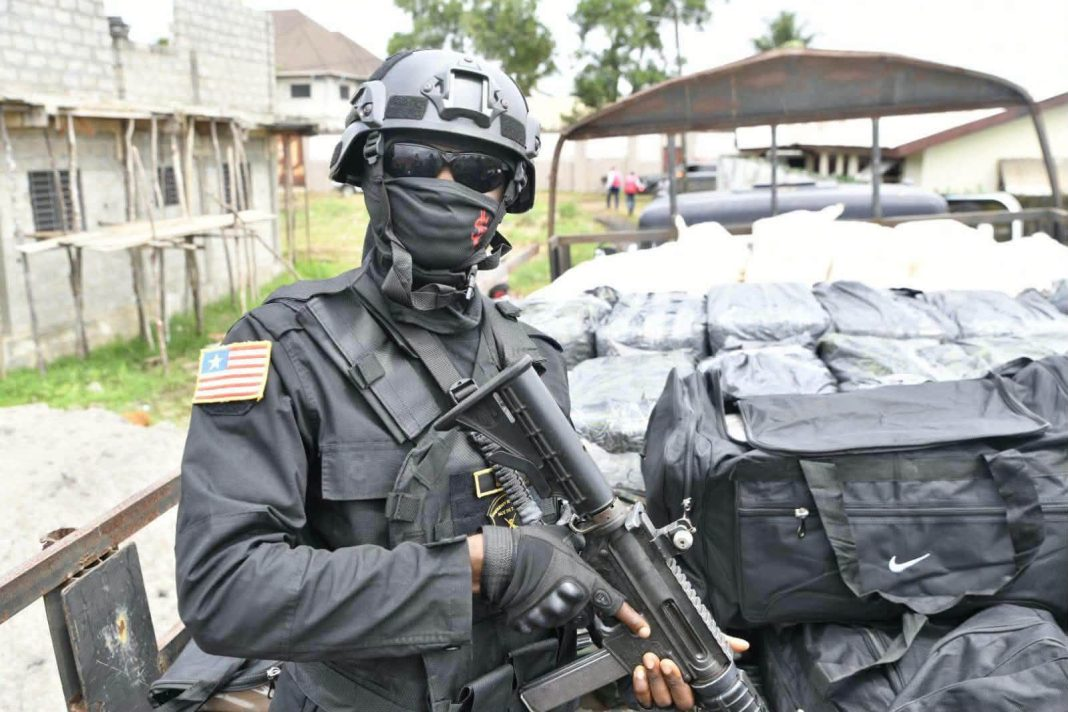
Drug trafficking, money laundering, human trafficking, firearms trafficking, organized crime, and criminal facilitation represent interconnected forms of serious criminality that threaten public safety, national security, economic development, human rights, and the rule of law.
Although these offenses are legally distinct, contemporary criminal networks frequently combine them into a single criminal enterprise. Drugs generate illicit profits; money laundering conceals and legitimizes those profits; firearms provide protection and coercive power; human trafficking exploits vulnerable persons; organized criminal structures coordinate these activities; and criminal facilitation provides the means, opportunity, transportation, financial support, information, premises, or other assistance necessary to make criminal conduct possible.
This article examines these offenses from a Liberian criminal justice perspective, with particular attention to substantive criminal law, criminal responsibility, investigation, prosecution, evidence, inter-agency cooperation, asset recovery, international cooperation, and protection of victims and constitutional rights. Liberia’s legal framework includes the Controlled Drug and Substance Act of 2023, the Penal Law of Liberia, the Anti-Money Laundering and Terrorist Financing framework, legislation concerning human trafficking, and laws regulating firearms and related criminal conduct. Liberia’s Penal Law expressly recognizes criminal facilitation, solicitation, and conspiracy.
The article argues that Liberia should increasingly approach these crimes through an integrated criminal justice and intelligence-led model, rather than treating each offense in isolation.
Effective enforcement requires professional investigation, financial intelligence, evidence preservation, forensic capacity, border management, prosecutorial specialization, judicial competence, witness and victim protection, inter-agency coordination, and international cooperation. The article concludes that the fight against transnational organized crime must remain firmly grounded in legality, due process, constitutional rights, professional ethics, and institutional neutrality.
Keywords: Drug trafficking; money laundering; human trafficking; firearms trafficking; organized crime; criminal facilitation; Liberia; criminal justice; LDEA; LNP; FIA; prosecution; transnational crime.
Introduction
Crime has changed significantly in the twenty-first century. Traditional criminality often involved an individual committing an offense against another individual or property. Modern organized criminality, however, increasingly operates through networks that may cross municipal, county, national, and international borders.
A criminal organization may recruit individuals to transport narcotics, use legitimate businesses to conceal illicit proceeds, employ firearms to protect criminal operations, exploit vulnerable persons for profit, and rely upon facilitators within transportation, communications, financial, governmental, or commercial systems.
The United Nations Office on Drugs and Crime (UNODC) recognizes drug trafficking, human trafficking, money laundering, firearms trafficking, and other illicit markets as major forms of transnational organized crime.
For Liberia, this subject has particular importance. Liberia possesses extensive land borders, a coastline, ports, airports, commercial transportation routes, and connections to neighboring West African states. These characteristics provide legitimate opportunities for trade and movement but can also be exploited by criminal networks.
The legal challenge is therefore not merely to arrest individuals who possess illegal drugs, firearms, or illicit proceeds. The larger challenge is to identify criminal networks, their organizers, financiers, facilitators, logistics providers, beneficiaries, communication systems, assets, and international connections, while ensuring that every investigation and prosecution complies with Liberian law.
Liberia’s contemporary legal framework demonstrates the importance of this integrated approach. The Government enacted the Controlled Drug and Substance Act of 2023, which regulates controlled substances and establishes offenses relating to unauthorized importation, distribution, transportation, and illicit trafficking.
The Anti-Money Laundering and Terrorist Financing framework provides another essential component. The Financial Intelligence Agency (FIA), established by legislation in 2022, serves as Liberia’s central institution for receiving and analyzing suspicious transaction information and conducting preliminary investigations concerning money laundering, predicate offenses, terrorist financing, proceeds of crime, and related financial activities.
The legal significance of criminal facilitation is equally important. Under 10.2 of Liberia’s Penal Law, a person may be guilty of criminal facilitation where, believing it probable that he or she is assisting a person intending to commit a crime, the person provides the means or opportunity for commission of the crime and thereby aids the commission of a felony.
Accordingly, Liberia’s criminal justice system must understand these offenses not simply as isolated crimes but as components of an interconnected criminal ecosystem.
Conceptual Understanding of Transnational Organized Crime
Organized crime should not be understood simply as a group of criminals committing crimes together.
The more useful criminal justice concept is that organized crime involves structured cooperation for continuing criminal purposes, usually motivated by financial or material benefit.
UNODC describes transnational organized crime as encompassing serious profit-motivated criminal conduct involving more than one country. Its manifestations include drug trafficking, trafficking in persons, firearms trafficking, money laundering, migrant smuggling, and other illicit markets.
The criminal organization may have: leaders; financiers; recruiters; transporters; couriers; brokers; corrupt facilitators; document providers; money launderers; weapons suppliers; information providers; distributors; enforcers; and legitimate-business fronts.
The organizational structure may be hierarchical, decentralized, network-based, or temporary.
This distinction is important for Liberian investigators because an investigation that focuses only on the person physically caught with contraband may fail to identify the people who organized and financed the operation.
Drug Trafficking: Legal Understanding
Meaning of drug trafficking
Drug trafficking generally involves the unlawful production, acquisition, possession, importation, exportation, transportation, distribution, sale, delivery, or movement of controlled drugs or substances, depending on the particular statutory provision.
Liberia’s Controlled Drug and Substance Act of 2023 represents a major component of the country’s contemporary drug-control framework. The law was signed by President George Manneh Weah in July 2023 and was intended to regulate, restrict, control, and combat the illegal importation, exportation, proliferation, and abuse of controlled substances.
The law is significant because modern drug trafficking is not simply a question of drug possession. The criminal justice system must distinguish between different forms of conduct and prove the elements of the specific offense charged.
Money Laundering: Following the Criminal Proceeds
Meaning of money laundering: Money laundering is generally understood as conduct designed to conceal, disguise, transfer, convert, possess, use, or otherwise deal with proceeds of criminal activity in a manner intended to conceal their criminal origin or facilitate their use.
The essential principle is straightforward: Crime generates proceeds, and money laundering attempts to separate those proceeds from their criminal origin.
UNODC explains that criminal organizations face the problem that illicit cash is difficult and dangerous to retain. Criminal proceeds may therefore be moved, invested, transferred, or introduced into legitimate economic activity to reduce the likelihood of detection.
Liberia maintains an anti-money laundering and counter-terrorist financing framework that includes the Anti-Money Laundering and Terrorist Financing Act of 2012, together with subsequent institutional and legal developments. The Financial Intelligence Agency lists the AML/CFT Act, the Fraud Act, the Mutual Legal Assistance in Criminal Matters Act, and other related legislation among Liberia’s AML/CFT laws.
The FIA became an independent and autonomous agency under legislation enacted in 2022, replacing the former Financial Intelligence Unit. Its functions include receiving and analyzing suspicious transaction reports and other relevant information concerning money laundering, predicate offenses, terrorist financing, proceeds of crime, and related matters.
Human trafficking as exploitation
Human trafficking is fundamentally different from ordinary smuggling because trafficking focuses on exploitation.
International law, particularly the UN Protocol to Prevent, Suppress and Punish Trafficking in Persons, commonly describes trafficking through three components:
Act: recruitment; transportation; transfer; harboring; or receipt of persons.
Means: force; threats; coercion; abduction; fraud; deception; abuse of vulnerability; or improper payments or benefits.
Purpose: exploitation. Exploitation can include forced labor, sexual exploitation, slavery or practices similar to slavery, servitude, and other forms of exploitation.
Victim-centered criminal justice: Human trafficking requires a victim-centered approach.
The victim should not simply be treated as an evidentiary instrument for the prosecution.
Investigators should consider: physical safety; psychological trauma; confidentiality; medical needs; protection from retaliation; interpretation and communication needs; child-protection requirements; access to legal assistance; and safe reintegration.
The criminal justice system must recognize that traffickers frequently control victims through fear, debt, deception, threats, dependency, and vulnerability.
Firearms Trafficking: Meaning
Firearms trafficking involves the illicit movement, transfer, acquisition, sale, or distribution of firearms and ammunition contrary to applicable law.
Firearms trafficking is particularly significant because firearms are both commodities of organized crime and instruments that enable other crimes.
UNODC notes that illicit firearms increase the power of organized criminal groups and may facilitate drug trafficking, human trafficking, illegal mining, wildlife crime, oil theft, and other criminal activities.
Firearms as crime multipliers
The relationship may be illustrated as: Firearms → intimidation → enforcement of criminal authority → territorial control → protection of illicit markets.
For example, an organized criminal group involved in narcotics trafficking may use firearms to: protect illicit shipments; intimidate competitors; threaten witnesses; enforce debts; protect criminal premises; resist law enforcement; or exercise territorial influence.
Consequently, firearms investigations should not be separated entirely from organized-crime investigations.
Organized Crime in the Liberian Context
Organized crime presents a particular institutional challenge because criminal organizations can exploit weaknesses in: border control; financial supervision; transportation systems; customs; ports; airports; communications; identity systems; public procurement; commercial enterprises; and law enforcement institutions.
The objective of the criminal justice system should therefore be to identify the criminal network, rather than merely individual offenders.
Liberia’s law-enforcement architecture already includes institutions with complementary responsibilities. The FIA identifies the Liberia Drug Enforcement Agency (LDEA) as an agency involved in combating narcotics trafficking and drug money laundering, while the Liberia National Police (LNP) coordinates with other law-enforcement agencies in investigating money laundering, terrorist financing, predicate offenses, arrests, searches, seizures, and asset-freezing applications.
Criminal Facilitation Under Liberian Law
Criminal facilitation is one of the most important concepts in understanding organized crime.
Under 10.2 of Liberia’s Penal Law, a person commits criminal facilitation when, believing it probable that he or she is rendering aid to a person who intends to commit a crime, the person engages in conduct that provides the means or opportunity for the commission of the crime and in fact aids the person in committing a felony.
This provision has major implications.
Consider a hypothetical situation: A person knows that another individual intends to transport illegal drugs. The person knowingly provides a vehicle for that purpose, believing it probable that the vehicle will be used to facilitate the crime.
The vehicle provider may potentially face criminal responsibility even though the provider did not personally possess or transport the drugs.
This illustrates an important principle: Criminal responsibility can extend beyond the person who performs the central physical act when another person knowingly provides the means or opportunity necessary for the felony.
Criminal Solicitation: Solicitation is another important component of organized criminal responsibility. Liberia’s Penal Law recognizes criminal solicitation under Chapter 10. The offense involves commanding, inducing, entreating, or attempting to persuade another person to engage in conduct that would constitute a felony, with the purpose of promoting or facilitating the offense.
Solicitation therefore focuses on the intentional effort to cause another person to commit a crime. This is particularly relevant to organized criminal networks because leaders may avoid direct participation while directing others to perform criminal acts.
Criminal Conspiracy: Conspiracy generally concerns an agreement between two or more persons to commit a criminal offense. The importance of conspiracy in organized crime investigations is that criminal organizations frequently require agreement and coordination before the substantive offense occurs.
The investigation may therefore examine: communications; meetings; financial transactions; transportation arrangements; repeated associations; coded communications; procurement; travel; logistics; and conduct demonstrating coordination.
The existence of an association alone, however, should not automatically be treated as proof of conspiracy. The prosecution must establish the legal elements required by the applicable Liberian law.
Criminal Investigation Perspective
An effective investigation should proceed from the crime to the network.
First stage: identify the offense
Investigators should establish: What happened?, What law was violated?, Where did it happen?, When did it happen?, Who was involved?, What evidence exists?
Second stage: identify the participants
Investigators should distinguish among: principal offenders; organizers; financiers; facilitators; couriers; suppliers; recruiters; accomplices; and beneficiaries.
Third stage: identify the financial structure
Investigators should ask: Who paid?, Who received?, What accounts were used?, What assets, were acquired?, Who benefited?, Were legitimate businesses used?
Fourth stage: identify international connections
Investigators should examine: immigration records; border crossings; travel history; customs records; international communications; financial transfers;
foreign associates; shipping and aviation records.
Evidence and Chain of Custody
One of the most important responsibilities of law enforcement is protecting evidence from contamination, alteration, loss, or challenge.
Evidence may include: drugs; firearms; ammunition; money; bank records;
electronic devices; photographs; surveillance footage; documents; vehicles;
computers; mobile phones; fingerprints; DNA; and forensic laboratory results.
Every significant item should be properly documented.
The investigator should be able to explain:
Who found it, where it was found, when it was found, how it was collected, how it was packaged, who received it, where it was stored, who examined it, and how it ultimately reached court.
This chain is essential to evidentiary credibility.
Recent Liberian Illustration: The importance of these principles is illustrated by developments reported in Liberia in August 2026.
The Ministry of Justice announced that former Vice President Jewel Howard-Taylor had been formally charged in connection with an alleged transnational narcotics network.
According to the government’s statement, the charges included alleged offenses under the 2023 Controlled Drug and Substance Act, Chapter 10 of the Penal Law—criminal solicitation, criminal facilitation, and criminal conspiracy—and money laundering under the Anti-Money Laundering and Terrorist Financing framework.
This example is legally significant not because allegations establish guilt—they do not—but because it demonstrates how a contemporary investigation may involve multiple criminal statutes simultaneously.
The reported case illustrates the legal relationship between:
Drug trafficking + criminal facilitation + solicitation + conspiracy + money laundering.
It therefore provides an important contemporary illustration of why investigators and prosecutors need an integrated understanding of criminal law.
The accused remains entitled to due process, including the presumption of innocence and a fair determination of the allegations in court.
Recommended Criminal Justice Strategy for Liberia
Recommendation 1: Develop an integrated organized-crime strategy
Liberia should develop a national strategy linking: narcotics enforcement; financial crime; human trafficking; firearms trafficking; border security; organized crime;
corruption; cyber-enabled crime.
Recommendation 2: Strengthen specialized investigators
Investigators should receive advanced training in: organized-crime investigations;
financial investigations; narcotics investigations; human trafficking;
firearms tracing; digital evidence; surveillance law; interview techniques; evidence management.
Recommendation 3: Strengthen financial investigation
Every major trafficking investigation should consider a parallel financial investigation.
The question should not end with: “Where are the drugs?”
It should continue: “Where is the money?”
Recommendation 4: Strengthen asset recovery
The criminal justice system should pursue lawful mechanisms for: seizure; freezing;
forfeiture; confiscation; preservation; management of proceeds of crime.
Taking away the economic benefits of organized crime can be more disruptive than simply arresting low-level participants.
Recommendation 5: Strengthen the FIA-Law Enforcement relationship
Financial intelligence should be appropriately integrated into criminal investigations while respecting statutory safeguards, confidentiality, due process, and institutional responsibilities.
Recommendation 6: Improve evidence management
Law enforcement should establish stronger national standards for: evidence collection; packaging; storage; laboratory submission; chain of custody; digital evidence;
firearms evidence; drug evidence.
Recommendation 7: Protect victims of trafficking
Human trafficking enforcement should incorporate: victim identification; safe shelter;
medical assistance; psychological support; child protection; legal support; confidentiality; protection from retaliation.
Recommendation 8: Increase international cooperation
Transnational crime requires transnational cooperation.
Liberia should continue strengthening cooperation with: neighboring West African states; ECOWAS mechanisms; INTERPOL; UNODC; foreign law-enforcement agencies; financial-intelligence counterparts; maritime-security partners.
Conclusion
Drug trafficking, money laundering, human trafficking, firearms trafficking, organized crime, and criminal facilitation are among the most complex challenges facing modern criminal justice systems.
For Liberia, these offenses should not be viewed as isolated legal categories.
They frequently operate as interconnected components of a broader criminal enterprise.
Drug trafficking generates illicit profits.
Money laundering conceals and reinvests those profits.
Firearms trafficking provides weapons and coercive power.
Human trafficking generates profit through exploitation and attacks human dignity.
Organized crime provides the structure through which criminal activities are coordinated.
Criminal facilitation, solicitation, and conspiracy enable individuals to participate without necessarily performing the principal criminal act themselves.
Liberia’s current legal framework provides important tools for confronting these threats. The 2023 Controlled Drug and Substance Act strengthens the country’s narcotics-control framework. The AML/CFT framework and the Financial Intelligence Agency provide mechanisms for addressing illicit financial flows and proceeds of crime. Chapter 10 of the Penal Law provides important mechanisms for addressing facilitation, solicitation, and conspiracy.
Counter Terror Law
Nevertheless, laws alone cannot defeat organized criminal networks.
Liberia requires professional investigators, competent prosecutors, independent courts, forensic capacity, financial intelligence, strong border management, inter-agency cooperation, international partnerships, victim protection, witness protection, and institutional integrity.
Most importantly, the fight against serious crime must remain grounded in the rule of law.
The ultimate objective of criminal justice is not simply to imprison offenders. It is to protect society, uphold justice, preserve human dignity, deter crime, dismantle criminal enterprises, recover the proceeds of crime, protect victims, and maintain public confidence in the institutions of the Republic.
As Liberia continues to strengthen its criminal justice institutions, the country must recognize that organized crime is increasingly a networked phenomenon requiring a networked response.
Therefore, the appropriate philosophy for Liberia should be:
Investigate the crime, identify the network, follow the money, recover the proceeds, protect the victims, prosecute the offenders, and uphold the Constitution and the rule of law.
That is the foundation of an effective Liberian criminal justice response to transnational organized crime.
About the Author
Apostle Dr. Tarpeh Lasanah U-sayee Jr. is a Liberian law-enforcement professional, criminal justice scholar, university professor, security and executive-protection trainer, researcher, minister of the Gospel, and international relations practitioner. His professional career brings together law enforcement, criminal justice education, security administration, leadership, theology, and public service. Publicly available profiles also identify him as a trainer with Liberia’s law-enforcement institutions and a Criminal Justice professor. Dr. U-sayee has a multidisciplinary academic background, including:
Doctoral Degree in Church Growth and Ministry — T-Net International/Teleo University, USA,
Master of Divinity (MDiv).
Master of Foreign Service Leadership in International Relations.
Bachelor’s Degree in Criminal Justice.
Bachelor’s Degree in Sociology.
Associate Degree in Management.
His educational background combines criminal justice, sociology, international relations, management, theology, and church growth, giving him an interdisciplinary foundation for his work in education, security, governance, and ministry.
References
Financial Intelligence Agency of Liberia. (n.d.). AML/CFT laws and regulations. Financial Intelligence Agency, Republic of Liberia.
Financial Intelligence Agency of Liberia. (n.d.). Establishment of the Financial Intelligence Agency. Republic of Liberia.
Financial Intelligence Agency of Liberia. (n.d.). Law enforcement agencies. Republic of Liberia.
Government of Liberia. (2023). Control Drug and Substance Act of 2023. Republic of Liberia.
Liberia. (1976). Penal Law, Title 26, Liberian Code of Laws Revised, Chapter 10.
Ministry of Information, Cultural Affairs and Tourism, Republic of Liberia. (2026). Formal statement by the Attorney General and Minister of Justice concerning the transnational narcotics investigation. Republic of Liberia.
United Nations Office on Drugs and Crime. (n.d.). Transnational organized crime: The globalized illegal economy. United Nations.
United Nations Office on Drugs and Crime. (n.d.). Transnational organized crime in West Africa: A threat assessment. United Nations.
United Nations Office on Drugs and Crime. (n.d.). Organized crime module: Firearms trafficking. United Nations.
:United Nations Office on Drugs and Crime. (n.d.). Firearms trafficking as a cross-cutting element present in many other crimes. United Nations.
:United Nations Office on Drugs and Crime. (2021). Increasing links between drug trafficking, corruption and other forms of organized crime. United Nations.
United Nations. (2000). United Nations Convention against Transnational Organized Crime. New York: United Nations.
United Nations. (2000). Protocol to Prevent, Suppress and Punish Trafficking in Persons, Especially Women and Children. New York: United Nations.
United Nations. (2001). Protocol against the Illicit Manufacturing of and Trafficking in Firearms, Their Parts and Components and Ammunition. New York: United Nations.
United Nations. (1988). United Nations Convention against Illicit Traffic in Narcotic Drugs and Psychotropic Substances. Vienna: United Nations.
World Bank. (2011). World Development Report 2011: Conflict, Security, and Development. Washington, DC: World Bank.

