

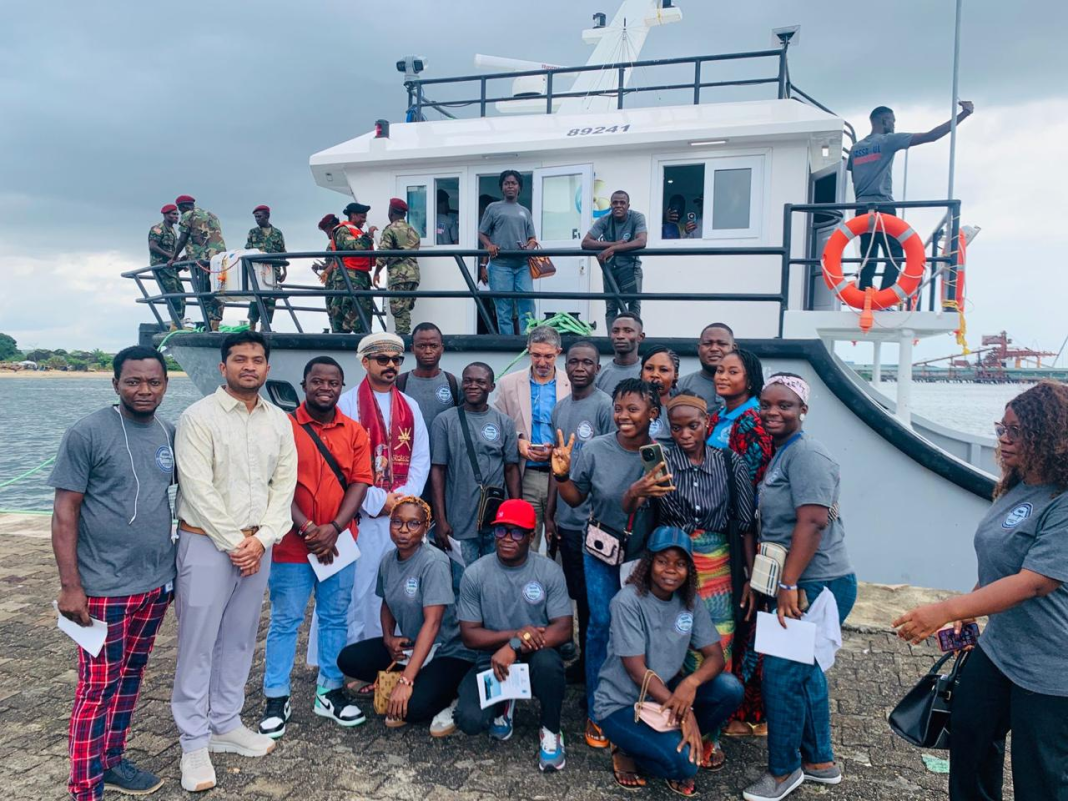
In a groundbreaking stride for global education and sustainable development, the University of Liberia (UL), with support from the Food and Agriculture Organization (FAO), has embarked on developing the world’s first academic curriculum dedicated to sustainable small‑scale fisheries (SSF).
The initiative, housed within UL’s Department of Fishery and Aquaculture Sciences (DoFAS), is backed by a $45,000 FAO technical cooperation pilot grant. Officials say the successful rollout of this pilot could unlock additional international funding, positioning Liberia as a pioneer in fisheries education and sustainability.
On September 2, 2026, UL President Dr. Layli Maparyan met with FAO officials in Monrovia to finalize details of the curriculum’s establishment. Present were Dr. Ibrahim G. Ahmed, Country Team Lead of FAO’s Emergency Center for Transboundary Animal Diseases; Musa Sanoe, Assistant FAO Representative and National M&E Specialist; Mr. Chelleh B. M. Mitchell, National Fisheries Coordinator & FAO Technical Expert; and Dr. Alvin Jueseah, Chair of DoFAS.
The project, including a comprehensive needs assessment, is expected to be completed within one year. It will introduce both a Bachelor of Science specialization and certificate/diploma programs, ensuring accessibility for fishers and practitioners who may not pursue a full four‑year degree.
The curriculum is being developed in collaboration with Duke University, Stanford University, UC Santa Cruz, and Conservation International, alongside FAO headquarters in Rome. These partners will provide technical guidance, ensuring the program meets international standards while addressing local realities.
FAO has urged UL to publicize its earlier fisheries curriculum study conducted two years ago and to establish a dedicated project account similar to those used by UNDP and UN Women, reinforcing transparency and accountability.
“It is a distinct honor for the University of Liberia to be at the forefront of knowledge in an area so vital to national development and global sustainability,” she said.
She credited Dr. Jueseah and his DoFAS colleagues for years of networking and groundwork that culminated in this landmark grant.
Dr. Jueseah emphasized that, to the best of his knowledge, this will be the first modular undergraduate curriculum globally designed specifically for SSF.
“It will allow students to pursue a BSc specialization in SSF, while individual modules can support certificate and diploma programs for fisheries practitioners,” he explained.
This flexible approach, he added, will strengthen professional skills, support private‑sector development, and advance Liberia’s national priorities.
Students enrolled in DoFAS’s four‑year program will now have the option to specialize in SSF. Meanwhile, certificate and diploma tracks will provide fishers and practitioners across Liberia and the subregion with practical opportunities to upgrade their skills, improve livelihoods, and contribute to sustainable resource management.
The FAO grant will fund a curriculum needs assessment and gap analysis, the development of SSF modules and syllabi based on the SSF Guidelines and Illuminating Hidden Harvests findings, and the validation and institutionalization of the curriculum. It will also support training of trainers, equipping DoFAS faculty with the expertise to deliver the program effectively.
“This program will develop skilled fisheries professionals and strengthen the capacity of those already working in the sector. It will prepare them to address the complex environmental, social, economic, and governance challenges affecting small‑scale fisheries in Liberia and the wider subregion.”
By integrating international expertise with local realities, UL’s SSF curriculum is expected to become a model for other nations seeking to balance economic growth with environmental stewardship.
Liberia’s fisheries sector, vital to food security and livelihoods, has long faced challenges including limited training opportunities, inadequate infrastructure, and vulnerability to climate change. This initiative signals a turning point, offering structured education that empowers communities while aligning with global sustainability goals.
For Liberia, the curriculum is more than an academic milestone — it is a strategic investment in human capital, environmental resilience, and economic transformation. For the world, it sets a precedent: that small‑scale fisheries, often overlooked, deserve dedicated academic focus to secure the future of oceans and coastal communities.

