

By George K. Werner (former education minister)
In New York, I see unflattering images of President Donald Trump—images meant to mock, provoke and ridicule. Some are offensive or distasteful. Yet they make me think about Liberia.
How much room is there in Liberia today to offend the powerful?
Liberia’s postwar reforms sought to create a country where citizens could speak without constantly looking over their shoulders. That progress was imperfect, but it strengthened the expectation that public officials must answer to the people.
Recent events raise questions about whether that space is narrowing. Yekeh Kolubah has been expelled from the House of Representatives. Prophet Key served a six-month contempt sentence and has regained his freedom.
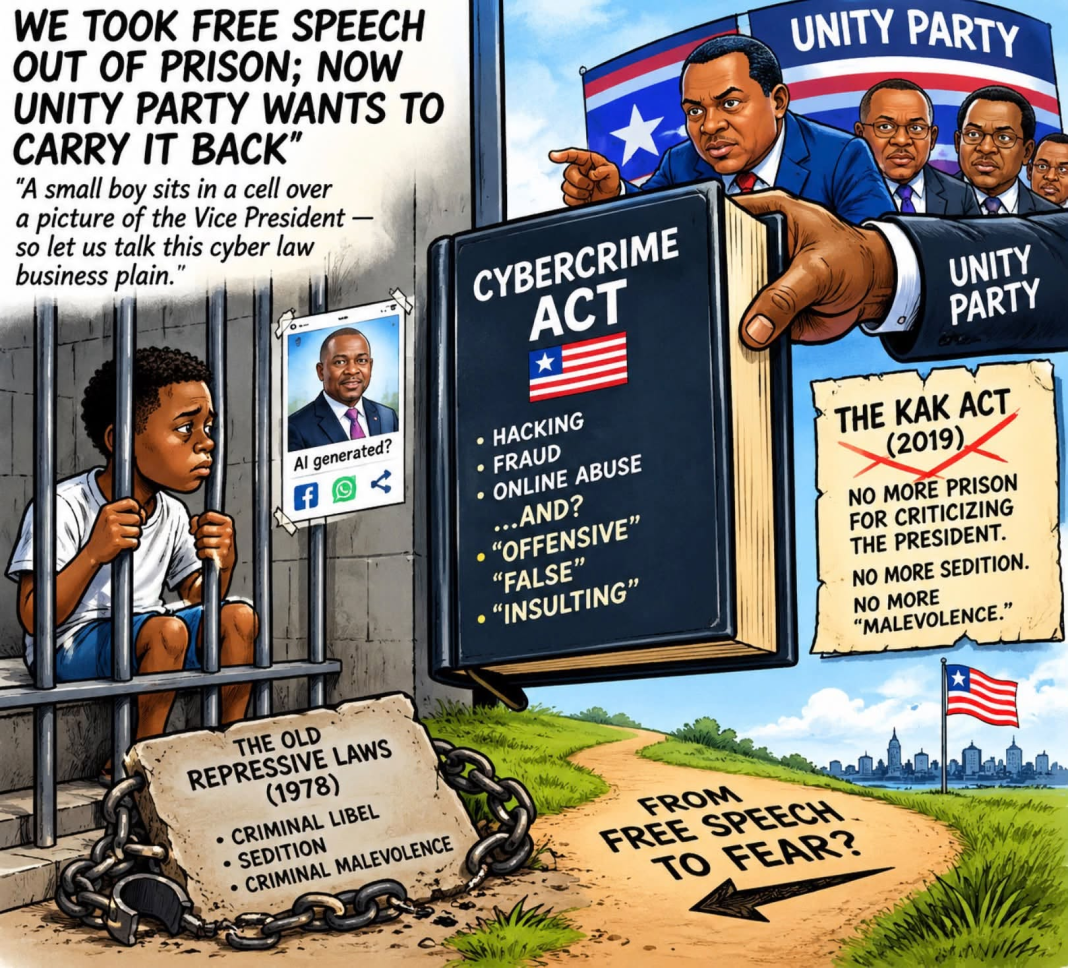
Jerry Nyantee Wrato was arrested over AI-generated content involving Vice President Jeremiah Koung, with police announcing four cybercrime charges. These cases involve different institutions and legal issues, but together they warrant scrutiny of Liberia’s treatment of political criticism.
American law cannot simply be transplanted into Liberia. Still, the images around me sharpen a democratic question: how much protection should public office provide against public ridicule?
I encounter a modest version of this tension in my own writing. Some readers disagree with my arguments; others leave insulting comments. I deliberately leave those comments visible. I can respond, correct, challenge or move on. Public conversation requires accepting that one cannot control every response.
My experience is minor compared with the pressures of high office. But it informs what I expect from those who hold power. Public officials have substantial platforms from which to respond, while state institutions can restrict another person’s liberty. That imbalance makes restraint essential.
Liberia has long known the roughness of political expression. In January 2017, CDC supporters carried coffins through Monrovia to symbolize the end of the Sirleaf–Boakai administration, accompanied by hostile chants. Ellen Johnson Sirleaf also faced gendered abuse, including the 2005 campaign incident in which young men waved women’s underwear smeared with tomato paste to ridicule the prospect of a female president.
Under George Weah, personal abuse remained part of political life. Reporting documented Yekeh’s repeated insults and profanity against the president, while Weah publicly warned in June 2019 against insulting the presidency. Neither administration can honestly be portrayed as consistently tolerant.
Nevertheless, Liberia made important gains. Sirleaf signed the Freedom of Information Act in 2010 and endorsed the Table Mountain Declaration in 2012. Weah signed the Kamara Abdullah Kamara Act of Press Freedom in 2019, repealing criminal libel against the president, sedition and criminal malevolence. These reforms followed sustained advocacy by journalists, civil society and others.
They did not erase every failure or eliminate all speech-related liability. Rodney Sieh’s imprisonment over an unpaid US$1.5 million civil libel judgment showed how severely legal proceedings could punish journalism. The 2019 reforms repealed three specified offenses; they did not abolish every possible claim involving speech.
Article 15 of Liberia’s Constitution protects freedom of expression while recognizing narrowly framed limitations, including those necessary to protect national security, public order, public health or morals, and the rights and reputations of others. Article 20 protects due process. The legal question is therefore whether a restriction has a valid legal basis, serves a legitimate purpose and is applied consistently with constitutional safeguards.
International law reinforces that caution. Article 19 of the International Covenant on Civil and Political Rights protects the right to hold opinions and to seek, receive and impart information and ideas.
Restrictions must be provided by law and necessary to protect specified interests. The UN Human Rights Committee has stated in General Comment No. 34 that the mere fact that expression insults a public figure is insufficient to justify punishment. Public officials retain rights, but their position requires them to withstand substantial criticism and political opposition.
The current leadership inherited a responsibility to preserve that space.
Boakai’s political camp benefited from some of Weah’s fiercest critics. The Unity Party publicly supported Yekeh’s reelection in 2023, and reporting describes Prophet Key as an outspoken opponent of Weah who raised funds for Boakai’s presidential bid. These relationships do not prove approval of every insult. They do make political consistency a legitimate concern.
What standards did leaders demand when these voices attacked their opponents? What standards do they demand now?
Earlier political support does not excuse later misconduct. But a change in political allegiance should not change the standard of justice. Leaders should explain whether their objections concern identifiable misconduct or merely the discomfort of becoming its target.
Yekeh’s expulsion followed proceedings concerning remarks about disputed territory between Liberia and Guinea and other alleged misconduct.
Article 38 permits the House to expel a member for cause with the concurrence of two-thirds of its entire membership, while requiring its rules to conform to due process. Article 42 protects legislative speech and provides limited immunity from arrest. The scope of those protections, particularly regarding disciplinary proceedings or statements outside legislative sessions, may present unresolved legal questions.
The expulsion must therefore be assessed by examining the actual remarks, their context, the stated cause and the procedures followed. A sufficient vote does not by itself establish lawful cause or procedural fairness, just as an electoral mandate does not place a legislator beyond discipline. Expulsion is serious because it affects both the representative and the constituency that elected him.
One can strongly disagree with Yekeh while still demanding a convincing explanation of why expulsion was justified.
Prophet Key’s case raises a different concern. The Supreme Court sentenced him for contempt following corruption accusations and vulgar personal attacks against members of the Bench. That was a judicial decision, not a presidential sentence.
His release does not end questions about proportionality or the implications for public commentary about judges. The public record should distinguish the fact of the sentence from unresolved questions about the contempt finding, the procedure and whether the punishment was necessary and proportionate.
Courts need authority to administer justice. Citizens also need room to scrutinize judicial conduct. Criticism should be accurate and responsible, but contempt powers must remain open to careful public examination.
Then there is Wrato.
According to reporting on the police’s September 21 letter, investigators announced charges under Liberia’s cybercrime framework for misuse of devices, cyberstalking, distribution of harmful data messages and distribution of messages inciting property damage or violence. The exact statutory sections, charging documents and supporting evidence should be verified against the enacted law and court record. These are allegations, not proof of guilt.
AI-generated content can deceive and cause harm. Material presented as authentic may raise different questions from an obvious caricature. A responsible assessment requires the original posts, their context, the applicable statutes and the evidence supporting each charge. We should neither declare the content harmless without examination nor assume that an embarrassing depiction of a public official is criminal.
The incitement allegation especially demands explanation. What content allegedly encouraged violence or property damage? The public should not confuse humiliation with a threat to public safety. Under international standards, an incitement restriction must address a specific and serious risk, not merely offensiveness or reputational harm.
Koung reportedly asked Police Inspector General Gregory Coleman to release Wrato, saying that criticism and ridicule come with public office. Coleman reportedly acknowledged the request but said police would proceed independently of the affected person’s wishes. That record deserves fair treatment.
A vice president’s request does not determine whether an investigation should continue. The governing questions are whether authorities have a lawful basis, adequate evidence and respect for the suspect’s rights.
I have not established that Boakai or Koung directed the legislative or judicial actions discussed here, or that Koung initiated Wrato’s arrest. Nor can I determine, without reviewing the relevant records, whether any official influenced the investigation. My concern is the use of state power and its consequences for expression.
Liberians say, “Throw a stone and hide your hand.” The proverb reflects suspicion of concealed responsibility. But suspicion must lead to evidence, not replace it. Who initiated the complaint? Did anyone acting for a public official request intervention? What conduct supports the charges? Clear answers would serve both the accused and the officials concerned.
A citizen’s liberty should depend on rights, evidence and lawful procedure—not on an offended official’s willingness to show compassion.
This is the danger of reversal: constitutional guarantees can remain formally intact while expansive enforcement makes citizens afraid to use them. People begin avoiding certain names, offices and institutions because they cannot predict whether criticism will become a police matter.
A society does not need to silence everyone to make many people afraid.
These cases do not prove a coordinated campaign. Each must be judged on its own facts. But together they justify asking whether Liberia’s institutions are preserving the distinction between protecting people from unlawful harm and protecting powerful people from embarrassment.
Boakai and Koung should welcome that examination. They reached office through a political system that allowed citizens to challenge incumbents loudly, persistently and sometimes offensively. Preserving that space now would show that their commitment to freedom extends beyond its usefulness during elections.
Liberia can demand a more decent public conversation while protecting the right to criticize. We can reject misogyny, vulgarity and deliberate falsehood while insisting that state punishment be lawful, justified and proportionate.
When I leave an insulting comment beneath one of my articles, I make a modest choice about participating in public life. Those entrusted with state power face a greater test: whether they can protect the rights of people whose words they resent.
As I continue my brief stay in New York, I think less about whether I approve of the images around me than about what happens to the people who produce them.
That is the question we must ask in Liberia.
The freedom that helped today’s leaders reach office must remain available to those who criticize them from outside it.

