

By E. J. Nathaniel Daygbor
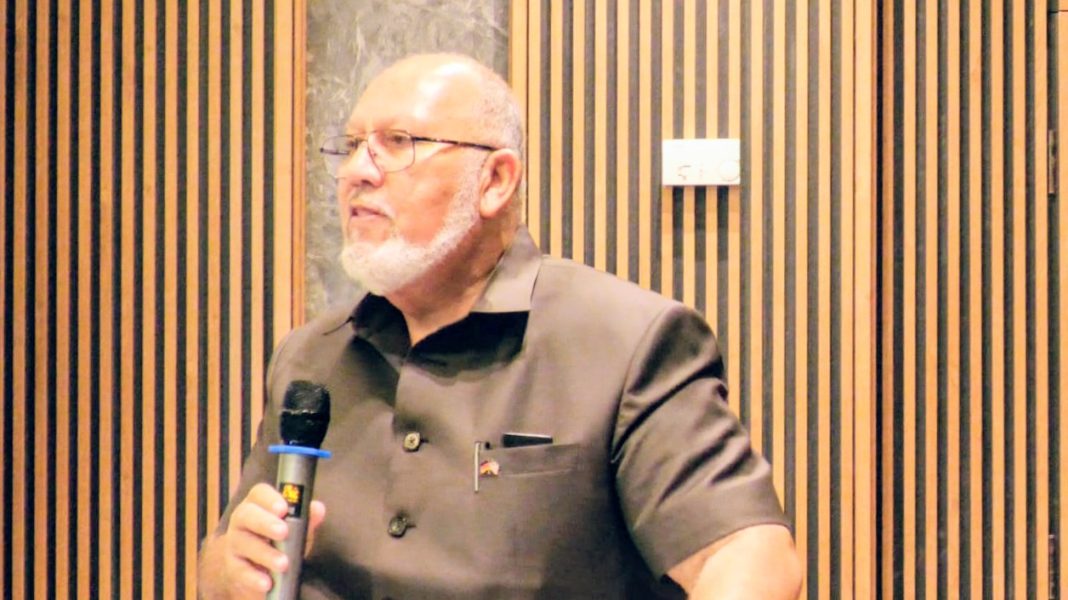
A bold proposal by the Managing Director of the Forestry Development Authority (FDA), Rudolph J. Merab, has called for the harvesting of the nation’s preserved forest for better result in near future.
Speaking at the relaunch of the Taï–Grebo–Krahn Complex Biodiversity Protection Project, Merab suggested that selective harvesting within Liberia’s 11 protected national forest parks may be necessary to ensure ecological balance, generate revenue, and sustain community livelihoods.
The remarks, delivered at a high profile event attended by government officials, conservationists, and international partners, have placed Liberia at the crossroads of a contentious global conversation: how to reconcile strict preservation with sustainable use in an era of donor fatigue and shifting international priorities.
Liberia’s forest conservation efforts date back to the 1950s, when the government, with technical assistance from Germany, identified and established 11 national parks and reserves. These areas were designed to safeguard biodiversity, protect rare species, and preserve ecosystems unique to Liberia’s Upper Guinea rainforest.
Over the decades, international donors have invested millions of dollars to strengthen Liberia’s conservation institutions, build ranger capacity, and promote sustainable forest management.
Today, Liberia boasts some of the most intact forest ecosystems in West Africa. Its parks host endangered species such as chimpanzees, pygmy hippos, and forest elephants, making them critical not only for national heritage but also for global biodiversity protection.
Yet Merab warned that the sustainability of these achievements is under threat. “The world is changing stage and interest,” he said. “Who knows what will happen if donors draw back? How does Liberia maintain and sustain its parks?”
Merab’s argument rests on a provocative premise: that Liberia’s forests, preserved for decades, have become “overgrown” and could benefit from controlled harvesting. He contends that carefully managed extraction of forest resources would stimulate regeneration, create jobs, and generate domestic revenue. “The harvesting will create jobs, bring in additional income and revenue, and help communities thrive,” Merab emphasized, framing the proposal as a balance between conservation and livelihood support.
The FDA chief insists that conservation must directly benefit forest communities. His guiding principle — “people, planet, and profit” — underscores the need to integrate ecological protection with economic empowerment. Without tangible benefits for local citizens, Merab argues, conservation efforts risk alienating the very communities whose cooperation is essential.
The event where Merab spoke marked the relaunch of the KfW funded Taï–Grebo–Krahn Complex Biodiversity Protection Project, a transboundary initiative linking Liberia and Côte d’Ivoire. Originally conceived in 2015 under a €6 million agreement, the project envisions an ecological corridor connecting the Grebo–Krahn National Park (GKNP) and the Sapo National Park (SNP). It also aims to strengthen FDA’s institutional capacity and promote cross border conservation.
Launched in 2017, the project faced setbacks in 2019 due to funding shortfalls. Renewed efforts have revived its objectives, which include: Ranger deployment: Recruitment and training of 133 rangers to monitor wildlife and enforce conservation laws, infrastructure development: Construction and rehabilitation of ranger posts, headquarters, park offices, guest houses, and water systems in Ziah Town, Tempo, Freetown, Gloyway, and Youbor, river surveillance: Establishment of dock posts and acquisition of boats, motorbikes, and high beam lights to monitor the Cavalla River along GKNP, community livelihood programs: Small scale infrastructure, savings schemes, and buffer zone activities to involve local residents in conservation and cross border cooperation: Joint monitoring by Liberian and Ivorian authorities to strengthen law enforcement and biodiversity protection.
The project’s €4.7 million budget runs until March 2029, with key outcomes expected to include stabilization or growth of wildlife populations, improved monitoring systems, and enhanced conditions for crossworder management.
Merab’s proposal introduces a controversial dimension to Liberia’s conservation discourse. Conservationists have long emphasized strict preservation, warning that harvesting risks undermining decades of hard-won gains. Critics argue that once harvesting is permitted, it could open the door to unsustainable exploitation, particularly in a country where enforcement capacity remains limited.
Yet Merab counters that selective harvesting would be carefully regulated, designed to ensure ecological balance and community benefit. He insists that Liberia cannot rely indefinitely on international donors and must find ways to generate domestic revenue from its natural resources.
Speaking for the German government, Ambassador Carsten Holscher reaffirmed Germany’s commitment to environmental protection and sustainable development, expressing pride in supporting Liberia’s forest conservation efforts.
Several stakeholders weighed in during the event: Jerry Yonmah, Technical Manager for Conservation at FDA, outlined the project’s overarching goals, emphasizing biodiversity protection and sustainable forest management. Nora G. Bowier, Deputy Managing Director for Community, Conservation and Carbon, presented the governance framework, stressing inclusivity and accountability.
Ekema A. Witherspoon serves as the focal person for the KfW initiative, ensuring smooth implementation., and Dr. Annika Hillers of the Wild Chimpanzee Foundation highlighted persistent challenges, including limited employment opportunities, inadequate livelihood infrastructure, and insufficient law enforcement training. She urged stronger collaboration with government institutions such as the Ministry of Agriculture, Public Works, EPA, and Ministry of Local Government.
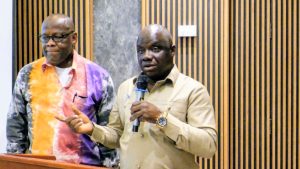
The KfW project promises a wide range of benefits for forest communities, including; lighting in rural areas, road construction to improve access to parks and surrounding communities, ranger quarters and operational facilities, expanded employment opportunities for local citizens, and savings schemes and community patrols.
The Tai–Grebo–Krahn Complex is one of the last remaining strongholds of the Upper Guinea rainforest. Its protection is not only a national priority but also a global responsibility, given the forest’s role in biodiversity conservation and climate regulation.
As Liberia pursues the Taï–Grebo–Krahn Biodiversity Project, the debate over forest harvesting underscores the broader challenge of reconciling environmental protection with economic development. With nearly half of Liberia’s landmass covered by forest, the stakes are high: the country must safeguard its biodiversity while addressing the livelihood needs of its people.
The coming years will test whether Liberia can pioneer a model of conservation that integrates sustainable use, community empowerment, and international cooperation. For Merab, the answer lies in pragmatic adaptation. “Harvesting,” he said, “can be helpful — not harmful — if done responsibly.”

