

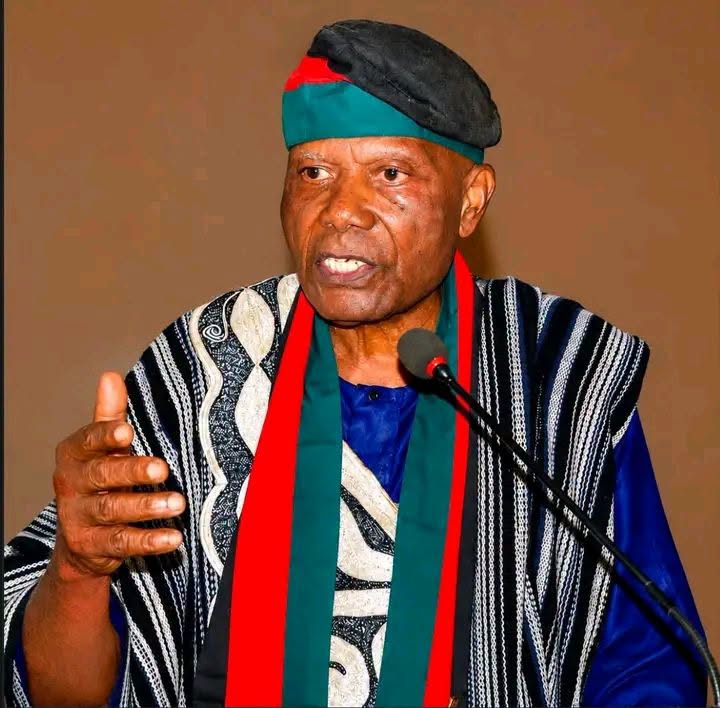
The Supreme Court of Liberia has ordered the Liberia Bank for Development and Investment (LBDI) to pay prominent Liberian academic and statesman Dr. Togbah Nah Tipoteh a total of US$50,000 in damages after finding the bank liable for wrongfully withholding his land deed despite the full repayment of a loan.
The ruling brings to a close a legal battle that spanned nearly a decade after Dr. Tipoteh filed an Action of Damages for Wrong against LBDI in 2016.
The case was heard during the Supreme Court’s March Term A.D. 2026 before the full bench headed by Chief Justice Yamie Quiqui Gbeisay Sr. The Court heard arguments on June 1, 2026, and delivered its final opinion on August 28, 2026.
Delivering the opinion of the Court, Associate Justice Ceaineh D. Clinton-Johnson recounted that Dr. Tipoteh had obtained a US$10,000 loan from LBDI on November 27, 2015, using the deed to his quarter-acre property on Ashmun Street in Monrovia as collateral.
According to the Court, Dr. Tipoteh fully settled the loan, including all interest and associated charges, on March 26, 2016. However, despite repeated requests, LBDI failed to return the deed and allegedly provided no satisfactory explanation for withholding the document.
Court records indicated that Dr. Tipoteh argued that the bank’s refusal to release the deed caused him embarrassment, inconvenience, mental anguish, and economic hardship. He further maintained that the absence of the deed prevented him from using the property as collateral to secure financing elsewhere, thereby limiting potential economic opportunities.
Based on those claims, Dr. Tipoteh sought damages of not less than US$300,000.
A lower court later awarded him US$200,000 in damages, a decision that was subsequently challenged and reviewed by the Supreme Court.
While affirming that LBDI acted wrongfully in withholding the deed, the Supreme Court reduced the amount awarded, emphasizing that claims for substantial general damages must be supported by evidence demonstrating the extent of the injuries or losses suffered.
The Court held that although Dr. Tipoteh established that he suffered inconvenience and hardship, he failed to present sufficient evidence to substantiate the full extent of the economic losses claimed.
In support of its ruling, the Court cited several precedents, including Teahjay v. Dweh et al. (2014) and National Milling Company of Liberia v. Bridgeway Corporation (1990), which established that damages must be grounded in proof and that courts must rely on evidence when determining the size of an award.
The opinion also referenced Intrusco Corp. v. Osseily (1985), in which the Supreme Court defined damages as monetary compensation awarded for injuries or wrongs arising from contractual breaches or tortious conduct.
Consequently, the Supreme Court modified the lower court’s judgment, reducing the award from US$200,000 to US$50,000.
The Court ordered LBDI to pay US$35,000 in general damages and US$15,000 in punitive damages, citing the bank’s “wanton and reckless” conduct in failing to return the deed after the loan had been fully repaid.
The Supreme Court further instructed its Clerk to issue a mandate directing the trial court to resume jurisdiction and enforce the judgment in accordance with the Court’s opinion.
The decision marks the final resolution of a dispute that has remained before Liberia’s courts for nearly ten years and underscores the judiciary’s insistence that financial institutions honor their obligations to borrowers once contractual requirements have been fulfilled.

