

By Festus Poquie
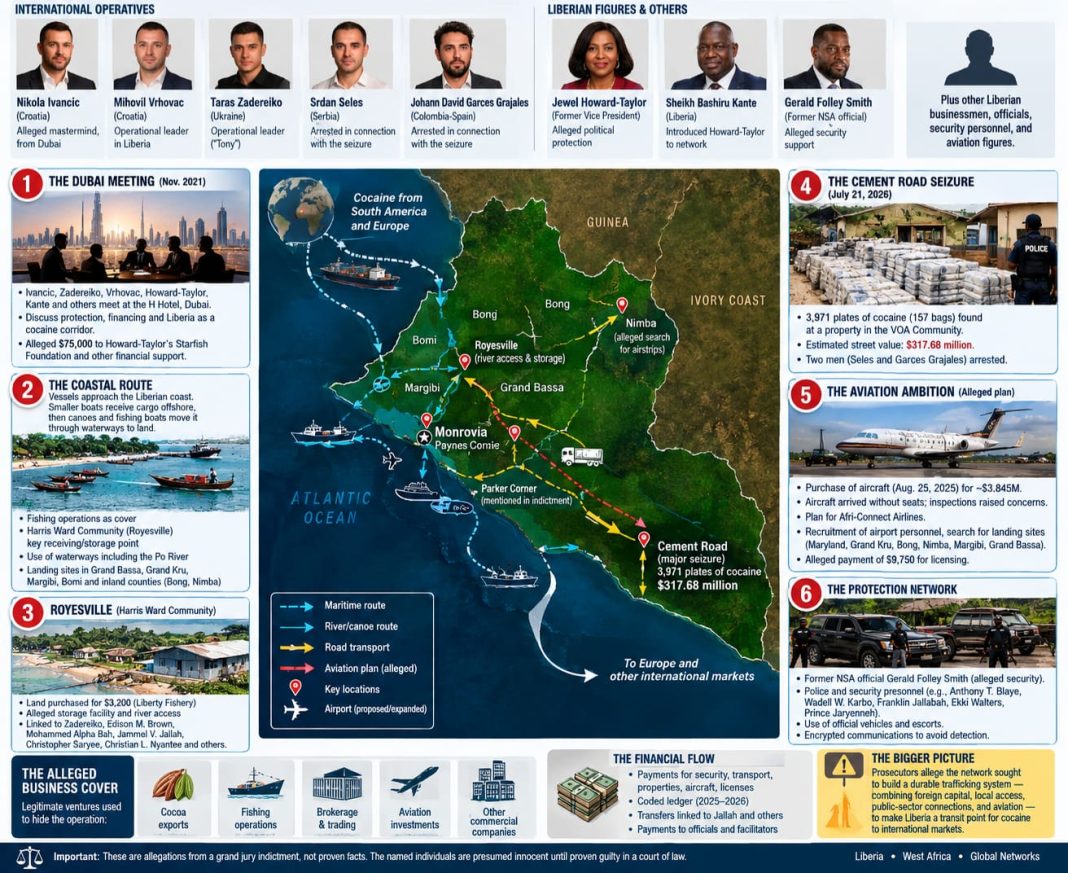
A grand jury indictment describes how an international network of European, South American, and Liberian operatives allegedly combined maritime smuggling, covert landing sites, aviation investments, legitimate businesses, and political connections to build a cocaine-trafficking corridor through Liberia—with a former vice president placed at the genesis of the plot.
The operation, as described by prosecutors, began not with an aircraft disappearing into a forest or a container of cocaine passing through a commercial port, but with relationships.
There were meetings in Dubai, introductions in Monrovia, promises of protection, and conversations about business. There were men with international connections and ambitions, Liberian businessmen with established commercial operations, and people whose positions in government, security, policing, and aviation could, prosecutors allege, help transform a clandestine drug operation into something resembling a legitimate enterprise.
By the time the alleged network reached its most ambitious stage, its plans extended from Liberia’s coastline to remote inland terrain, from fishing operations and cocoa shipments to aircraft acquisitions and the proposed establishment of an airline.
The objective, according to a special grand jury indictment from Montserrado County, was to make Liberia a reception, storage, transit, and onward-shipment point for cocaine destined principally for Europe and other foreign markets.
The indictment names Croatian nationals Nikola Ivancic and Mihovil Vrhovac, Ukrainian national Taras Zadereiko, Serbian national Srdan Seles, Colombian-Spanish national Johann David Garces Grajales, and a series of Liberian business figures and current or former public officials.
It also implicates former Liberian Vice President Jewel Howard-Taylor in an alleged arrangement to provide high-level political protection.
The allegations describe a network that, prosecutors contend, developed over approximately six years, beginning in 2021 and continuing into 2026.
Its architecture was both international and local: foreign figures allegedly supplied strategic direction and financial resources, while Liberian associates helped arrange coastal access, storage facilities, transportation, security, business registrations, and aviation logistics.
The scale of the alleged enterprise became difficult to ignore on July 21, 2026, when investigators recovered 3,971 plates of cocaine, packed in 157 bags, from a property along Cement Road in the VOA Community area of Montserrado County.
The estimated street value: approximately $317.68 million.
Two men, Srdan Seles and Johann David Garces Grajales, were arrested in connection with the seizure, according to the indictment.
But the cocaine found in that building was only the most visible part of the story prosecutors presented. Their case describes something larger than a single shipment: an alleged attempt to construct an integrated trafficking system, one capable of bringing cocaine ashore, moving it through Liberian territory, protecting it in storage, and eventually transporting it abroad by sea or air.
It was a plan whose ambition, if the allegations are established in court, lay not simply in the quantity of cocaine involved but in the infrastructure assembled around it.
The Dubai Meeting That Prosecutors Say Opened the Door
In November 2021, according to the indictment, a meeting took place at the H Hotel near the Trade Centre Roundabout on Sheikh Zayed Road in Dubai, United Arab Emirates.
Among those allegedly present were Ivancic, Zadereiko, Vrhovac, Howard-Taylor, Liberian businessman Sheikh Bashiru Kante, and a Russian national identified in the indictment as Dejan.
Prosecutors describe the meeting as a formative moment in the alleged conspiracy.
Ivancic, whom the indictment identifies as a principal figure in the network, was allegedly directing the operation from Dubai. Zadereiko, known as Tony, and Vrhovac, known as Michael, are described as local operational leaders responsible for developing the enterprise in Liberia and reporting to Ivancic.
The indictment alleges that the men sought political protection for their proposed trafficking operation. They reportedly offered assurances that cocaine passing through Liberia would not be sold on the Liberian market and would not be shipped to the United States or its allies.
The promise, if accurately described, was revealing. The proposed arrangement was not presented as a plan to flood Liberia with cocaine for local consumption. Rather, Liberia was to serve as a corridor: a place through which shipments could pass on their way to more lucrative markets abroad.
That distinction would not make the alleged enterprise any less consequential for Liberia. It would, however, help explain the network’s reported interest in securing political assurances, law-enforcement cooperation, coastal access, and aviation facilities.
The indictment alleges that Ivancic promised financial support to Howard-Taylor and her charitable organization, the Starfish Foundation, in exchange for protection. Prosecutors cite an alleged contribution of approximately $75,000 to the foundation and describe other financial assistance allegedly provided through Kante.
Howard-Taylor is accused of knowingly agreeing to provide high-level protection while she was vice president. The allegations are serious, but they remain allegations in a criminal prosecution; their legal significance depends on the evidence and the proceedings before the court.
The grand jury’s account places the alleged political relationship near the beginning of the network’s development. It suggests that the organizers were not merely looking for a country with a coastline. They were looking for access to people who could make that coastline, its roads, and its institutions more useful to them.
The Business of Finding a Way Ashore
Cocaine does not need a formal port to enter a country. It needs a route, a receiving point, people who can move it, and somewhere to put it when it arrives.
According to the indictment, the alleged network sought all four.
The maritime operation described by prosecutors relied on vessels approaching the Liberian coast, smaller boats receiving cargo offshore, and canoes transporting it through coastal waters and waterways toward land-based storage facilities.
The indictment specifically identifies routes involving the sea, canoes, and waterways connecting to the Po River and surrounding areas. It describes the use of fishing activities as a commercial cover and identifies Harris Ward Community in Royesville, Montserrado County, as a key receiving and storage location.
The alleged method was straightforward in concept, though dependent on coordination at every stage.
A vessel would approach the coast. Smaller boats would meet it offshore, receive the cargo, and carry it toward a designated landing point. From there, the cargo could be moved into a temporary storage facility before being transported by road to another location.
In the alleged network, the coastline was not simply a boundary between sea and land. It was the first segment of a transportation system.
Prosecutors allege that Zadereiko and his associates searched for suitable coastal locations in several counties, including Grand Bassa, Grand Kru, Margibi, and Bomi. The wider reconnaissance effort also involved inland counties, including Bong and Nimba.
The selection of a landing site would have depended on more than the existence of a beach. According to the prosecution’s account, the network needed access to waterways, places where boats could operate, properties that could serve as temporary storage, and road connections that would allow cargo to move toward Monrovia and Paynesville.
A fishing operation could provide a plausible reason for acquiring canoes, nets, engines, and riverbank property. A business with a legitimate public face could also help explain why people and vehicles repeatedly visited a coastal location.
The indictment alleges that former National Security Agency official Gerald Folley Smith procured fishing equipment and land near the riverbank in Jummaba Village, Bomi County, under the cover of a fishing business. It further alleges that coastal locations associated with fishing activities were used to receive incoming shipments.
One location mentioned in the indictment is Extreme Fishing, within the Lower Virginia and Riverview area. The same account describes boats receiving cargo offshore and transporting it under security escort to designated compounds, including a property in the Parker Corner area of Brewerville.
The precise sequence of every shipment is not fully established in the indictment. But the broader allegation is clear: maritime access, fishing infrastructure, and local transport were allegedly combined to create a network of entry points and temporary holding locations.
Royesville: Where the River Met the Road
The indictment identifies Royesville, in Harris Ward Community, as one of the most important pieces of the alleged operation.
According to prosecutors, members of the network acquired a parcel of land there in 2026 for approximately $3,200, with the property ostensibly intended for a fishing business operating under the name Liberty Fishery. The property was allegedly used to receive, store, and move cocaine.
Its reported proximity to the Po River made it valuable for the purpose prosecutors describe: transferring cargo from smaller boats to land, holding it temporarily, and then moving it by road toward a more secure destination.
The location appears repeatedly in the indictment’s account of the alleged network’s preparations and operations. Zadereiko, Edison M. Brown, Mohammed Alpha Bah, Jammel V. Jallah, Christopher Saryee, and Christian L. Nyantee are among the individuals prosecutors associate with the property’s acquisition, use, or related logistics.
The indictment alleges that the network financed renovations or construction at the property to create a temporary storage facility.
It also describes a division of responsibilities. Some participants allegedly arranged the property and its business cover; others coordinated security, transportation, or communications; still others were linked to the movement of cocaine from the riverbank toward Monrovia.
The arrangement would have allowed the operation to divide its activities into stages. Cargo arriving by sea did not have to move immediately to its ultimate destination. It could first be brought ashore, held at a local facility, and transported later, when the people responsible for road movement and security were ready.
That separation mattered. It meant that the arrival of a vessel, the movement of a vehicle, and the final storage of cocaine could be handled by different people while remaining parts of the same alleged enterprise.
The prosecution’s account describes this coordination as a conspiracy rather than a collection of unrelated criminal acts.
The alleged use of fishing operations was central to that theory. A business could appear ordinary while the property associated with it served a different purpose.
From Royesville to VOA Cement Road
By May 2026, according to the indictment, the alleged operation had moved beyond establishing coastal access and temporary storage.
Cocaine was being transported from Royesville to a property on Cement Road in the VOA Community area of Paynesville, along the Robertsfield Highway.
The indictment identifies May 30 and May 31 as dates on which cocaine was allegedly loaded into vehicles and moved along this route.
It describes a convoy involving a grey Nissan van and a white Kia truck, among other vehicles, and alleges that security personnel accompanied or facilitated parts of the movement.
The route connected a coastal receiving and storage location to a more inland property near a major road corridor. The cargo could then be kept at the second location while arrangements for further transportation were made.
The Cement Road property would eventually become the focal point of the investigation.
On July 21, 2026, authorities recovered 3,971 plates of cocaine packed in 157 bags, according to the indictment. The estimated street value was $317.68 million.
The seizure represented a substantial quantity of drugs, but it also gave investigators a physical starting point from which to examine the wider alleged network.
The indictment identifies vehicles, business-registration documents, aircraft records, telephone records, WhatsApp messages, audio communications, financial transactions, and other digital materials among the evidence collected or identified by investigators.
These records, prosecutors contend, help connect the people allegedly involved in the network’s separate activities.
A property can establish where drugs were stored. A vehicle can help establish how they were transported. A payment can point to a financial relationship. A message can help explain why a meeting took place or what its participants intended.
No single item necessarily proves the entire alleged conspiracy. The prosecution’s theory depends on how the evidence fits together.
The cocaine seizure therefore marks two things at once: the discovery of a major alleged drug cache and the point at which a wider investigation could seek to reconstruct the relationships and transactions behind it.
The Aviation Ambition
If the maritime network was the alleged enterprise’s entry system, aviation represented its planned next stage.
The indictment describes efforts to obtain an aircraft, secure aviation-related licenses, establish an airline, recruit airport personnel, identify potential landing sites, and arrange access to aviation facilities.
The goal, prosecutors allege, was to move cocaine through Liberia and onward to foreign destinations while using apparently legitimate aviation activity as cover.
The proposed airline was called Afri-Connect Airlines.
The aviation plan was not limited to registering a business name. According to the indictment, its participants pursued the purchase of an aircraft, sought assistance with licensing, arranged aircraft parking, engaged with aviation personnel, and explored potential landing sites in several counties.
On August 25, 2025, an agreement was signed under which Infinite Holdings, Inc., associated in the indictment with Brown and Bah, purchased an aircraft from Zentro Solutions for approximately $3.845 million.
The aircraft’s arrival in Liberia reportedly raised questions.
According to the indictment, the aircraft arrived at James Spriggs Payne Airfield without seats inside. A technical team from the Liberia Civil Aviation Authority and a consultant from Ghana raised concerns about it.
The document alleges that Christian Nyantee received the pilots and helped manage arrangements following the aircraft’s arrival. It further describes communications among Nyantee, Brown, Jallah, Saryee, Zadereiko, and others after the pilots expressed concerns and indicated that they could not remain in Liberia.
The indictment also describes the payment of aircraft-parking charges and the pursuit of aviation licensing. Brown allegedly paid $9,750 in connection with a licensing application and related arrangements.
The prosecution’s broader allegation is that the aircraft was not simply part of a conventional commercial aviation investment. It was intended to support the transportation of cocaine.
The distinction between a legitimate aircraft business and an aviation operation allegedly designed to facilitate drug trafficking is central to the case.
An aircraft purchase is not, by itself, evidence of a crime. Nor does the establishment of an airline prove an unlawful purpose. Prosecutors must establish the alleged connection between these transactions, the participants’ knowledge, and the intended movement of cocaine.
In the indictment, however, the aviation arrangements are presented alongside communications about drug transportation, recruitment of airport personnel, reconnaissance of potential landing sites, and financial transactions said to support the operation.
Taken together, prosecutors argue, these activities reveal a planned transportation structure rather than an ordinary commercial venture.
Searching for Runways in the Forest and Along the Coast
The aviation plan required somewhere for aircraft to land.
The indictment describes reconnaissance trips in early 2026 to Maryland, Grand Kru, Bong, Nimba, Margibi, and Grand Bassa.
The purpose, prosecutors allege, was to identify suitable airfields or parcels of land that could support the aircraft operation.
The search extended across different landscapes: coastal counties with access to the sea, inland communities with road connections, and areas where farmland or isolated terrain might offer potential landing locations.
The document alleges that Jallah and Caycee Nelson traveled to Maryland and Grand Kru to examine possible landing areas. It also alleges that Zadereiko, Nyantee, Saryee, and others traveled to Bong, Nimba, Margibi, and Grand Bassa to look for suitable farmland. Zadereiko allegedly financed at least part of the inland reconnaissance.
Nimba occupied a particular place in the alleged search because its forested terrain and inland geography presented a different setting from the coast.
The indictment’s reference to searching for farmland there suggests that the network was examining alternatives to established aviation facilities.
The indictment similarly describes searches for landing sites in Maryland and Grand Kru without establishing that every location considered became operational.
The alleged ambition, nevertheless, was substantial. Rather than depending entirely on existing airports, the network was exploring whether alternative landing areas could expand its options for receiving or moving cargo.
In a country where coastal transport, inland roads, established airports, and remote farmland offer very different forms of access, the search for landing sites would have represented an attempt to connect separate logistical environments.
The allegation was not merely that cocaine could enter Liberia. It was that the network wanted to create several ways for it to move through and eventually leave the country.
Afri-Connect and the Business of Appearances
The proposed airline was one part of a broader pattern described in the indictment: the use of commercial ventures to give ordinary explanations to activities that prosecutors allege had an illicit purpose.
Brown’s brokerage businesses, cocoa shipments, fishing operations, aviation arrangements, and other commercial activities appear throughout the document.
Brown is described as a central logistical and financial facilitator. The indictment alleges that his companies were used in shipments of cocoa in which cocaine was concealed, and that he helped finance or arrange aviation-related activities.
One shipment mentioned in the indictment involved four containers declared as cocoa and booked for Antwerp in March 2022. Prosecutors allege that the recovered shipping documents contained materially inconsistent weights.
The document also alleges that Kante continued shipping containers containing cocaine concealed among cocoa under the appearance of legitimate cocoa exports.
Such allegations point to a recurring challenge in investigating international trafficking: legitimate trade can provide both a practical means of moving goods and an explanation for their presence.
A cocoa container moving through a port is not inherently suspicious. A fishing business operating along the coast is not inherently criminal. An airline applying for a license is not evidence of a conspiracy.
The prosecution’s case rests on the allegation that these activities were connected by a common purpose and were used to facilitate the movement of cocaine.
Afri-Connect was therefore significant not simply because it carried the name of a proposed airline. It represented the possibility of adding another layer to the network’s logistics: an apparently legitimate aviation operation that could, according to prosecutors, provide cover for international transportation.
The indictment alleges that Caycee Nelson was recruited to manage the proposed airline and that airport and aviation personnel were approached for assistance.
It also describes payments, mobile phones, communications arrangements, and efforts to secure licenses and other approvals.
The alleged enterprise was not built around a single false document or a single compromised official. Prosecutors describe a series of relationships that, taken together, were intended to make the aviation project function. Whether those relationships establish criminal liability for each person involved is a question for the legal process.
The Alleged Protection Network
A transportation system cannot operate on vehicles and properties alone. It also depends on people who can make movement easier—or make interference less likely.
The indictment alleges that members of the network sought assistance from individuals associated with national security, law enforcement, airport management, and aviation regulation.
Among those named are former National Security Agency personnel and former or current officials connected to the Liberia National Police and civil aviation institutions.
Gerald Folley Smith, a former deputy director at the National Security Agency, is accused of agreeing to provide security protection for the enterprise. Prosecutors allege that agents were assigned to escort cocaine shipments and that payments were made in exchange for those services.
The indictment identifies Franklin Jallabah, Ekki Walters, and Prince Jaryenneh as agents allegedly assigned to escort shipments on several occasions.
It also alleges that former police officials Anthony T. Blaye and Wadell W. Karbo, together with others, participated in the May 30, 2026, movement of cocaine from Royesville toward the Cement Road property.
According to the prosecution’s account, official vehicles were used during parts of the journey. The indictment further alleges that payments were made following the operation: $5,000 United States dollars each for the ex-police officers.
These allegations, if proved, would raise questions about the use of public resources to facilitate private criminal activity.
Security personnel and police officers possess forms of access that ordinary participants in a trafficking operation may not have. Their presence can affect how vehicles move, how checkpoints are approached, and how the movement of cargo appears to observers.
The indictment alleges that the network sought to exploit precisely these advantages.
The alleged use of encrypted communications adds another dimension. Prosecutors say Vrhovac arranged for encrypted communication devices to be supplied to several associates to help evade detection.
In the prosecution’s theory, such devices and security arrangements were not isolated conveniences. They were components of an organization attempting to coordinate its operations while reducing the risk of exposure.
But allegations against named public officials must be examined individually. A person’s position in a security agency, contact with an accused individual, or appearance in a record does not, without additional evidence, establish criminal participation.
The prosecution must demonstrate what each person knew, what they agreed to do, and how their actions allegedly advanced the conspiracy.
A Former Vice President at the Alleged Beginning
The most politically consequential allegations concern Jewel Howard-Taylor, Liberia’s former vice president.
According to the indictment, Kante introduced her to Zadereiko and Vrhovac in October 2021. The men allegedly expressed interest in conducting business in Liberia and sought high-level protection for their activities.
The following month, Howard-Taylor traveled to Dubai, where prosecutors allege she met Ivancic and other members of the network at the H Hotel.
The indictment presents that meeting as a turning point in the alleged relationship between the foreign organizers and Liberian political figures.
Ivancic allegedly sought an assurance that the trafficking operation would receive protection at a high governmental level. Prosecutors say Howard-Taylor agreed to provide such protection and that financial support followed.
The indictment identifies an alleged $75,000 contribution to her Starfish Foundation, alongside other financial assistance that prosecutors contend was connected to the relationship.
It also cites WhatsApp audio messages allegedly exchanged on August 31, 2026, between Howard-Taylor and Kante.
According to the indictment, Howard-Taylor requested further financial assistance through Kante, including money that she said would help cover school expenses. Prosecutors allege that she acknowledged receiving $15,000 and requested additional assistance.
The document also describes conversations about political expenditures, campaign-related support, the allocation of money, and the possible use of legitimate businesses in financial arrangements.
One of the prosecution’s central arguments is that the alleged relationship extended beyond a single meeting or charitable contribution. It contends that the earlier Dubai meeting, subsequent financial transfers, communications, and continued contact should be considered together when assessing Howard-Taylor’s knowledge of and alleged participation in the network.
That is where the theory of knowledge and sustained financial relationships becomes important.
Prosecutors do not present the case as resting solely on the proposition that money changed hands. They argue that the nature, timing, and continuity of the alleged financial relationship—when considered alongside communications and meetings—help establish what Howard-Taylor knew and whether she knowingly supported the enterprise.
The distinction is legally significant.
A donation to a foundation or a request for financial assistance does not, by itself, prove knowledge of criminal activity.
Establishing criminal responsibility requires evidence that connects the financial relationship to the alleged unlawful purpose and demonstrates the individual’s legally relevant state of mind and conduct.
The indictment asks the court to interpret the alleged financial assistance, communications, and earlier meetings as parts of a continuing arrangement.
For Howard-Taylor, the allegations place her near the beginning of the prosecution’s account of how the enterprise sought political protection in Liberia. They do not, by themselves, constitute a judicial finding of guilt.
The Financial Relationships Behind the Route
The indictment describes an operation in which money allegedly moved alongside cocaine.
Payments were reportedly made for security, transportation, properties, aircraft, licenses, recruitment, and other logistical needs.
One example concerns the alleged recruitment of Mark Kuiah, a former deputy director for operations at the Liberia Civil Aviation Authority. According to the indictment, Kuiah proposed compensation of $250,000 for his services and received an advance of $50,000.
The document alleges that Kuiah subsequently recruited additional aviation personnel, while other participants supplied phones and arranged communications.
Brown is accused of financing several commercial and aviation arrangements. Bah is alleged to have participated in the financial and logistical structure, including the movement of cocaine and meetings about the proposed aircraft operation.
The indictment also references a coded ledger recording substantial transfers during 2025 and 2026, including payments allegedly connected to Jallah and another group.
Such transactions could help investigators determine who financed particular activities, who received payments, and whether the movement of money corresponded with the alleged movement of cocaine.
The significance of a payment, however, depends on its context. Investigators must distinguish legitimate commercial transactions from payments allegedly made to facilitate criminal conduct.
The prosecution’s theory is that the transactions were not random or independent. It alleges that the money helped maintain the relationships and infrastructure necessary to keep the enterprise operating.
The network’s alleged use of several companies would have complicated that task. Businesses engaged in brokerage, fishing, cocoa, or aviation could generate legitimate records alongside transactions that prosecutors say were intended to facilitate drug trafficking.
The financial evidence may therefore be as important as the physical seizure. Cocaine can establish that a shipment existed. Financial records and communications may help establish how the people connected to it allegedly organized, financed, and protected its movement.
A Cartel in the Making?
The grand jury’s account suggests that the alleged enterprise was moving toward a more elaborate structure than a conventional smuggling arrangement.
It describes foreign organizers, local operational leaders, coastal receiving points, storage facilities, road transport, security escorts, commercial cover, encrypted communications, aviation investments, and the recruitment of people connected to public institutions.
What the Case Could Mean for Liberia
The allegations raise questions that extend beyond the defendants and the cocaine seizure.
Liberia’s position along the Atlantic coast makes maritime transport an important part of its economy. Ports, fishing communities, commercial roads, airports, and inland transport routes connect the country to regional and international markets.
Those same connections can be exploited by criminal networks seeking to move illicit goods.
The indictment’s account highlights the potential vulnerability created when legitimate economic activity is allegedly used as cover for organized crime.

