

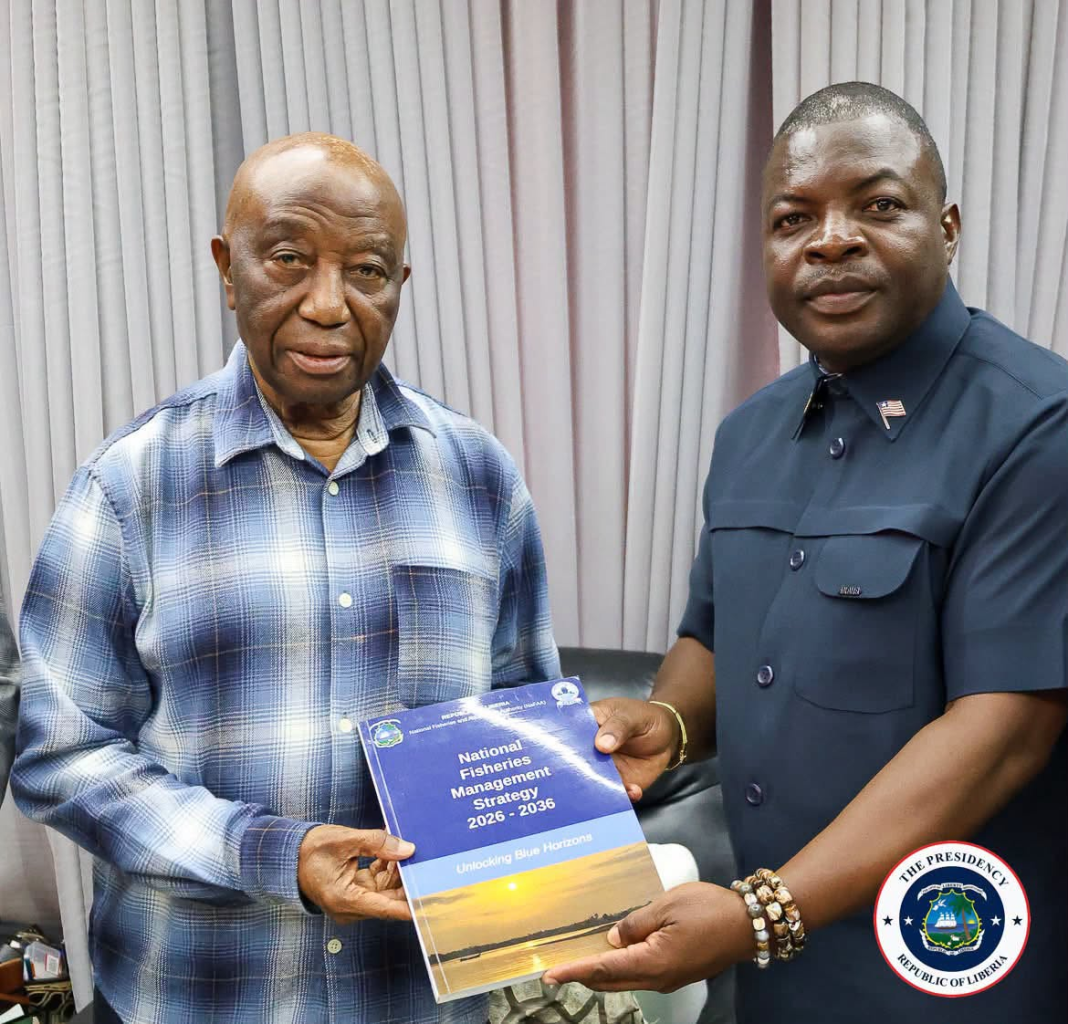
President Joseph Nyuma Boakai Sr. has reaffirmed his administration’s commitment to transforming Liberia’s fisheries and aquaculture sector, endorsing two major policy frameworks designed to guide sustainable growth, attract investment, and strengthen food security over the next decade.
The President made the commitment Monday when the management of the National Fisheries and Aquaculture Authority (NaFAA), led by Director-General Cyrus Saygbe Sr., presented the National Fisheries Investment Plan and Implementation Roadmap Strategy and the National Fisheries Management Strategy 2026-2036 at his Rehab Office in Paynesville.
Receiving the documents, President Boakai commended NaFAA’s leadership for its efforts to modernize the sector and develop a long-term vision aimed at maximizing the economic potential of Liberia’s fisheries resources while ensuring environmental sustainability.
He emphasized the critical role fisheries play in national food security, job creation, and the preservation of marine biodiversity, and pledged his government’s support for initiatives that promote sustainable resource management and expand opportunities for Liberians dependent on the sector.
The two strategic documents outline an ambitious roadmap for fisheries development, focusing on infrastructure expansion, aquaculture growth, resource management, and increased investment. Together, they provide a comprehensive framework intended to strengthen the sector’s contribution to economic development while protecting the marine resources that sustain coastal communities.
According to NaFAA, the National Fisheries Investment Plan identifies the private sector as the primary driver of growth, innovation, and wealth creation within Liberia’s fisheries and aquaculture industry. The accompanying implementation roadmap outlines strategies for converting investment priorities into tangible projects and measurable outcomes.
Meanwhile, the National Fisheries Management Strategy 2026-2036 is the result of extensive technical analysis, stakeholder consultations, and institutional collaboration conducted over the past year. The strategy seeks to balance economic development with responsible stewardship of fisheries resources and marine ecosystems, ensuring that future growth does not compromise sustainability.
During the meeting, NaFAA management also presented its Third Quarter Performance Report, highlighting key accomplishments, ongoing programs, institutional reforms, and priority interventions planned for the coming months. The report provided the President with a broader update on the Authority’s operational progress and strategic direction.
The Authority further briefed the President on preparations for this year’s observance of World Fisheries Day, scheduled for November 21 in Harper City, Maryland County.
The celebration is expected to coincide with the commissioning of NaFAA’s first regional office, a landmark step in the Authority’s decentralization agenda. The new office is intended to bring fisheries services closer to coastal and inland fishing communities while enhancing local engagement and regulatory oversight.
Accompanying Director-General Saygbe to the meeting were Deputy Director-General for Administration Madia H. Peters-Magbollah, Liberia Sustainable Management of Fisheries Project Coordinator Atty. Abraham Dioh, and NaFAA Chief of Staff Ezekiel Allen.
President Boakai’s endorsement of the two strategic frameworks is viewed as a significant boost to NaFAA’s reform agenda and its efforts to build a competitive, investment-driven fisheries sector. As implementation begins, attention will turn to translating policy into action through initiatives that enhance food security, protect marine resources, create employment opportunities, and improve the livelihoods of fishing communities across Liberia.

