

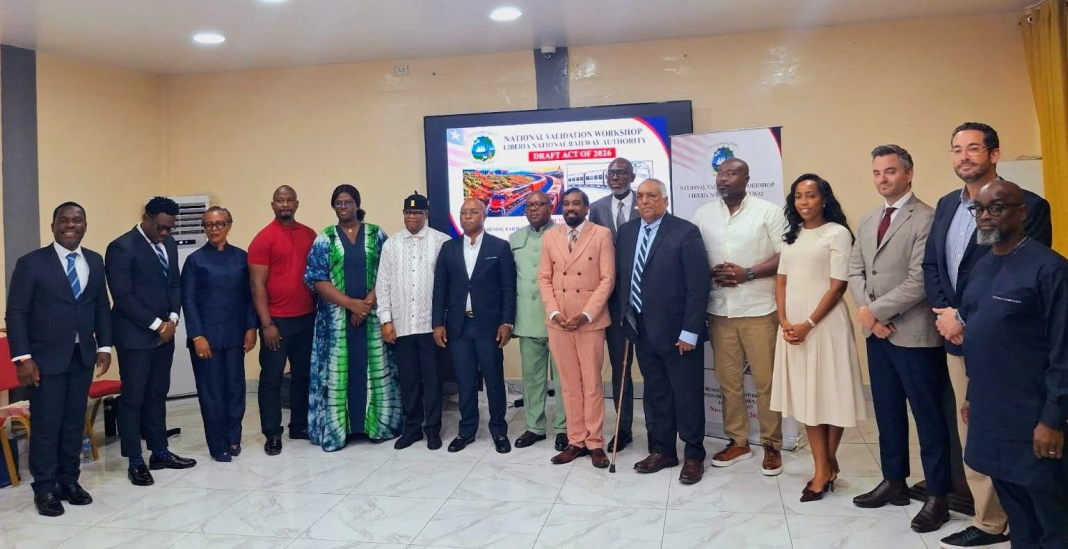
The Government of Liberia has advanced efforts to reform the country’s railway transportation sector following the successful completion of a stakeholder validation exercise on the Draft Liberia National Railway Authority (LNRA) Act of 2026, a landmark piece of legislation aimed at creating a permanent institution to regulate and coordinate access to the nation’s strategic railway infrastructure.
The validation exercise, held at the Ministry of Mines and Energy in Monrovia, brought together government officials, mining companies, railway operators, legal experts, environmental advocates, development partners and representatives of civil society organizations to review and finalize the proposed legislation.
The draft law seeks to establish the Liberia National Railway Authority as an independent statutory body responsible for overseeing railway operations and ensuring transparent, fair and non-discriminatory access to railway infrastructure under a multi-user system.
Participants scrutinized key provisions of the proposed legislation, discussed outstanding concerns and agreed on amendments intended to strengthen accountability, transparency and regulatory efficiency within the sector.
Among those participating in the discussions were representatives of ArcelorMittal Liberia, Ivanhoe Atlantic (HPX), the Liberia Chamber of Mines, the Bureau of Mines and Assistant Minister for Mines Sumo S. Momolu.
Providing an overview of the legislative process, Officer-in-Charge of the National Railway Authority, Ignatius S. Neepaye, said the proposed Act would provide the legal and institutional framework needed to transform the LNRA into a fully operational regulatory authority.
According to Neepaye, the legislation clearly defines the institution’s governance structure, administrative responsibilities and regulatory mandate, particularly in relation to ensuring equitable access to Liberia’s railway network.
He urged stakeholders to contribute constructively to the final document, emphasizing that the objective is to produce a comprehensive legal framework for submission to President Joseph Boakai and eventual consideration by the National Legislature.
Speaking during the exercise, Mines and Energy Minister R. Matenokay Tingban welcomed the country’s transition toward a multi-user railway model, stressing that Liberia needs a credible regulatory framework to attract investment and support sustainable growth in the mining sector.
Tingban said the proposed authority must balance the interests of current and future railway users while promoting economic development, infrastructure expansion and the responsible utilization of the nation’s natural resources.
He noted that a strong regulatory framework would provide investors with greater certainty and confidence by enhancing transparency and predictability within Liberia’s mining and transportation industries.
Also addressing the gathering, Law Reform Commission Chairman and Executive Director Cllr. Bonor Varmah emphasized the importance of creating an institution empowered with meaningful legal authority rather than one that exists only in name.
Varmah said the legislation must contain sufficient safeguards to protect Liberia’s national interests while ensuring accountability and fairness for all stakeholders. He reaffirmed the Commission’s commitment to providing legal and technical support throughout the legislative process.
The proposed reform is rooted in Liberia’s long history of railway development, which has been closely linked to the growth of the iron ore industry. Historical records show that three major railway corridors were constructed during the 1960s: the 145-kilometer Mano River Railway serving western mining areas, the 78-kilometer Bong Mines Railway, and the 267-kilometer Liberia-American Swedish Minerals Company (LAMCO) railway linking Yekepa, Nimba County, to the Port of Buchanan.
Together, the three corridors accounted for nearly 490 kilometers of railway infrastructure. However, years of civil conflict between 1989 and 2003 severely damaged the network and disrupted mining activities, leaving large portions of the railway system abandoned.
The rehabilitation of the Yekepa-Buchanan corridor later paved the way for renewed mining operations, with ArcelorMittal resuming rail transport in 2011.
The government’s latest push for railway reform aligns with broader efforts to maximize the economic benefits of Liberia’s mineral wealth through shared infrastructure and increased private-sector participation.
In October 2025, President Boakai renewed the Executive Order establishing the Liberia National Railway Authority and reinforced its mandate to promote safe, equitable and sustainable access to railway infrastructure. The administration has also called for a permanent statutory authority supported by an internationally informed regulatory framework, transparent multi-user arrangements and robust environmental safeguards.
The strategic importance of railway infrastructure was further highlighted in January 2026 when the Government of Liberia and ArcelorMittal amended their Mineral Development Agreement, extending the company’s concession to 2050 with an option for an additional 25 years. The agreement also guarantees multi-user access to the Tokadeh-Buchanan railway corridor.
ArcelorMittal’s ongoing US$1.8 billion expansion project is expected to boost annual iron ore shipments from approximately five million tonnes to 20 million tonnes, underscoring the growing demand for efficient railway capacity.
If enacted, the LNRA Act is expected to strengthen oversight, improve coordination among railway users and create opportunities for expanded investment in transportation infrastructure, benefiting not only the mining sector but also agriculture, forestry and other freight-dependent industries across Liberia.

