

By E. J. Nathaniel Daygbor
President Joseph Boakai has submitted a proposed US$1.538 billion National Budget for budget year 2027 to the 55th Liberian Legislature, outlining an ambitious spending plan aimed at accelerating economic growth, improving public services, creating jobs and expanding social investments across Liberia.
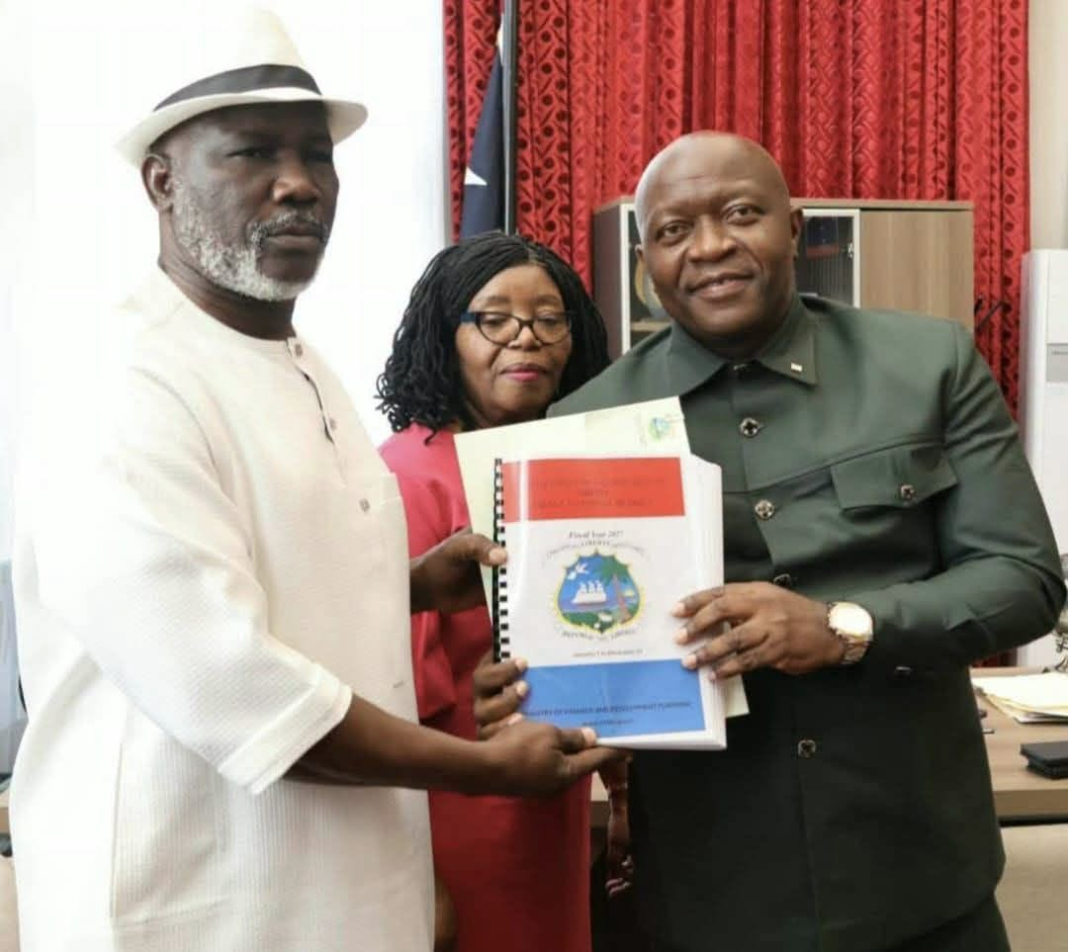
The budget, themed “A Growing Budget for Bigger Impact: Accelerating the Implementation of the ARREST Agenda for Inclusive Development,” was formally presented Friday by Finance and Development Planning Minister Augustine Ngafuan on behalf of the President to House Speaker Richard Koon.
The proposal marks one of the largest fiscal plans in Liberia’s history and reflects the government’s efforts to translate increased domestic revenue into tangible development outcomes. The administration says the spending framework will prioritize healthcare, education, public sector compensation, youth empowerment, women’s economic participation and national infrastructure development.
A key highlight of the President’s budget message is the reported collection of more than US$1 billion in domestic revenue by September 2026, a milestone the government says demonstrates Liberia’s growing capacity to finance national development priorities through internally generated resources.
President Boakai said the achievement provides an opportunity to expand investments in critical sectors while reducing dependence on external financing.
Healthcare remains a central pillar of the proposed budget, with the sector allocation increasing from US$110.9 million in budget 2026 to US$135.8 million in budget 2027, representing a rise of nearly 22.5 percent.
The additional funding is expected to support the expansion of health facilities, recruitment of medical personnel, procurement of essential equipment and improvements in healthcare workers’ compensation.
Among major proposed investments is funding to fully staff, equip and operationalize the newly constructed Redemption Hospital. The budget also earmarks US$5.3 million for the John F. Kennedy Medical Center, including the acquisition of dialysis machines and other medical equipment, while US$15.3 million has been allocated for infrastructure improvements and equipment at Jackson F. Doe Memorial Hospital.
Additional allocations include US$1 million for the Community Pharmacy Program, US$1.5 million for construction of the National Public Health Institute of Liberia headquarters, US$1.5 million for continued work at C.H. Rennie Hospital, and US$800,000 for strengthening Liberia’s Hepatitis B response program.
Education is another major winner under the proposed fiscal plan, receiving US$163.5 million, up from US$143.6 million in FY2026.
The government has proposed US$7 million for continued renovation and furnishing of the University of Liberia, along with US$750,000 for the construction of Grand Kru Technical College and US$700,000 for ongoing modernization efforts at Booker Washington Institute.
Additional support is earmarked for technology-driven learning initiatives, STEM education, examination systems and higher education infrastructure.
Government officials say these investments are intended to improve educational quality, strengthen technical and vocational training and better prepare Liberian students for emerging labor market demands.
According to the budget message, approximately 17,350 individuals are expected to benefit from compensation-related measures, including salary increases for roughly 13,000 existing government employees and payroll enrollment for about 4,350 additional workers and volunteers.
The government plans to standardize salaries for qualified teachers nationwide. Under the proposal, teachers with master’s degrees would receive a minimum monthly salary of US$650, while bachelor’s degree holders would earn US$400. County Education Officers would receive US$1,200, while District Education Officers would earn US$700 per month.
The budget also proposes salary improvements for Liberia National Police personnel, Liberia Drug Enforcement Agency officers and hundreds of health workers across the country.
The government has proposed US$2 million to support commercial motorcyclists, including the construction of designated rest stops, and US$3 million for the Lone Star National Football Team. Additional support is planned for technical and vocational education programs, cadetships, internships and youth organizations.
Meanwhile, the Ministry of Gender, Children and Social Protection is set to receive a 77 percent increase in funding. Key interventions include expanded support for survivors of sexual and gender-based violence, assistance for vulnerable children and greater social protection services.
The budget also allocates US$2.5 million to support small businesses, particularly women-led enterprises, while US$1.4 million is proposed as initial funding Beyond sectoral allocations, the Annual Year 2027 budget underscores the administration’s broader objective of strengthening domestic revenue generation while improving public service delivery.
However, economists and policy analysts note that the success of the spending plan will depend largely on fiscal discipline, transparency and effective implementation.
With the proposal now before the Legislature, lawmakers are expected to scrutinize revenue projections, spending priorities and the government’s capacity to finance its commitments.
President Boakai has urged lawmakers to act expeditiously, describing the budget as more than a financial document. He said it represents a roadmap for improving living standards and accelerating implementation of the ARREST Agenda for Inclusive Development.
Ultimately, the impact of the record US$1.538 billion budget will be judged not by its size, but by its ability to deliver better healthcare, stronger schools, decent jobs and meaningful improvements in the lives of ordinary Liberians.

