

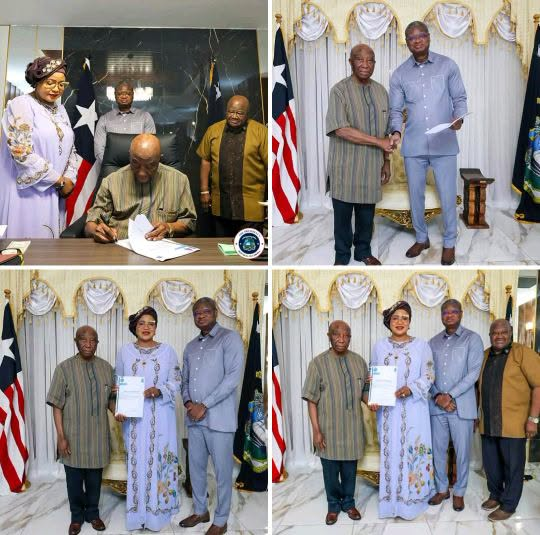
President Joseph Nyuma Boakai has signed the founding Project Charter for Liberia’s proposed Peace, Reconciliation and Memorial Museum, a landmark initiative aimed at preserving the nation’s civil war history, honoring victims and survivors, and deepening efforts toward national reconciliation and lasting peace.
The signing ceremony, held Friday at the Executive Mansion, marks a major step in establishing what is expected to become Liberia’s foremost institution for historical preservation, remembrance, public education and peacebuilding.
The charter provides the legal and administrative framework for the development of the museum and outlines the structures necessary to guide its implementation.
The move comes ahead of the inaugural meeting of the National Steering Committee scheduled for November 16-18, 2026, at the Executive Pavilion in Monrovia. President Boakai is expected to preside over the opening session, while technical delegations from Rwanda and South Africa will participate in discussions and share lessons from their own post-conflict reconciliation and memorialization experiences.
President Boakai signed the charter alongside Minister of State without Portfolio Hadja Mamaka Bility, who chairs the National Steering Committee, and United Nations Development Programme (UNDP) Resident Representative Ambassador Aliou Mamadou Dia, who serves as the committee’s co-chair.
The charter establishes the museum’s mandate, governance structure, leadership arrangements and operational guidelines. It also creates five technical working groups that will focus on critical areas including historical documentation, archives and collections management, governance and legal frameworks, museum design and visitor experience, and public education and engagement.
Speaking during the ceremony, President Boakai emphasized that meaningful reconciliation can only be achieved through an honest acknowledgment of the nation’s past.
“Liberia cannot build a united future on a past it refuses to remember,” the President said.
He noted that the museum will serve as a national repository of memory, preserving the stories of those affected by the country’s conflicts and educating future generations about the importance of safeguarding peace.
“This Museum will keep the memory of what we endured alive, honor those we lost, and teach our children that peace is a choice we must make every day,” Boakai added.
Minister Bility characterized the signing as a national pledge to truth, remembrance and unity.
“Today we have put our names to a promise,” she said, stressing that documenting Liberia’s painful history and building a more cohesive future is a shared responsibility for all Liberians.
UNDP Resident Representative Ambassador Dia welcomed the initiative and praised the government’s commitment to preserving the country’s collective memory. He said the museum would play a critical role in inspiring future generations to uphold peace and learn from the country’s experiences.
International collaboration is expected to play a central role in shaping the project. Experts from Rwanda and South Africa will bring valuable perspectives on memorialization, transitional justice, historical preservation and post-conflict recovery.
The engagement follows a UNDP-supported study visit led by Minister Bility to both countries between August and September 2026. During the mission, Liberian officials visited Rwanda’s Gacaca Archives and the Campaign Against Genocide Museum, as well as South Africa’s renowned Apartheid Museum and Freedom Park.
The experiences gained from those institutions are expected to assist Liberia in developing credible historical records, preserving sensitive archival materials, documenting survivor experiences and ensuring that memorial initiatives contribute to healing and national cohesion.
The proposed museum emerges against the backdrop of Liberia’s devastating civil conflicts, which spanned from 1989 to 2003. The two wars claimed an estimated 250,000 lives, displaced more than one million people, devastated communities and infrastructure, and left deep social and psychological scars across the country.
The conflicts were marked by widespread human rights abuses, massacres, sexual violence, the recruitment of child soldiers and the destruction of public institutions. Although the 2003 Comprehensive Peace Agreement ended the fighting and paved the way for democratic governance and reconstruction, many recommendations from the Truth and Reconciliation Commission, including measures related to memorialization and reparations, remain only partially implemented.
The Peace, Reconciliation and Memorial Museum is expected to help address that gap by serving as a permanent institution dedicated to preserving historical truth and promoting national reflection.
Under the initiative, the museum will collect, preserve and digitize photographs, official records, audiovisual materials and personal testimonies from survivors and affected communities. It will also provide researchers, educators, students and the public with access to reliable information on Liberia’s political evolution, civil conflicts, peacebuilding efforts and post-war recovery.
The project forms part of President Boakai’s broader National Historical Recovery Initiative, launched during Liberia’s 179th Independence Day celebrations in Buchanan in July 2026. The initiative seeks to recover and preserve important historical records while ensuring Liberians take the lead in documenting and interpreting their own history.
For a nation still grappling with the legacy of war, the proposed museum represents more than a repository of artifacts and archives. It symbolizes Liberia’s determination to confront its past, honor the memories of victims and survivors, and ensure that the lessons of its darkest years remain a foundation for peace, justice and national unity for generations to come.

