

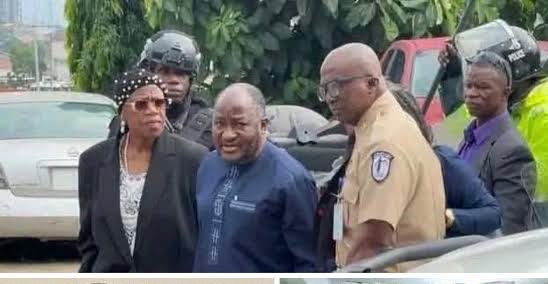
Former Foreign Affairs Minister Dee-Maxwell Saah Kemayah and several co-defendants convicted in the high-profile Saudi rice corruption scandal have announced plans to appeal their convictions and prison sentences to the Supreme Court of Liberia after Criminal Court “C” rejected their motion for a new trial.
The decision was announced on Friday, November 13, shortly after Resident Judge Ousman Feika dismissed the defense’s request to overturn the jury’s verdict and proceeded with sentencing proceedings at the Temple of Justice in Monrovia.
Under the court’s ruling, Kemayah and several co-defendants were sentenced to 10 years imprisonment, while others received five-year prison terms for their involvement in the misappropriation of humanitarian rice donated by the Kingdom of Saudi Arabia to Liberia.
The sentencing represents a significant development in one of Liberia’s most closely watched corruption cases, involving former senior government officials who served under the administration of former President George Manneh Weah.
With the lower court declining to disturb the jury’s verdict, the convicted individuals have now shifted their legal battle to the nation’s highest court, seeking a review of both their convictions and the judicial process that led to the guilty verdicts.
The appeal follows the defense team’s unsuccessful effort to persuade Criminal Court “C” to vacate the jury’s October 9 verdict and grant a retrial.
During arguments presented on November 6, defense lawyers contended that the verdict was contrary to the weight of the evidence introduced during the more than 40-day trial. They argued that prosecutors failed to sufficiently establish the charges against the defendants and maintained that the jury’s conclusions were unsupported by the facts presented before the court.
However, Judge Feika rejected those arguments, ruling that the defense had failed to provide sufficient grounds for a new trial. His decision cleared the way for the court to sentence the convicted defendants.
Defense attorneys have indicated that they will challenge the ruling before the Supreme Court, where they are expected to raise concerns regarding the conduct of the trial, the sufficiency of the evidence, the jury’s findings, and the legal justification for denying their motion for a retrial.
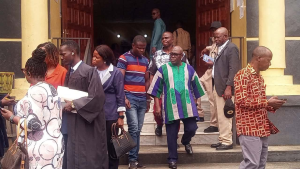
At the center of the case is the handling of 29,412 bags of 25-kilogram rice donated to Liberia in April 2023 by the King Salman Humanitarian Aid and Relief Center of Saudi Arabia. The donation was intended to support disaster victims and vulnerable communities across the country.
Prosecutors alleged that 25,054 bags, valued at approximately US$425,918, were unlawfully diverted from their intended humanitarian purpose. The prosecution argued that the accused officials and associates engaged in the unauthorized handling and distribution of the rice, depriving intended beneficiaries of critical relief assistance.
A total of 13 individuals were prosecuted in connection with the case on charges including theft of property, economic sabotage, misuse of public office, criminal conspiracy, and misapplication of entrusted property.
Following deliberations, the jury returned mixed verdicts on October 9. Eight defendants, including Kemayah and former Internal Affairs Minister Varney A. Sirleaf, were found guilty. Three defendants were acquitted, while the jury failed to reach unanimous verdicts regarding two others.
Throughout the lengthy proceedings, prosecutors sought to establish that public officials and their associates exploited their positions to divert humanitarian aid meant for vulnerable Liberians. Defense lawyers, meanwhile, consistently challenged the credibility and sufficiency of the prosecution’s evidence, arguing that the allegations were not proven beyond a reasonable doubt.
Legal analysts say the appeal process could become another defining chapter in a case that has attracted widespread public attention and has been viewed as a critical test of Liberia’s commitment to accountability and anti-corruption enforcement.
Under Liberian law, the Supreme Court is empowered to review alleged procedural errors, assess whether legal standards were properly applied during the trial, and determine whether the convictions are supported by sufficient evidence. The Court may uphold the convictions, overturn portions of the judgment, order a new trial, or grant other remedies allowed by law.
While the convictions and sentences mark a major victory for state prosecutors and the Asset Recovery and Property Retrieval Taskforce (AREPT), the defendants’ decision to appeal ensures that the legal battle is far from over.
As the matter advances to the Supreme Court, national attention is expected to focus on whether the convictions can withstand appellate scrutiny in a case with far-reaching implications for Liberia’s justice system and anti-corruption efforts.

