

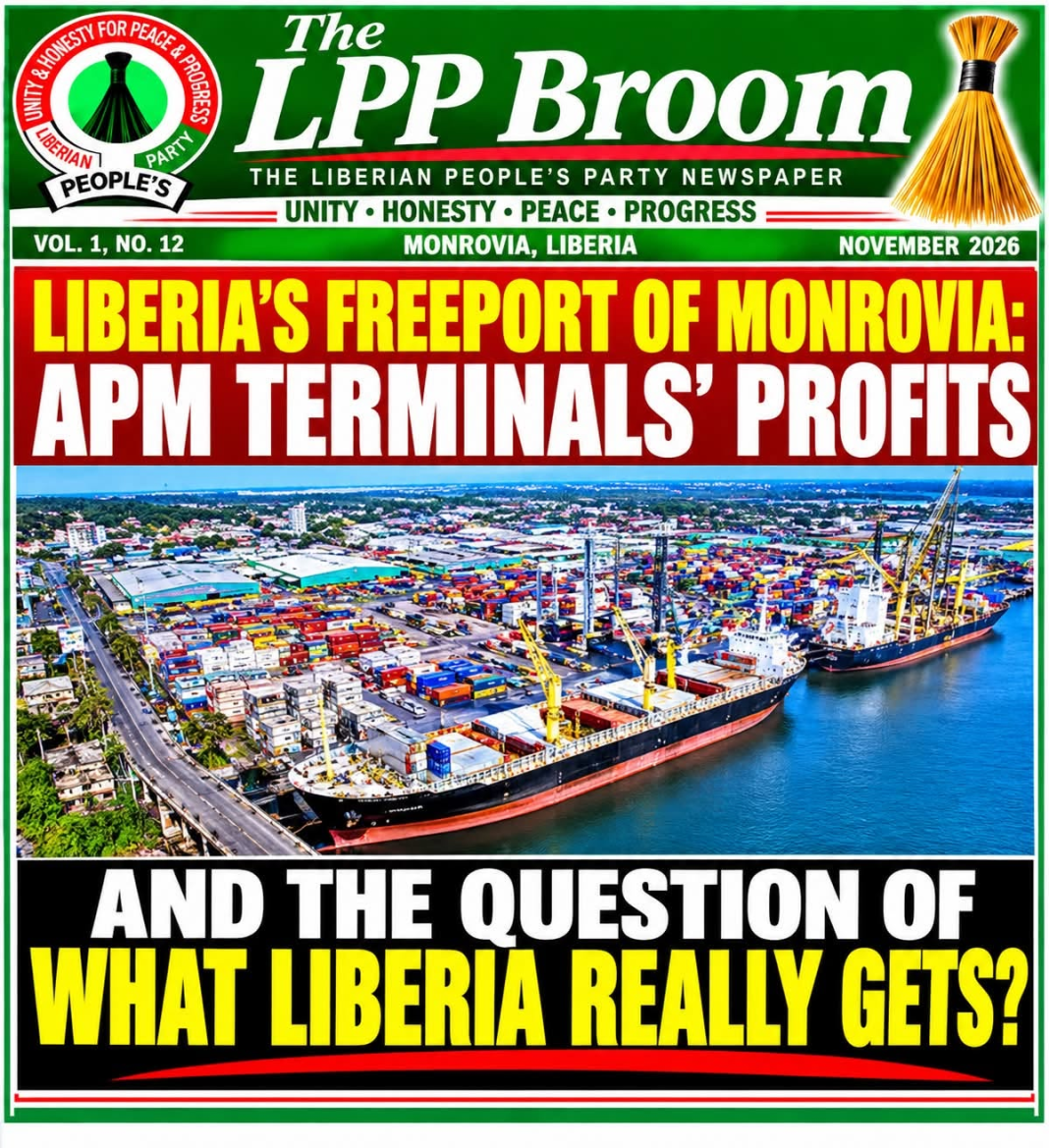
By Cllr. Tiawan Saye Gongloe (political, Liberia People’s Party)
Why Liberia Must Demand Financial Transparency, Fair Revenue Sharing and Accountability from the Operator of Its Principal Seaport.
The Freeport of Monrovia is not the private property of APM Terminals. It is a strategic national economic asset entrusted to a private operator under a concession agreement. Therefore, the fundamental question is not simply how much APM Terminals has invested in Liberia, but how much Liberia has earned from allowing the company to operate its principal seaport for more than 15 years.
The Freeport is the principal gateway for imported rice, petroleum products, medicines, cement, vehicles and other essential commodities. Its efficiency and operating costs directly affect businesses, consumers and the wider economy. Its management must therefore prioritize transparency, accountability and Liberia’s national economic interests.
After more than 15 years of operations, Liberians deserve answers to three fundamental questions: How much has APM Terminals earned? How much has Liberia received? And is Liberia getting a fair return from its national port?
HOW MUCH DOES APM TERMINALS MAKE, AND HOW MUCH DOES LIBERIA RECEIVE?
Under the concession signed in September 2010, APM Terminals committed at least US$120 million to rehabilitate and modernize the Freeport of Monrovia. The company subsequently reported completing a US$125 million terminal upgrade in 2017.
APM Terminals also reports contributing more than US$107 million to Liberia between 2011 and 2020 through concession fees, corporate taxes, employee taxes and land lease payments.
These contributions are significant. However, they do not tell Liberians how much revenue the company generated, its operating costs or its annual net profits.
I have not identified publicly available, independently verified annual net-profit figures for APM Terminals Liberia.
Why should the Liberian people remain unable to establish the actual financial benefits accruing to the country from one of its most important national economic assets?
The Government should demand and publish the company’s audited financial statements, annual revenue, operating expenses, net profits, taxes, concession payments and earnings from auxiliary services.
Liberians deserve to know what their country earns from this arrangement.
THE AUDIT FINDINGS: WHERE IS THE MONEY?
The General Auditing Commission’s May 2021 management letter on the National Port Authority raised serious concerns about the NPA’s ability to independently verify APM Terminals’ reported revenue.
The audit noted that the NPA received monthly summary reports without adequate supporting documents, including invoices, adjustments and credit notes, to independently verify the figures.
Even more concerning was a joint reconciliation that reportedly identified US$29.6 million in auxiliary revenue generated between February 2011 and July 2019 that had not been shared with the NPA.
APM Terminals disputed the amount, putting it at US$25.2 million, and cited provisions of the concession agreement to justify retaining certain auxiliary revenues.
This is a documented financial disagreement, not proof of wrongdoing. Nevertheless, what became of the dispute? Was it resolved? Did Liberia recover any outstanding revenue?
The Government owes the Liberian people an explanation. Public institutions cannot effectively protect national revenue without access to the financial records necessary to verify what private concessionaires report.
MONOPOLY RIGHTS, PORT CHARGES AND THE STRUGGLES OF LOCAL BUSINESSES
The concession granted APM Terminals extensive operational privileges, including exclusivity over certain marine services within a 30-mile radius of the Freeport of Monrovia.
The agreement also provides for tariff adjustments. For February 2026 through January 2027, the company announced a 4.73% increase in selected charges.
Meanwhile, Liberian importers and businesswomen have complained about excessive charges, shipping delays, cargo-clearance difficulties and the rising cost of doing business.
Their November 2026 protests brought these concerns directly to the Legislature and the National Port Authority. Some importers reported that their shipments were delayed for five to seven months, tying up investment capital and exposing their businesses to additional expenses.
These complaints must not be ignored. Local entrepreneurs create employment, pay taxes and support thousands of families. Government must ensure that port operations do not unnecessarily disadvantage Liberian-owned businesses.
A port should facilitate trade, not become an additional obstacle to economic participation.
PORT EXPANSION AND MODERNIZATION MUST SERVE THE NATIONAL INTEREST
Liberia’s port development agenda must go beyond managing congestion and increasing operational capacity. It must create a competitive, efficient and financially accountable maritime sector.
The Government has announced plans involving port infrastructure development, dredging, expansion of container yards and berths, improved logistics and round-the-clock operations. It has also pursued other maritime agreements and partnerships to improve port services and competition.
These initiatives are important. However, infrastructure expansion must be accompanied by financial transparency and effective regulation.
The Government must ensure that every agreement involving public port infrastructure produces measurable benefits for Liberia, including increased government revenue, employment opportunities, lower trade costs and improved services.
IMMEDIATE RELIEF IS WELCOME, BUT STRUCTURAL REFORM IS NECESSARY
The relief measures announced following the November 16, 2026, meeting between the Government and port stakeholders are welcome. They include a 30-day free-storage clearance window for eligible stranded containers under NPA-controlled charges, suspension of certain vessel movement surcharges, 24-hour port operations, additional customs personnel and plans for digital customs payments beginning January 1, 2027.
These interventions may ease immediate difficulties, but they do not resolve the underlying structural weaknesses.
Liberia needs a port system that is transparent, efficient, competitive and affordable. Temporary relief cannot replace enforceable contractual obligations, independent oversight and effective regulation.
WHAT MUST CHANGE IN THE EXISTING APM TERMINALS CONCESSION?
The Government’s review of the existing concession provides an opportunity to address weaknesses in the agreement and strengthen Liberia’s economic interests. This review should not be confused with an extension of the concession period.
I believe the following ten priorities deserve serious consideration:
- Full financial disclosure: Publication of APM Terminals’ audited revenue, expenditure, profits, taxes and concession payments.
- Independent auditing: Unrestricted access for the General Auditing Commission to relevant financial and operational records.
- Fair revenue sharing: A transparent arrangement that protects and improves Liberia’s financial benefits.
- Review of monopoly provisions: Removal or revision of unnecessary restrictions that discourage competition.
- Transparent tariffs: Clear pricing rules and effective government oversight of port charges.
- Operational accountability: Enforceable standards for vessel turnaround, cargo handling, equipment maintenance and container clearance.
- Protection of Liberian workers: Improved employment opportunities, professional training and fair labour practices.
- Infrastructure obligations: Clearly defined responsibilities for dredging, maintenance, marine facilities and port modernization.
- Public reporting: Regular disclosure of concession revenue and operational performance.
- Public and institutional oversight: Appropriate legislative scrutiny and public access to the outcome of the concession review.
These are reasonable requirements for an agreement involving one of Liberia’s most important national assets.
LIBERIA MUST BENEFIT FROM ITS OWN NATIONAL ASSETS
I recognize the importance of foreign investment and the contribution APM Terminals has made to modernizing the Freeport of Monrovia. However, attracting foreign investment must never mean surrendering the responsibility to protect national economic interests.
Liberia needs increased domestic revenue, affordable imports, competitive local businesses, decent employment and improved infrastructure. The Freeport must contribute meaningfully to these national priorities.
The success of this concession cannot be measured solely by the amount APM Terminals says it has invested. It must also be measured by the revenue Liberia actually receives, the quality of port services, the opportunities created for Liberian workers and the impact of port charges on local businesses and consumers.
A company has a legitimate right to earn profits from its investment. But Liberia, as the country providing the national port infrastructure and commercial opportunity, also has a legitimate right to receive a fair return.
The Government must ensure that decisions concerning the Freeport are transparent and that the Liberian people are not excluded from understanding what their country earns from this important national asset.
The Freeport of Monrovia must serve more than the commercial interests of its operator. It must contribute to national development, economic growth and the prosperity of ordinary Liberians.
Our port must work for Liberia. Our national assets must benefit our people.
Government is a place to serve, not to steal. A Better Liberia is Possible.

