

By Aria Deemie
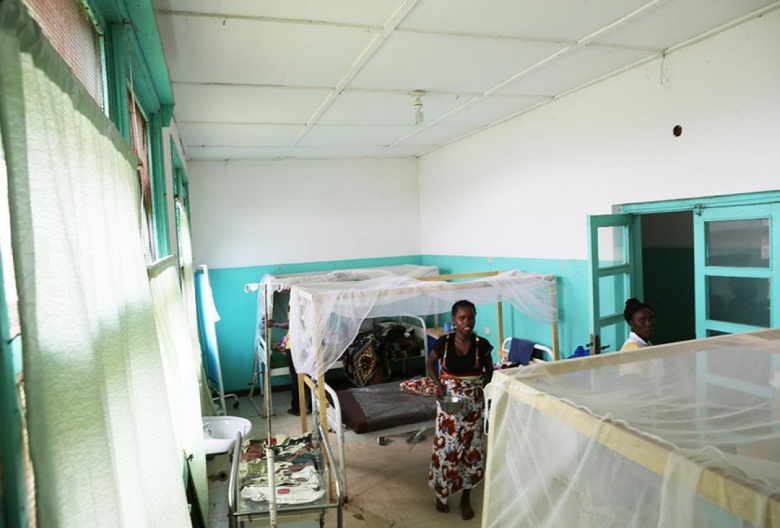
A maternity ward at Pleebo Health Center in Maryland County, Liberia. Photo: Partners In Health.
- Extreme heat can increase health risks for pregnant women and newborns, including dehydration and pregnancy complications.
- Research links heatwave exposure to a 26 percent increase in the odds of preterm birth, or birth before 37 weeks of pregnancy.
- In Liberia, limited electricity, inadequate hospital cooling and gaps in antenatal education leave families with fewer ways to manage extreme heat.
When the electricity went off during her fourth pregnancy, Epangelia Vera-Yah Ndubueze was on bed rest at her home in Thinkers’ Village, along the Roberts International Airport Highway, with the Atlantic Ocean just across the road. But the sea offered little relief from the heat. Without electricity, she struggled to sleep, spending nights on her mattress fanning herself.
“I remember spending my whole night just fanning myself,” she said.
After the community went without electricity for three days, the power failed again on the fourth. Ndubueze walked to the generator site, determined not to return home without power. She said she was wheezing and puffing as she made the journey and stayed there crying until the generator was repaired at about 11 p.m. The following day, she bought her own generator.
“That has got to be literally 24/7 like the worst, the most uncomfortable time of my life, to be honest,” she said.
Her experience raises questions about how pregnant women and newborns in Liberia are coping with rising temperatures. For expectant mothers and new babies, extreme heat can bring additional health risks, while unreliable electricity and limited ventilation may make the heat harder to manage at home and in health facilities.
But there is little systematic data in Liberia showing how heat affects pregnancy and newborn health. It is also unclear how consistently pregnant women are being informed about heat-related risks during antenatal visits.
That concern comes as the World Meteorological Organization (WMO) warns that a strong El Niño is expected to influence weather patterns into 2027. El Niño is a naturally occurring climate pattern involving unusually warm surface waters in the central and eastern tropical Pacific Ocean. It can shift rainfall and temperature patterns in different parts of the world, although its effects vary by location.
WMO Secretary-General Celeste Saulo addressed the issue during a COP31 side event. She explained that the effects of El Niño differ from country to country and are difficult to predict precisely.
“El Niño doesn’t flick a switch. It’s more like a dial that shifts weather patterns around the world. Drier here. Wetter there. Hotter almost everywhere,” she said.
The warning is not that El Niño will produce identical conditions everywhere. Rather, it adds urgency to understanding how changing weather patterns may affect people already exposed to high temperatures and limited services.
In December 2025, FrontPage Africa reported that Monrovia had experienced its hottest dry season on record in 2024, raising concerns about the city’s exposure to rising temperatures and its preparedness for extreme heat. The investigation also examined the health risks of prolonged heat exposure, particularly for pregnant women.
Dr. Dennis Jlaty Blay Jr., a Liberian medical doctor, describes extreme heat as “an emerging but insufficiently recognized threat to maternal and newborn health in Liberia.”
Pregnancy brings physiological changes that can make women more vulnerable to heat stress, particularly when they are dehydrated, physically active or in poorly ventilated environments. In his written response to this reporter, Blay said extreme heat can cause dehydration, disturbances in the body’s salt balance, heat exhaustion and, in severe cases, heatstroke.
Research has also associated high temperatures during pregnancy with increased risks of preterm birth, stillbirth, low birthweight and pregnancy-related high blood pressure disorders.
For newborns, he said, heat-related risks include dehydration, difficulty maintaining a stable body temperature, poor feeding and heat-related illness. Premature and low-birthweight babies are particularly vulnerable because their bodies are less able to regulate temperature.
Evidence relevant to Liberia is emerging, although Blay cautions against treating research associations as proof that heat caused a particular pregnancy complication. The United Nations Children’s Fund (UNICEF), in its Climate Landscape Analysis for Children in Liberia, cites a meta-analysis covering 19 African countries, including Liberia, that found links between extreme heat during pregnancy, pre-eclampsia and low birthweight. Pre-eclampsia is a potentially serious pregnancy complication involving high blood pressure. The report also cites research linking extreme temperatures to macrosomia, or babies born significantly larger than expected.
But the country lacks sufficient hospital-based surveillance to establish how many cases of preterm labor, stillbirth, low birthweight or other complications are directly attributable to heat. Blay said a woman may arrive at a health facility with dehydration, dizziness or contractions and receive treatment without heat exposure being recorded as a possible contributing factor.
In Liberia, the Liberia Meteorological Service issued a heat stress alert in January 2026 covering several parts of the country. The alert identified pregnant women, children, older people and outdoor workers among those particularly at risk of heat-related illness. It advised people to drink water frequently, seek shade and avoid outdoor activity during the hottest hours of the day.
For Ndubueze, the risks do not end with pregnancy. She said her children struggled with heat as newborns and that she avoided covering them with blankets after leaving the hospital.
“Liberia has a very horrible culture where we believe that newborn babies should be wrapped in layers and layers and layers of clothing,” she said.
She described seeing babies dressed in several layers, including rompers, pajamas, socks, shirts and caps, before being covered with thick blankets. Some, she said, were sweating so much that their clothes became soaked. She recalled trying to cover her firstborn with a blanket, after which his skin developed a severe rash.
She believes parents need better information about dressing newborns in hot weather and recognizing when babies are uncomfortable. She also wants health workers and hospitals to address the practice of over-bundling during maternal and newborn health education.
Her concerns are based on her own experiences as a mother, not a clinical assessment of the effects of clothing on newborns. Blay said newborns can experience temperature instability and heat-related illness, and that poor feeding, lethargy, irritability, abnormal temperature and reduced urine output should prompt urgent medical assessment. He cautioned that symptoms such as these can also indicate infection or other medical conditions.
Ndubueze also questioned whether pregnant women are being adequately educated about heat during antenatal visits. She said that during her most recent pregnancy, in January, she did not receive information about heat-related risks.
“I don’t know if they are educating the pregnant women right now,” she said. “But in the past, when we used to go for antenatal, and I mean the past, I’m talking about just January, because I was pregnant in January, we never, we never got educated at all on anything concerning the heat or anything.”
She said antenatal sessions, which can include 30 minutes to an hour of health education, should address heat exposure, maternal health and how to dress newborns. She also wants practical information included in the maternal health handbooks given to pregnant women.
The concern extends beyond household preparedness to the conditions inside health facilities. Ndubueze said electricity and cooling remain important, including in hospitals. “Even in the hospitals, you can barely feel a little air,” she said, adding that she had noticed air conditioning in the delivery room during a more recent visit.
Blay said Liberia’s existing health-system limitations could make it harder to manage complications associated with heat exposure. The Ministry of Health’s 2021 Rapid Emergency Obstetric and Newborn Care Needs Assessment, published in 2022 and covering 106 health facilities, found that only 25.5 percent had a functional fan or air conditioning in the maternity area. The figure was 83.3 percent for hospitals, 21.4 percent for health centers and 10 percent for clinics.The assessment also found that incubators were available in 12.3 percent of all facilities surveyed, including 50 percent of hospitals and 7.1 percent of health centers. Only 10.4 percent of facilities had radiant warmers, equipment used to keep newborns warm.
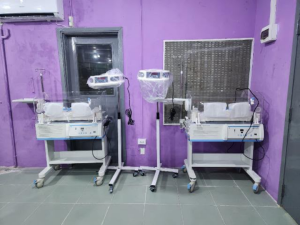
Neonatal incubators at John F. Kennedy Memorial Hospital in Monrovia, Liberia. Photo: The Church of Jesus Christ of Latter-day Saints.
Blay stressed that having an incubator does not necessarily mean a facility has a functional neonatal unit. Caring for premature babies also requires trained personnel, reliable electricity, monitoring, oxygen and respiratory support, feeding expertise and effective referral systems.
A separate study of health facility readiness to provide safe childbirth in Liberia, published in 2022 using facility data from 2018 and birth records from 2019, found that only 18 percent of facilities could provide all six basic emergency obstetric and newborn care functions. Only 8 percent of facilities could provide both caesarean sections and blood transfusions. The study also found that 63 percent of facility births took place in facilities without full basic emergency readiness, while 60 percent of facilities lacked emergency referral capacity.
World Bank data show that 34.9 percent of Liberia’s population had access to electricity in 2024. This means roughly two out of every three Liberians still lack access to electricity. Although the rate has risen from 23.1 percent in 2019, access remains limited. And for households that are connected, an electricity connection does not necessarily guarantee a reliable supply.
Power shortages are a particular concern during the dry season. Liberia depends heavily on hydropower from the Mount Coffee plant, where electricity generation falls as water levels in the St. Paul River decline. The government’s National Energy Compact says generation begins to decline in November, with shortages and outages often worsening between January and May. During this period, Liberia relies more on fuel-powered generation and electricity imports to meet demand.
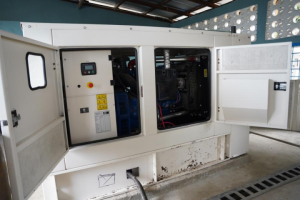
One of the 100 KVA generators provided by Partners In Health to supply backup electricity at Pleebo Health Center in Maryland County, Liberia. Photo by Ansumana O. Sesay.
Unreliable electricity can make it harder for pregnant women and families with newborns to cope with high temperatures, particularly in homes and health facilities with limited cooling options.
For Blay, these weaknesses mean heat should not be treated as a problem that can be addressed simply by telling pregnant women to drink more water. He called for better ventilation, reliable electricity and safe water in health facilities, alongside improved neonatal services, clinical training and stronger referral systems.
He also wants heat exposure included in maternal health risk assessments and climate information integrated into public-health surveillance and early-warning systems. That would help health authorities better understand where heat-related risks are occurring and how they may be affecting pregnant women and newborns.
The issue is receiving greater attention internationally. At COP31 in Antalya, Türkiye, health is one of the priorities of the conference’s Action Agenda under “Dynamic and Resilient Health Systems”. The World Health Organization, WMO, UNICEF and the United Nations Population Fund have also called for improved monitoring of heat-related effects on pregnant women, newborns and children.
A joint framework released in October 2026 by the four agencies introduced the first set of priority indicators to help countries track these health impacts. The agencies cited research associating heatwave exposure with a 26 percent increase in the odds of preterm birth. The figure comes from a systematic review of 198 studies conducted across 66 countries, not from research conducted exclusively in Liberia.
At COP31, UN climate chief Simon Stiell warned that people cannot stay cool when there is no cool place to go. “You can’t ‘stay cool’ when there is no cool place to go,” he said.
For Liberia, that challenge reaches from homes without reliable electricity to health facilities with limited equipment and communities where pregnant women may not receive practical guidance about heat exposure.
Ndubueze said the government should make electricity more widely available and that health facilities, parents and organizations all have a role in raising awareness.
“We don’t have to think that having heatstroke or having heat exhaustion is normal,” she said. “We don’t have to think that, ‘I know we are living in a hot climate, so whatever, it’s normal in Africa.’”
FrontPage Africa also contacted Augustus Sayweh Walker Jr., Head of Communications at Liberia’s Ministry of Health, through WhatsApp calls and messages to seek the Ministry’s response on measures to address heat-related risks to pregnant women and newborns. He had not responded by the time of publication.
This story was produced as part of the COP31 Climate Change Media Partnership, a journalism fellowship organized by Internews’ Earth Journalism Network, Informed Earth and the Stanley Center for Peace and Security.

