

By Junior B. Kessele & Y. Bestman Yarkpawolo, Lofa County
The Ministry of Agriculture has intensified efforts to boost rice production in Lofa County through expanded land development, technical support, and rural road rehabilitation, as part of a broader strategy to strengthen national food security and reduce Liberia’s dependence on imported rice.
At the center of the initiative is a partnership between the Ministry and the Selma Agriculture Development Corporation, which plans to expand rice cultivation to more than 1,000 hectares in 2027. The move is expected to increase domestic food production, create employment opportunities, and strengthen agricultural value chains in the county.
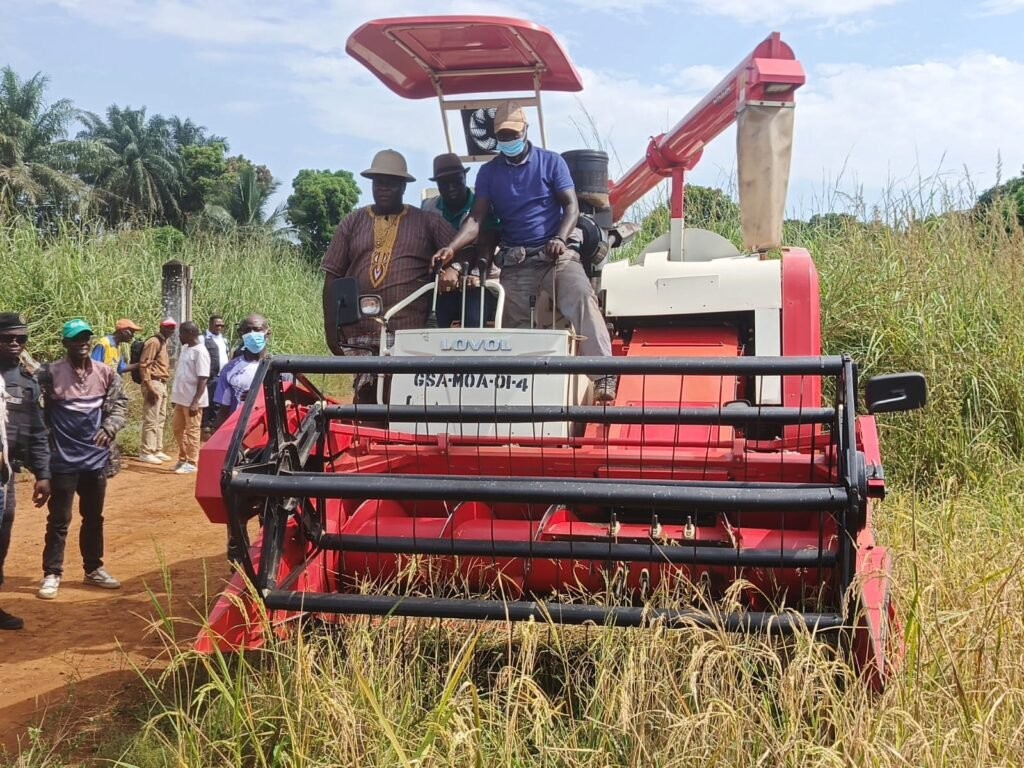
Agriculture Minister Dr. J. Alexander Nuetah announced the expansion plan on November 20 during the official harvest launch at the company’s lowland rice farm in Lisco Town. The farm currently covers approximately 927 acres, or 375 hectares, making it one of the largest rice operations benefiting from government support in Lofa County.
According to the company’s owner, John Selmah, the farm also cultivated an additional 60 hectares of beans and corn during the current farming season.
The harvest ceremony attracted representatives from the International Fund for Agricultural Development (IFAD), the Smallholder Agriculture Transformation and Agribusiness Revitalization Project (STAR-P), local authorities, and residents of nearby communities.
Speaking at the event, Minister Nuetah underscored the importance of increasing local agricultural production to meet national food demands and reduce import dependency.
“We provided support in land development, we also provided some input directly from the ministry, and our project teams that are working with him,” Nuetah said, referring to assistance provided to the farming enterprise.
He noted that the government’s agricultural agenda seeks to attract larger investments capable of significantly increasing production while creating opportunities for farmers, agribusinesses, and rural communities.
As part of the expansion strategy, the Minister said he has directed the Lofa County Agriculture Team to identify and survey additional land suitable for large-scale rice cultivation. Similar instructions have also been issued to agricultural coordinators across the country.
Nuetah said his long-term vision is to increase the availability of locally produced rice in Liberian markets while supporting the growth of successful agricultural enterprises nationwide.
The government’s intervention extends beyond agricultural production. Recognizing that poor road conditions remain a major obstacle to farming activities, the Ministry is supporting the rehabilitation of critical feeder roads to improve transportation and market access.
Under the Tree Crops Extension Project II (TCEP II), funded by IFAD, the government launched the rehabilitation and reconstruction of 18 rural road segments covering more than 144 kilometers across six districts in Lofa County.
The project spans Salayea, Voinjama, Kolahun, Zorzor, Quardu Gboni, and Foya districts and aims to improve mobility, lower transportation costs, and facilitate access to markets and essential services.
Along the Voinjama-Lisco corridor, several road sections are undergoing rehabilitation, including the 6.1-kilometre route from Voinjama Highway to Sekemai Town, the 10-kilometre Sekemai-to-Kpadeh Village road, and the 10-kilometre stretch connecting Kpadeh Village to Kpotomai Town. Rehabilitation of the 9.5-kilometre road linking Zeayorzu Town and Lisco Town is also ongoing.
Although the broader road project was originally scheduled for completion within ten months, construction activities continued in parts of the corridor as of November 2026.
Selmah said improved road access has already delivered significant benefits to his farming operation. He recalled years of transportation difficulties that resulted in substantial losses, including damaged equipment and fertilizer.
“This road was a serious disaster to us. We lost two tractors and over 250 bags of fertilizer dumping in the water,” he said.
He credited the Ministry of Agriculture and its development partners for helping improve road conditions, noting that the upgrades have reduced transportation costs and shortened travel time.
Residents of surrounding communities have also welcomed the rehabilitation works. Gaydoubah Akoi, landlord of Kpademai Town, said the improved roads have transformed access to his community and lowered transportation fares between Lisco and Voinjama.
Another resident, Mulbahyoko Kwa, praised both the agricultural and road development interventions, describing them as beneficial to farmers and local businesses.
With plans to expand rice cultivation beyond 1,000 hectares next year and extend operations into other counties, including Grand Gedeh, the Selma Agriculture Development Corporation is positioning itself as a growing contributor to Liberia’s agricultural sector. Officials say sustained investment in roads, farming inputs, technical support, and market access will be essential to ensuring that rising production translates into lasting economic benefits for farmers and rural communities.

