

By George Kronnisanyon Werner (former education minister)
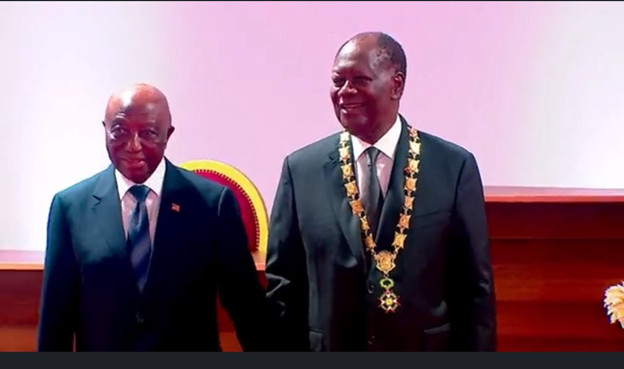
Before our three lessons begin tomorrow, I want to set the scene with what unfolded today in Abidjan — an event too symbolic, too revealing, and too instructive to ignore. President Alassane Ouattara was inaugurated once again, and Abidjan gleamed. Motorcades stretched through manicured streets, presidential jets lined the tarmac, and Africa’s political elite — from ECOWAS, the AU, and beyond — gathered to applaud him.
The ceremony was dignified, the speeches polished, the optics impressive. But beneath the glamour sits a deeper story about power, legitimacy, and the quiet ways leaders encourage one another to bend the rules they swore to protect.
And because we are in the Christmas season, today’s pageantry called to mind a familiar biblical story: the Magi — the so-called wise men — who journeyed far from home to honor a future king. Matthew writes, “Wise men from the East came to Jerusalem” (Matthew 2:1).
They traveled in glory, bearing gifts fit for royalty. Yet their journey existed alongside the sorrow of others. For as they went to pay homage, another king — Herod — reacted with violence. And scripture records the consequence in one of the most haunting lines in the Bible:
“A voice was heard in Ramah, Rachel weeping for her children and refusing to be comforted, because they are no more.” (Matthew 2:18; Jeremiah 31:15)
Watching Abidjan today, it is impossible not to hear Rachel weeping again.
For while leaders traveled to applaud a colleague whose return to power rests on a controversial constitutional interpretation, their own nations were left behind with deep, unresolved pains — youth unemployment, insecurity, corruption, failing schools, broken health systems, widening inequalities.
The wise men of West Africa, like the Magi before them, embarked on a journey of homage while the cries in their own countries go unanswered. But unlike the biblical story, there is no innocence at the center of this gathering — only political convenience.
Côte d’Ivoire has indeed achieved notable progress. No honest observer can deny its growth. But economic success is not a license to stretch constitutional limits. Stability built on legal bending is fragile, even deceptive. And today’s ceremony, attended by presidents who themselves battle questions of legitimacy back home, sends a dangerous message across the region: that as long as your economy performs and donors are pleased, you may reshape your constitution and still receive applause.
This is how democratic erosion spreads. First quietly, then confidently, then openly. Leaders who watched today’s inauguration will take note. They will remember that ECOWAS and the AU, though loud against military coups, remain muted in the face of constitutional coups. They will see that manipulating a term limit draws less condemnation than wearing a military uniform. And they will calculate — carefully — how to extend their own stay in power.
Yet Rachel continues to weep. She weeps in Mali, in Burkina Faso, in Guinea, where constitutional manipulation paved the way for military takeovers. She weeps in Liberia’s slums, in Senegal’s streets after political unrest, in Nigeria’s conflict zones, in Ghana’s frustrated youth centers. She weeps in Côte d’Ivoire itself, where memories of conflict still linger behind the skyline’s beauty. These tears are the region’s moral alarm — a warning ignored at great cost.
Scripture does not spare leaders from accountability. “By justice a king gives a country stability, but those who are greedy for bribes tear it down,” Proverbs warns (Proverbs 29:4). Isaiah denounces those “who make unjust laws” (Isaiah 10:1). Micah reminds rulers that God requires not pomp and ceremony, but justice, mercy, humility (Micah 6:8). Yet today in Abidjan, justice and humility stood outside the gates while power congratulated itself.
This inauguration, then, is more than a national event. It is a regional parable. It reveals a moral contradiction: leaders celebrate stability abroad while neglecting the instability they have tolerated or created at home. They applaud constitutional bending in others while expecting deference from their own citizens. They perform unity on foreign soil while domestic inequalities rot the foundations of their republics.
And the danger is clear: when constitutions bend too far, they eventually break. And when they break, coups find their opening. Seventeen coups and attempted coups since 2020 are not isolated incidents; they are the harvest of seeds sown by decades of erosion in governance, trust, and constitutional fidelity.
So, dear class, before our lessons begin tomorrow, reflect on what you witnessed today. Abidjan’s beauty cannot hide the region’s political cracks. The applause of presidents cannot drown out Rachel’s lament. And if West Africa continues down this path, one dawn soon — just as history has shown us — another calm voice may appear on national radio to announce the familiar words:
“The army has taken responsibility.”
Tomorrow, we begin our deep dive into these themes. But today stands as the prologue — the scene-setter — for the story we must examine with honesty.

