

By George K. Werner (former education minister)
Liberians do not always wait for economists, Central Bank bulletins, or radio talk shows to know whether the economy is improving or worsening.
They know at dawn.
They know from the price of the morning bowl.
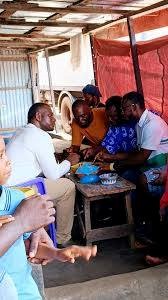
Before government ministries open their gates, before schools ring their bells, before the first cement mixer turns at a construction site, the lappa be doors are already alive. Coal pots glow in the half-light. Rice steams in aluminum pots. Greens, beans, gravy, fish soup, and pepper broth simmer behind curtains of cloth and zinc. These humble roadside food stalls — often partitioned by pieces of lappa cloth that give them their name — are among the most honest institutions in Liberia.
This is where the nation first reads itself.
Around ministries, civil servants gather before the day’s files and meetings begin. Near schools, teachers, students, and support staff take their first meal before classes. Around construction sites, masons, welders, and laborers strengthen themselves before the first block is laid. In poor communities, where time, fuel, or income may not allow every household to cook at dawn, the lappa be door becomes the neighborhood kitchen.
This is not merely street food.
This is social infrastructure.
A cooked bowl in Liberia is one of the most democratic spaces in the country. Taxi drivers, civil servants, market women, fishermen, students, and laborers stand side by side under the same zinc roof, eating from the same pot. For between L$150 and L$250, one can have breakfast rice with greens, beans, gravy, fish, or soup, depending on what ingredients are available and what the day’s budget can bear.
That price tells a story.
Long before inflation figures are released, before exchange-rate analyses are discussed on radio, ordinary Liberians already know the truth from the bowl. The civil servant on a fixed salary notices immediately when yesterday’s L$150 breakfast becomes L$200, then L$250. The construction worker paid by the day feels it before noon. The teacher supporting a family recalculates the week’s budget on the spot.
In Liberia, the morning bowl is the people’s first economic report.
A rise in the price signals that something deeper is happening. Rice costs may be increasing. Fuel prices may have gone up. Charcoal may be more expensive. Transport fares may be squeezing the vendor’s margins. Imported ingredients may be reacting to movements in the exchange rate.
Even when the price remains unchanged, Liberians notice when the quantity shrinks.
If the fish portion becomes smaller, people talk.
If the rice is less than yesterday, people notice.
If the beans are thinner, people begin to worry.
This is where macroeconomics meets lived reality.
Under zinc roofs and behind lappa curtains, the nation conducts its own daily economic analysis. People may not use technical terms like inflation, consumer price index, or exchange-rate pass-through, but their conclusions are often sharper than those found in formal reports.
If the bowl price holds steady, there is relief.
If the price rises while salaries remain fixed, anxiety spreads.
The lappa be door becomes both canteen and policy forum.
And at the heart of this institution are women.
Like the women who dominate the fisheries trade along Liberia’s Atlantic coast, women are the backbone of the cooked bowl economy. They rise before sunrise, light the coal pots, wash the rice, prepare the greens and beans, and by first light have already fed an entire neighborhood.
Along the coast, fishermen at dawn often get their first meal from the women before going to sea or immediately upon returning. The same women may later manage the sale of the fish when the canoes come in.
The day begins and ends in women’s hands. This is care. This is entrepreneurship. This is survival.
The origins of the cooked bowl may not be formally documented, but its roots are unmistakably Liberian. It emerges from our deep rice culture, from women’s enterprise, and from the practical needs of a society where labor begins early and income is often fragile.
It is a people’s institution.
Not created by policy.
Not legislated by decree.
Born instead from necessity and care.
Workers needed to be fed.
Women needed to earn.
Communities needed affordable food.
And so, the institution emerged.
That is why the cooked bowl remains one of the most honest mirrors of national life.
Sometimes the truest measure of a country’s economy is not found in official statistics.
Sometimes it rises in steam from a bowl at dawn. Liberia reads its economy every morning — one cooked bowl at a time.

