

By T. Prince Mulbah | The DayLight
When Chief Anthony Flomo joined his townspeople in May 2020 to sign a memorandum of understanding (MoU) with Golden Trip Group Limited, hope filled the air in Kpeteyea, a town in the Gbalin Clan of Salayea District, Lofa County.
The five-year deal promised US$900 in monthly payments, scholarships, and a paved road with concrete bridges. For the first time, residents believed their nightmare of bad roads, unsafe drinking water, and limited education opportunities was ending.
But the optimism quickly soured. What the townspeople did not know was that Golden Trip carried a trail of irregularities. Between the signing and the community’s realization, the company dug giant pits, polluted watercourses, allegedly defaulted on community benefits, and evaded tens of thousands of dollars in taxes. The dream of development collapsed into a nightmare of environmental destruction and betrayal.
Golden Trip was incorporated in April 2018, owned 75 percent by Chinese national Chein Haibin and 25 percent by Liberian businessman Randy Scott. In February 2020, it applied for a medium-scale mining license covering 98.3 acres in Salayea District. The license was approved three months later. Yet by 2024, the Ministry of Mines placed the license under review, leaving its legality in limbo.
Suspicion grew when Scott allegedly refused to present documents to locals, who discovered multiple companies claiming the same gold mine. Arthur Quiah, then the district’s mining agent, investigated and shut down Golden Trip’s operations, citing expired and falsified documents. “Their document was not proper, and the false one expired,” Quiah told The DayLight. Scott dismissed the accusation as lies, insisting the ministry continued to send him communications.
The people of Kpeteyea say Golden Trip owes them US$8,100 in unpaid dues, two hand pumps, a guesthouse, three bridges, and a renovated school building. “I swear these people lied to us,” Chief Flomo lamented. “If they cannot pay our US$8,100 and implement the projects, nobody will take any machine from here.” The community has seized Golden Trip’s equipment until debts are settled.
Scott denies the claims, calling them “nonsense.” He now says he has moved from the area, claiming the government issued the license to another company. Yet no record of such a company exists.
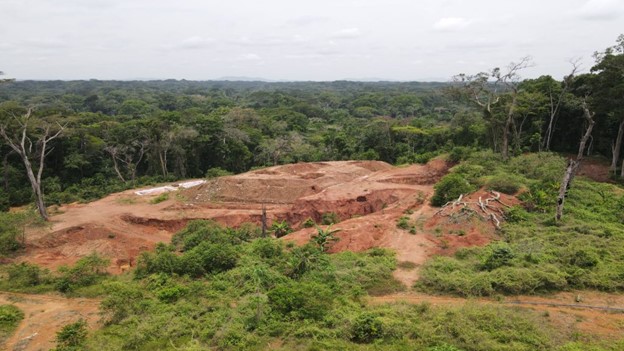
Reporters documented Golden Trip’s mining footprints: massive open pits, locally dubbed “bogeyman holes,” notorious for collapses that have killed miners nationwide. Muddy water from the pits flowed into the Wainda River, which feeds the St. Paul River—a vital source of drinking water. Farmers reported dead fish floating along the riverbank, consistent with cyanide poisoning. “We advised citizens not to use the water,” Chief Flomo said.
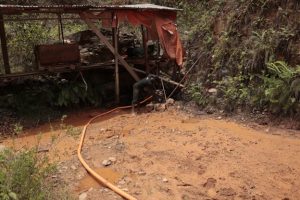
Scott dismissed the pollution claims as “lazy arguments,” insisting the pipes seen in the river were only used to fetch water for his camp. He denied leaving behind dangerous pits, claiming he mined a mountain instead. “You can’t cover a mountain,” he argued. But Liberia’s mining law requires companies to restore land and watercourses to their original state—no exceptions.
Golden Trip’s production remains shrouded in mystery. Official records show no mineral exports, and Scott insists the company found no gold. Yet locals tell a different story.
“Then why were trucks and Land Cruisers moving day and night?” asked youth leader Charles Vesselee. “Those guys carried minerals from here.” Residents recall Chinese and Liberian workers digging pits and piling gravel, with four Chinese teams mining under Golden Trip’s name.
Between 2021 and 2023, Golden Trip brought 16 foreign workers into Liberia without proper work permits. The Ministry of Labor confirmed only one had a valid permit. Immigration records showed no trace of the workers. Some residential statuses were renewed irregularly, raising questions about oversight.
Golden Trip also failed to renew its mining license from 2021 until its closure in 2024. It did not pay for environmental permits, evading tens of thousands of dollars in fees. Official records further revealed that majority shareholder Chein Haibin neither lived nor worked in Liberia, violating mining law requirements for foreign ownership.
For Kpeteyea, Golden Trip’s legacy is one of betrayal. The promised scholarships, bridges, and safe drinking water never materialized. Instead, the town was left with polluted rivers, dangerous pits, and unpaid dues. “Golden Trip really surprised me,” Chief Flomo reflected bitterly. “We thought our children would sit in modern classrooms with safe drinking water. Instead, we were deceived.”
The company’s collapse underscores broader failures in Liberia’s mining sector—weak enforcement, corruption, and disregard for community rights. Golden Trip’s story is not unique; it mirrors a pattern of exploitation where companies extract wealth while leaving behind devastation.
Golden Trip’s saga raises urgent questions about Liberia’s governance. Why did the Ministry of Mines allow operations despite expired documents? Why were illegal workers permitted? Why were environmental laws ignored? The answers point to systemic failures in oversight and accountability.
Liberia’s mining law provides for fines and prison terms for illegal operations, yet enforcement remains weak. Communities like Kpeteyea are left to fend for themselves, seizing equipment and demanding restitution. Without stronger institutions, the cycle of exploitation will continue.
Golden Trip’s rise and fall is a cautionary tale of promises betrayed, laws ignored, and communities abandoned. It highlights the urgent need for reform in Liberia’s mining sector—stricter enforcement, transparent licensing, and genuine community benefits. For Kpeteyea, the scars of Golden Trip’s operations remain etched in polluted rivers and death-trap pits. For Liberia, the lesson is clear: without accountability, mining will remain a curse rather than a blessing.
As Chief Flomo sits under the tree where the MoU was signed, his words capture the community’s disillusionment: “We thought it was a new day for us. But Golden Trip lied.”

