

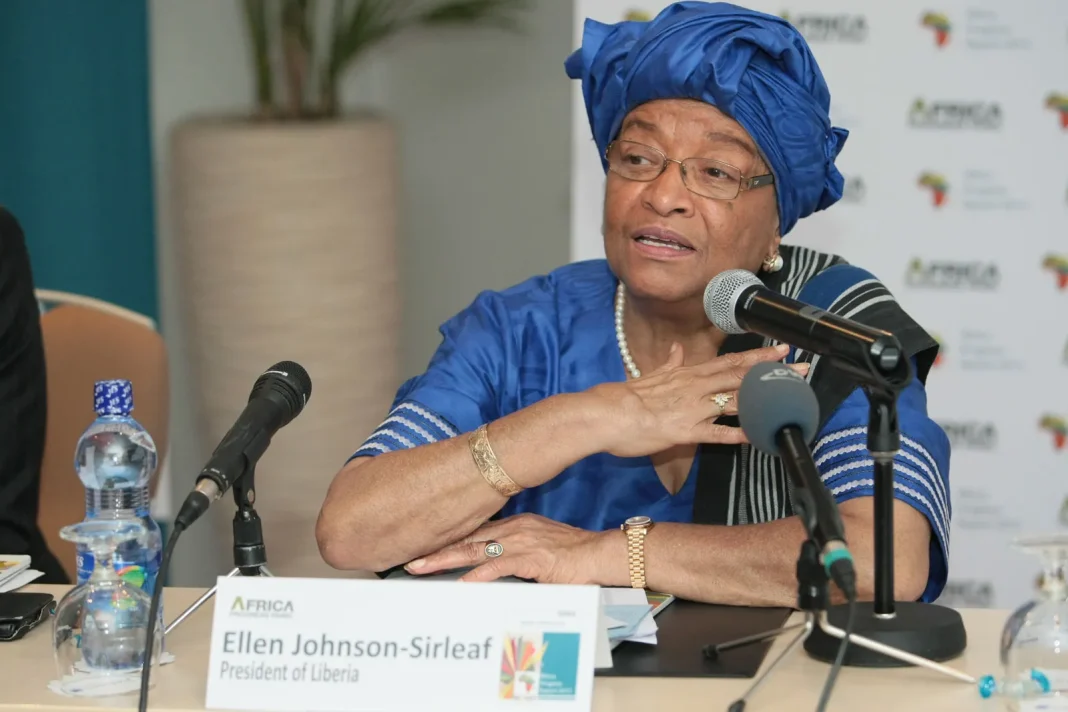
Former Liberian President Ellen Johnson Sirleaf has waded into one of the country’s most heated political controversies, sharply questioning the expulsion of outspoken lawmaker Yekeh Kolubah and warning that such actions risk undermining Liberia’s fragile democratic principles.
In her first public remarks on the matter, Sirleaf—Africa’s first elected female head of state and Nobel Peace Prize laureate—argued that freedom of expression must remain a cornerstone of governance, even when it unsettles those in power.
“I don’t think someone should be overly disturbed when people say things,” she stated. “I certainly do not think it should be a reason for someone to bear such a penalty. Freedom of speech is something that we must respect. That’s what makes good governance.”
Kolubah, known for his fiery rhetoric and confrontational style, has long been a polarizing figure in Liberian politics. His removal from legislative proceedings, reportedly tied to remarks deemed disruptive, has sparked a national debate. Supporters of the expulsion insist it was necessary to preserve decorum within the legislature, while critics denounce it as politically motivated and a dangerous precedent for silencing dissent.
Sirleaf’s intervention appears to align with the latter concern. Without directly attacking current authorities, she suggested that punitive measures should not be the default response to controversial speech. “There are other ways to curb that,” she noted, hinting at alternatives such as mediation, censure, or internal disciplinary dialogue.
Liberia, Africa’s oldest republic, has spent the past two decades rebuilding democratic institutions after 14 years of civil war. Since the end of conflict in 2003, the country has held multiple peaceful elections, including the historic 2005 poll that brought Sirleaf to power.
During her presidency (2006–2018), Sirleaf championed governance reforms and civil liberties, strengthening press freedom and reducing state interference in public discourse. International watchdogs have since ranked Liberia in the middle tier globally for press freedom—reflecting progress but also persistent challenges.
Referencing that legacy, Sirleaf reminded the public that her administration laid the groundwork for freer expression. “During my time, we took steps to ensure the independence of freedom of speech,” she said, underscoring the importance of tolerance in democratic systems.
The Kolubah episode highlights a dilemma faced by democracies worldwide: how to reconcile the right to free expression with the need for institutional discipline. Parliamentary systems often impose sanctions for disorderly conduct, but critics warn such measures can be weaponized to suppress dissent—especially in emerging democracies where checks and balances remain fragile.
Political analysts note that while freedom of speech is constitutionally guaranteed in Liberia, it is not absolute. Laws and parliamentary rules set boundaries, particularly in spaces meant to uphold professionalism and national representation. Yet Sirleaf’s remarks raise a critical question: where should the line be drawn?
Coming from a figure of Sirleaf’s stature, the statement carries symbolic and political weight. Observers suggest her intervention could influence public opinion and pressure lawmakers to revisit the decision or clarify disciplinary standards.
Her comments resonate beyond Kolubah’s case, touching on deeper issues of Liberia’s democratic maturity, institutional resilience, and commitment to civil liberties. For many, the controversy is not just about one lawmaker—it is about whether Liberia’s democracy can tolerate dissent without resorting to heavy‑handed tactics.
As Liberia continues its post‑war democratic journey, Sirleaf’s warning reverberates with urgency. A democracy, she implied, is not measured by how it handles agreement but by how it tolerates dissent.
The expulsion of Kolubah may fade as a political episode, but the questions it raises—about freedom, governance, and the boundaries of speech—will linger. And in Sirleaf’s words, the message is clear: freedom of speech is non‑negotiable.

