

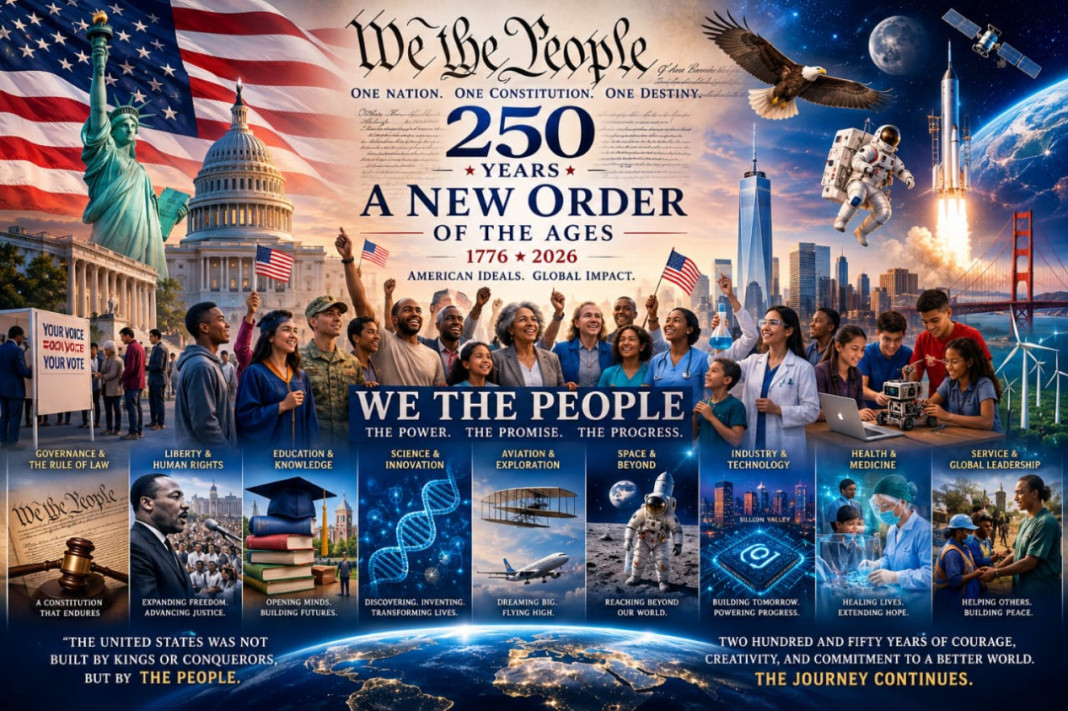
In 1776, a political experiment emerged that would alter the architecture of global governance. The United States of America declared that sovereignty rested not in monarchs, but in “We the People.” As the nation marks its 250th anniversary in 2026, its founding stands as one of history’s pivotal moments — not as an isolated rupture, but as a profound synthesis of ancient inheritances and modern political imagination.
Like the Hebrews who proclaimed moral law and covenantal brotherhood;
like the Greeks who pioneered participatory citizenship;
like the Romans who refined republican governance;
like the Egyptians who engineered durable systems of administration;
and like the Chinese whose innovations — including paper and printing — enabled the preservation and transmission of knowledge —
America did not invent civilization. It absorbed, reinterpreted, and recombined it.
Ancient Roots, Modern Synthesis
The American founding drew deeply from earlier traditions:
- Hebraic moral universalism informed the conviction that all persons stand equal before a Creator.
- Greek democracy, particularly in Athens, shaped ideals of civic participation.
- Roman republicanism influenced constitutionalism, separation of powers, and the rule of law.
- The administrative durability seen in ancient civilizations demonstrated the necessity of enduring institutions.
- Chinese technological innovation made literacy, record-keeping, and constitutional culture scalable across generations.
Drawing upon Enlightenment philosophy — particularly the social contract theory of John Locke and the separation of powers articulated by Montesquieu — the founders translated ancient political wisdom into modern constitutional form.
The result was neither wholly ancient nor entirely novel. It was synthesis.
A ‘New Order of the Ages’
On the Great Seal appears the Latin phrase Novus Ordo Seclorum — “A New Order of the Ages.” The declaration was not a rejection of history, but the inauguration of a new political principle: that legitimate government derives from the consent of the governed.
The language of 1776 would travel far beyond Philadelphia. In 1945, during Vietnam’s struggle for independence, Ho Chi Minh opened his declaration by invoking the American assertion that “all men are created equal.” Across continents, the grammar of self-determination drew strength from that revolutionary articulation — even when American practice struggled to match American promise.
Paradox and Progress
The American story is not free from contradiction.
Slavery coexisted with liberty.
Racial segregation contradicted equality.
Indigenous nations were displaced in expansion’s wake.
Yet the presence of articulated ideals — written, codified, and proclaimed — made reform possible. Abolitionists, suffragists, civil rights leaders, and advocates of broader inclusion did not reject the founding; they appealed to it.
The republic’s strength has often lain not in perfection, but in its capacity for self-correction.
Global Influence and Innovation
The American constitutional model influenced postwar reconstructions in Europe and Japan, democratic development in parts of Asia, and constitutional movements across the world.
Beyond political architecture, the American experiment propelled revolutions in science, industry, aviation, medicine, and digital technology that reshaped the global economy and compressed the distances between nations.
Its universities, laboratories, and industries became engines not merely of national prosperity, but of global transformation.
A Dialogue Across Oceans
The American experiment did not remain confined to its shores. Its reverberations were felt even on the West African coast, where another republic would rise in dialogue with its founding ideals — linked by history, migration, and a shared vocabulary of constitutional aspiration.
Thus, 1776 became not only an American date, but a chapter in a broader Atlantic story.
The Present Horizon
Two and a half centuries later, humanity faces challenges that transcend borders: climate instability, nuclear proliferation, technological disruption, shifting populations, and persistent conflict.
No single nation can resolve these alone. Yet the enduring principles of constitutional order, institutional resilience, free inquiry, and civic participation remain indispensable tools for navigating a fragile century.
If the 18th century question was whether self-government could endure, the 21st century question is whether free nations can cooperate without surrendering their sovereignty.
Conclusion
At 250 years, the United States stands neither as flawless model nor failed promise, but as an ongoing argument — a republic still in conversation with itself and the world.
Its genius lies not in perfection, but in aspiration.
Not in uniformity, but in pluralism.
Not in rigidity, but in adaptive reinvention.
A new order of the ages was declared in 1776.
Two and a half centuries later, the work remains unfinished — and therefore alive.
Biographical Note

Prof. Kettehkuehn E. Murray, Ph.D., is a Liberian writer and civic voice whose work engages questions of constitutional order, historical continuity, and moral philosophy. Drawing upon African intellectual traditions and Western political thought, he examines the interplay between heritage and modern governance. As an Americo-Liberian, his reflections often consider the shared historical currents linking Liberia and the United States within the broader narrative of republican development.

