

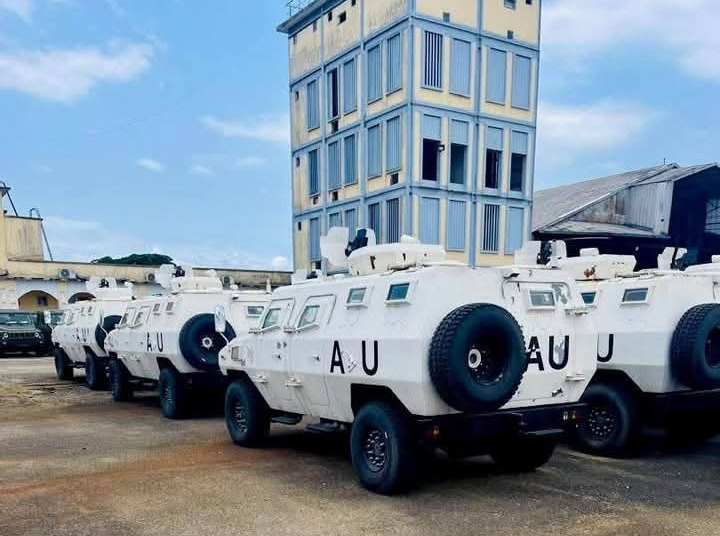
A plan to transfer nearly $43 million worth of equipment from the African Union’s Continental Logistics Base (CLB) in Cameroon to Liberia, Sierra Leone and The Gambia could cripple the continent’s African Standby Force (ASF) and deplete more than half of its strategic deployment stockpile, an internal AU report warns.
The report calls for an urgent audit of the base’s management and decision-making, questioning whether the proposed transfers comply with AU peace and security doctrine and warning that they could weaken one of Africa’s key collective security assets.
At the center of the dispute is the CLB, a strategic facility established to support the rapid deployment of AU peace support operations.
Created as part of the ASF architecture, the base was designed to maintain sufficient strategic deployment stocks to enable the AU to simultaneously launch a major multidimensional mission involving more than 5,000 personnel and two smaller operations.
The facility also supports humanitarian responses and provides logistical assistance to the Africa Centres for Disease Control and Prevention (Africa CDC).
The report raises questions about decisions taken by officials within the AU’s Political Affairs and Peace and Security Department.
It alleges that officials overseeing the base approved transfers benefiting countries linked to personnel managing the facility and calls for an independent audit to determine whether conflicts of interest existed.
Strategic assets according to the report, equipment held at the base is valued at $77.6 million.
Much of the inventory was acquired through donations from strategic partners, including a $30 million contribution from China in 2018 and a second consignment worth $63 million in 2023. Türkiye also donated generators and mobile field kitchens valued at about $750,000.
The controversy stems from plans to transfer equipment valued at $21.3 million to Liberia, $9.6 million to Sierra Leone and $12.1 million to The Gambia.
Combined, the proposed transfers would amount to nearly $43 million, representing more than 55 percent of the base’s total assets.
The report argues that such a reduction would leave the CLB incapable of fulfilling its core mandate.
“If they were to be concluded as they stand, the total donations to these three countries would amount to $42.9 million,” the report states, warning that the transfers would “render the Base inoperable” by drastically reducing its stocks.
Doctrine questioned the implications extend beyond the facility itself.
The African Standby Force has long been promoted as the cornerstone of Africa’s ambition to respond rapidly to conflicts without relying excessively on external actors.
Although the ASF has struggled to achieve full operational capability since its creation more than two decades ago, the logistics base in Cameroon has been regarded as one of its most tangible achievements.
The report notes that the CLB reached Initial Operational Capability in 2019 and was progressing towards full operational status before the current dispute emerged.
It also questions the rationale for transferring continental assets directly to member states.
AU officials cited in the report argued that the equipment was intended to strengthen the logistical capacity of the recipient countries and improve their readiness for future peace support operations under the ASF framework.
However, the report challenges that interpretation, arguing that ASF doctrine does not provide for direct donations of AU-owned strategic equipment to member states under such circumstances.
Instead, it says, countries participating in the ASF are expected to provide and maintain their own equipment for deployment, with periodic evaluations conducted at the regional level.
The report also expresses concern that some of the proposed transfers involve military equipment, including heavy machine guns, ammunition and armoured assault vehicles.
- The East African

