

By Festus Poquie
Liberia’s government is projecting a sharp increase in tax collections to finance a proposed $1.54 billion budget for 2027, placing a greater share of the cost of running the state on domestic taxpayers as the economy struggles with widespread poverty and limited productive capacity.
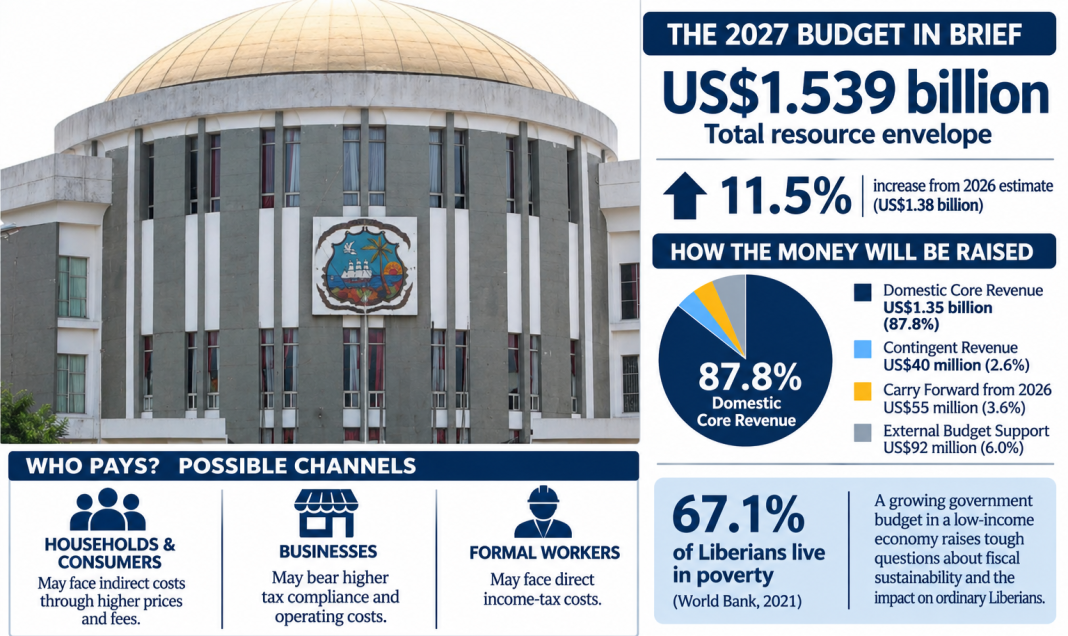
The draft budget, prepared by the Ministry of Finance and Development Planning, forecasts a resource envelope of $1.539 billion, up 11.5% from the estimated 2026 outturn of $1.38 billion and 18.1% above the approved budget of $1.30 billion.
Domestic core revenue is expected to contribute $1.35 billion, or 87.8% of the proposed budget, making local revenue collection the principal source of government financing. Another $40 million is classified as contingent revenue, while $55 million is expected to be carried forward from 2026 and $92 million provided through external budget support.
The financing structure signals a growing reliance on revenue raised within Liberia rather than external assistance, shifting more responsibility for funding government operations onto businesses, workers and consumers.
That dependence comes with significant economic risks. Liberia’s tax base remains constrained by low household incomes, a large informal economy and limited domestic manufacturing, leaving a relatively narrow pool of formal businesses and salaried workers to support an expanding public sector.
The World Bank estimated that national poverty reached 67.1% in 2021, based on its poverty nowcasts, after standing at 50.9% in 2016. The figures underscore the difficulty of expanding tax collections in an economy where a large share of households have limited capacity to absorb additional costs.
The government is banking on a transition from the Goods and Services Tax to a Value Added Tax system to improve collections, arguing that stronger controls against under-declaration will generate additional revenue without increasing statutory tax rates.
It also expects income and trade tax receipts to grow through stronger economic activity, improved compliance, electronic billing and more efficient communication of tax obligations.
But the projected revenue growth raises questions about how much additional pressure businesses and consumers may face as the government seeks to collect more money from an economy that remains heavily dependent on mining, imports and relatively low-productivity activities.
Tax reforms expected to drive collections
To support the revenue target, the administration is proposing amendments to the Liberia Revenue Code that would expand enforcement powers and modernize tax administration.
Among the measures are a minimum excise tax on digital financial services, revised penalties for tax violations, new methods for valuing real estate and expanded electronic invoicing and customs controls.
The proposed VAT transition is central to the revenue strategy. The government says the system will make it harder for businesses to understate sales and tax liabilities, improving compliance and collections.
Rice and petroleum products will remain outside VAT, with petroleum continuing to attract existing volume-based taxes and levies. The exemptions are intended to limit the risk of higher consumer prices from the tax reform.
However, the introduction of new levies and tighter compliance requirements could increase operating costs for businesses, particularly smaller enterprises already facing financing and infrastructure constraints.
Government obligations compete with development spending
The pressure to mobilize more revenue comes as a substantial portion of the proposed budget is assigned to government obligations.
The newly established General Obligations and Programs sector receives $419.65 million, representing 27.3% of the national budget. It covers debt servicing, statutory transfers, NASSCORP payments and national programs, including proposed support for small businesses and motorcyclists.
The reclassification separates these obligations from spending directly associated with individual ministries and agencies, although it also highlights the scale of resources committed to maintaining government operations and meeting existing financial commitments.
The budget also provides $328.49 million for recurrent and non-PSIP capital expenditure, equivalent to 21.3% of the total, to sustain government operations and ongoing priorities.
Meanwhile, agriculture receives just $18.4 million, or 1.2% of the budget, while industry and commerce gets $24.6 million, or 1.6%.
The relatively small allocations to these productive sectors raise questions about how quickly Liberia can expand the economic activities needed to generate more jobs, increase household incomes and broaden the tax base.
Development partners offer limited budget relief
External assistance is projected at $287.4 million in 2027, comprising $99.8 million in grants and $177.6 million in concessional loans.
However, only $92 million is expected to flow directly into the national budget. The remaining $195.4 million will finance development programs outside the central budget.
The difference here is that concessional loans still create repayment obligations, while off-budget assistance does not necessarily provide the government with additional cash to meet its routine operating expenses.
The World Bank is expected to provide $40 million in direct budget support, while the European Union and the International Monetary Fund’s Resilience and Sustainability Facility are each projected to contribute $20 million. The African Development Bank is expected to provide another $12 million.
The Finance Ministry’s assumptions also depend on reducing reliance on one-off receipts, traditionally from natural resource concessions deals. Sign-on bonuses are projected at $40 million in 2027, compared with $228 million in 2026, making recurring tax and other domestic revenue increasingly important to sustaining the budget.
The administration task now, is ensuring that the growing cost of government does not translate into a heavier burden on households and businesses whose incomes and productive capacity remain limited.
The proposed budget, which covers the 12 months ending Dec. 31, 2027, is before the Legislature for scrutiny and approval. Its eventual impact will depend on whether projected revenues materialize and whether increased public spending produces measurable improvements in services, infrastructure and economic opportunities.

