

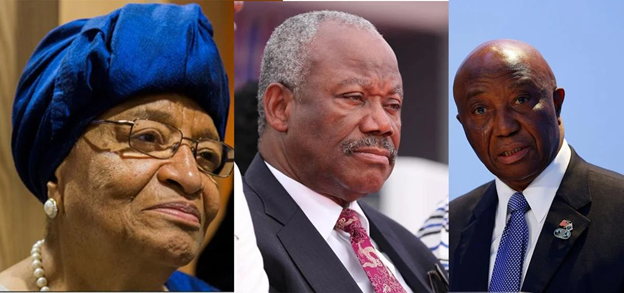
In Liberia, when someone as influential, as deeply rooted, and as essential to an institution as a pillar is to a house, passes away, we liken them to a giant cotton tree that has fallen. This is the case of Honorable Sylvester M. Grigsby, Minister of State for Presidential Affairs.
But this cotton tree, though towering and strong, fell without a crashing noise. His exit was as quiet as his storied tenure. News of his death came not with the thunder of public speculation or the whirlwind of rumor, but as a soft and sudden shock, hence the Executive Mansion’s press release describing President Joseph Nyuma Boakai’s “profound shock and deep sorrow” at the loss of his friend, aide, and confidant.
Such a departure mirrors the man’s professional life. For decades, Grigsby worked in the upper echelons of Liberian government without cultivating a flamboyant public persona. He wielded influence without theatrics, preferring the discipline of the back office to the glare of the spotlight. In an era when politics often rewards loudness over competence, his career is a case study in the quiet dignity of service.
What is it like to be trusted by two Presidents to run their governments? Grigsby was not simply a high-ranking bureaucrat. As Minister of State for Presidential Affairs — under both President Ellen Johnson Sirleaf and President Joseph Boakai — he occupied one of the most critical positions in the Executive branch of government.
The Minister of State is the President’s chief enabler, the one who ensures that policy vision becomes operational reality. It is a role that demands discretion, decisiveness, and unshakable loyalty. That two leaders, from different political contexts, entrusted him with this responsibility speaks volumes about his competence and character.
What does it mean to be a career public servant in Liberia? In our political culture, where change in leadership often sweeps away entire cadres of officials, longevity is rare. Grigsby’s more than four decades in public service — spanning foreign diplomacy, ministerial leadership, and even local governance — was not the product of inertia but of consistent relevance.
He adapted across administrations without compromising his professional identity. His stints as Acting Minister of Foreign Affairs, Deputy Minister for International Cooperation, Deputy Minister for Foreign Affairs, Superintendent of Sinoe County, and Liberia’s Ambassador to Belgium and the European Union Headquarters, all point to a skill set that was versatile yet grounded in service to the state.
Of course, to portray him as a flawless administrator would be an oversimplification. Public service at such a level inevitably involves navigating competing interests, making unpopular decisions, and sometimes standing at the center of controversy. But in assessing his legacy, the question is not whether he was perfect — no public figure is — but whether he contributed meaningfully to the stability and advancement of the government he served.
The lesson from Grigsby’s service may well be that leadership does not always need to be loud to be effective. In his tenure under President Boakai, he helped steer the ARREST agenda and facilitated landmark policy actions such as the establishment of the War and Economic Crimes Court within the administration’s first 110 days.
He was central to the government’s decision to conduct a sweeping audit of the previous administration, underscoring his belief in accountability. Ambassador Grigsby was also extremely instrumental on multiple levels in getting the Ivanhoe Atlantic Concession and Access Agreement over the IMCC finish line.
Yet, these accomplishments were rarely branded as “Grigsby’s initiatives.” He worked in the tradition of a true civil servant — advancing the President’s agenda without making himself the story.
There is another lesson in his friendship with President Boakai. The two men’s relationship stretched back over six decades to their days at the College of West Africa. While personal loyalty can be a double-edged sword in governance, in Grigsby’s case, it appears to have provided the President with a trusted voice — one who understood both the man and the mission. In a political landscape too often riddled with opportunism, the value of such trust is immeasurable.
His passing also raises broader questions about institutional memory in Liberia. Too often, when seasoned public servants leave — whether through retirement, political shifts, or death — their wealth of experience departs with them.
Grigsby embodied decades of lessons in diplomacy, statecraft, and executive management. What systems do we have in place to ensure that such knowledge is captured and passed on? Or do we allow it to vanish with the individual, leaving each administration to reinvent the wheel?
Perhaps the quiet manner of his death — succumbing to pancreatic cancer abroad, far from the public eye — will be remembered as symbolic. He was a man who, for all his proximity to power, lived and worked without seeking spectacle. The absence of public noise at his departure is not a sign of insignificance, but of the consistency with which he kept the focus on the office rather than the occupant.
As Liberia mourns the loss of this towering cotton tree, the truest tribute we can pay is not in ceremonial praise alone, but in the application of the virtues he modeled: integrity in service, humility in leadership, and a commitment to the collective good above personal gain. If future generations of public servants learn to value these principles as much as he did, then his legacy will endure beyond the confines of the Executive Mansion’s walls.
When a giant cotton tree falls in the Liberian forest, the sound may not always be deafening. Sometimes it is the quiet that speaks the loudest — reminding us that true strength is not always in the crash, but in the long, steady years of standing tall.

