

By Nicholas Putu
A Liberian woman says she is living in fear after her home was destroyed by fire and she allegedly received threatening messages from unknown individuals demanding that she disclose the whereabouts of a friend who she says is hiding after refusing to become a Chief Zoe, a traditional priestess role within the Sande Society that has historically been associated with female genital mutilation (FGM).
Speaking to this newspaper, Saybah Konnie alleged that her longtime friend, Sonnie Kollie, a trained nurse from Lofa County, has gone into hiding after resisting repeated pressure from family members and traditional leaders to assume the position of Chief Zoe.
“They want Sonnie to become the Chief Zoe and perform the cutting,” Konnie said, her voice shaking with emotion. “I have received text messages from unknown numbers demanding that I reveal where she is. They warned that they will find her at all costs.”
Konnie said she has known Kollie for several years and described her friend as someone deeply traumatized whenever discussions about the Sande Society arise.
“Every time the subject comes up, she becomes emotional,” Konnie said. “Based on what she told me happened to her in the Sande bush, she vowed she would never participate in a practice that harms innocent girls.”
The Sande Society is a traditional all-female institution found predominantly in northern, north- central, and western Liberia. Supporters describe it as a cultural institution that prepares girls for adulthood, leadership, and community life. However, critics argue that the society perpetuates female genital mutilation, a practice widely condemned by international health and human rights organizations because of its long-term physical and psychological consequences.
According to a 2022 report by the United Nations Population Fund (UNFPA), global efforts to eliminate FGM are struggling to keep pace with population growth. The agency estimates that girls at risk could increase from 4.3 million in 2023 to 4.6 million annually by 2030 if current trends continue. UNFPA says an investment of approximately US$3.3 billion across 31 affected countries could help prevent more than 24 million cases by 2030.
Konnie said Kollie’s opposition to FGM stems from painful personal experience.
“As a healthcare practitioner, Sonnie has seen firsthand the lifelong consequences,” she said. “She always told me FGM is not medicine. It violates bodily autonomy and can cause severe bleeding, infections, urinary complications, childbirth difficulties, and life-threatening infections.”
According to Konnie, Kollie was subjected to FGM as a child after relatives allegedly declared she was destined to inherit the role of Chief Zoe from her grandmother.
“She often told me that her family had already decided her future,” Konnie recalled. “She said they told her to prepare to become purified. That preparation was female genital mutilation.”
Konnie said those conversations often ended in tears.
“She would break down crying whenever she spoke about it,” she said. “Looking back now, I fear for her safety more than ever.”
Konnie also recounted what she described as Kollie’s memories of her initiation into the Sande Society.
“She told me women surrounded her and insisted the pain was necessary for her future,” Konnie said. “She said she had no choice. She was just a child being prepared for a life she never chose.”
According to Konnie, Kollie later described suffering infections and severe pain following the procedure. As she grew older, she allegedly continued to experience painful menstruation, childbirth complications, and emotional trauma.
“She always said she felt betrayed and ashamed, even though she knew what happened to her was beyond her control,” Konnie said.
Konnie further alleged that Kollie became determined to protect her own daughter from undergoing the same experience.
“She fought to keep her daughter safe. She feared members of her family might try to subject her to FGM.”
After earning a bachelor’s degree in nursing from United Methodist University in Monrovia, Kollie was reportedly assigned to work with the Lofa County Health Team.
However, Konnie claimed that her friend’s career was overshadowed by renewed family pressure.
She alleged that on September 1, 2021, Kollie’s grandmother and aunt visited her in Salayea District and demanded that she return to her home village of Kpakamai to assume her traditional role.
“Sonnie refused,” Konnie said. “She told them she would never become a Chief Zoe.”
According to Konnie, Kollie later told her that an aunt warned she would bring shame upon the family and could face serious consequences if she continued to reject what relatives described as her ancestral responsibility.
Konnie further alleged that on August 30, 2023, family members again arrived unexpectedly at Kollie’s residence and demanded that she accompany them immediately.
“They told her everyone was waiting,” Konnie said. “They warned that if she refused again, she would be abandoned and her life would be in danger.”
While allegedly moving between safe locations, Konnie said Kollie told her that relatives—including some whom she identified as members of the National Traditional Council of Elders—threatened to curse her and perform rituals intended to make her mentally unstable unless she returned.
“She told me she couldn’t sleep or eat,” Konnie said. “She had nightmares about the things she witnessed and about the girls she had seen being circumcised.”
Konnie said the situation escalated after relatives allegedly discovered that Kollie had been staying with her.
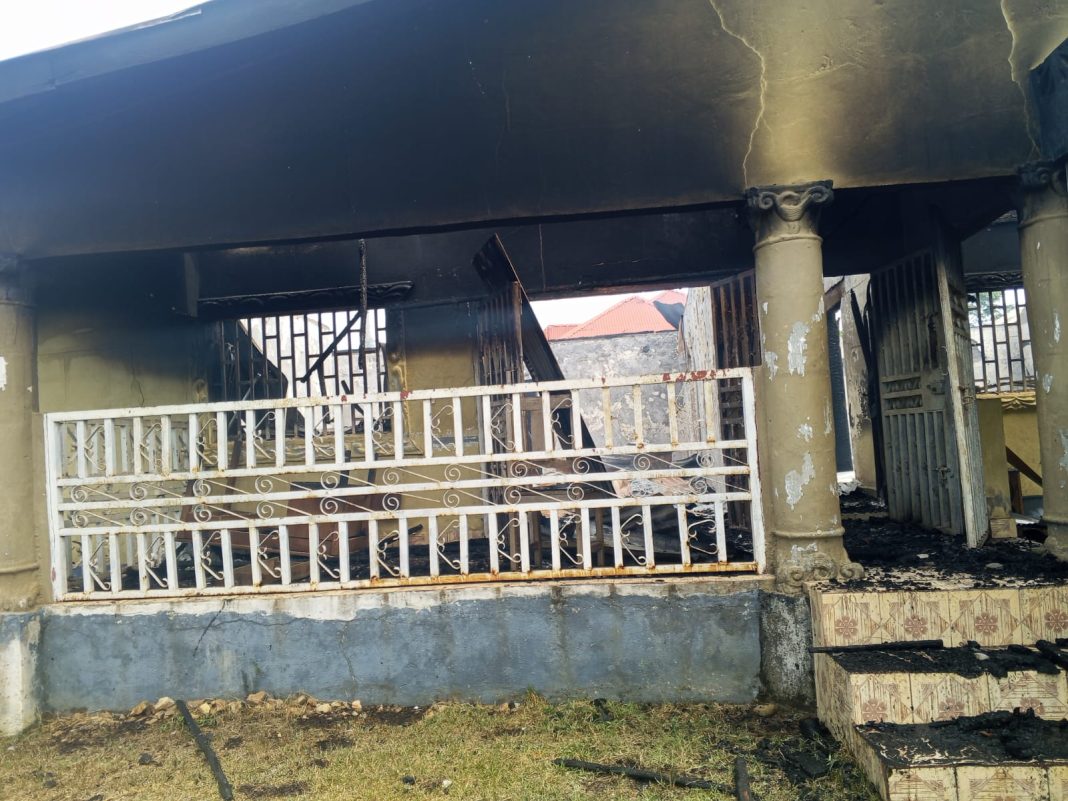
“I started receiving anonymous text messages demanding that I hand her over,” she said. “Then, two days later, my house caught fire.”
Fighting back tears, Konnie described watching her home burn.
“I lost everything trying to help a friend,” she said. “My neighbors called the fire service, but by the time firefighters arrived, the house had already been consumed.”
She said authorities have launched an investigation into the cause of the fire. At the time of publication, this newspaper had not independently verified whether the fire was connected to the alleged threats.
Konnie is now calling on the Liberian government, human rights organizations, and international partners to strengthen protection for women and girls who say they are fleeing harmful traditional practices.
” Sonnie might have survived,” she said. “But many girls don’t have a voice. I am speaking for them.”

