

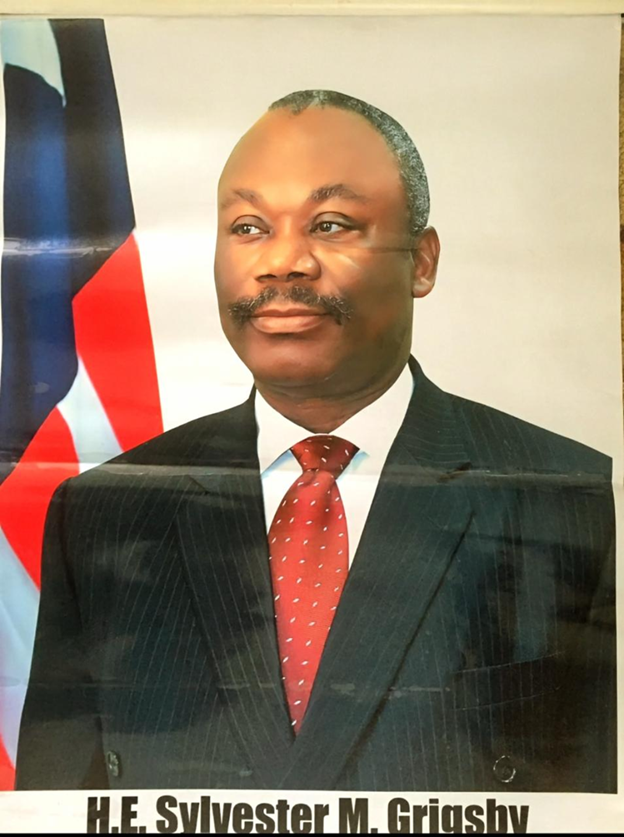
By Joe S. Kappia and Gabriel I.H. Williams, on behalf of the Sun Times Newspaper Family.
Solon, a Greek philosopher, who is recognized as one of the fathers of democracy, once said: No man should consider himself truly happy until he is dead.”
Solon believed that it is at the post of a person’s life (upon death) that the verdict comes out as to how well the individual lived with others for good or for bad. It is at that time when those who knew or interacted with the deceased, or were impacted by the actions of the deceased reminisce.
Accordingly, this article is in memory of Sylvester M. Grigsby, the Minister of State for Presidential Affairs in the government of President Joseph Nyuma Boakai, who died on August 9, 2025, in Houston, TX, USA, at the age of 74.
Much is known about Honorable Grigsby as a consummate public servant, who has served his country for decades. However, there is little public knowledge that the late Ambassador Grigsby was a quiet champion of press freedom during the period of military rule in Liberia in the 1980s.
Hon. Grigsby was a quiet bureaucrat at the Ministry of State for Presidential Affairs during the military regime of Master Sergeant Samuel Kanyon Doe. Considering the fact that he worked directly with then Head of State Doe, he observed and absorbed the political temperature in the country regarding freedom of expression and of the press. He witnessed what happened to journalists and newspapers – unlawful imprisonment, arbitrary closures, and constant harassment of media personnel and institutions.
Upon taking power, however, the military government had promised to protect the rights of Liberians, including freedom of speech and of the press, which it claimed was denied the people during the True Whig Party government. Sergeant Doe made this promise two days after the April 12, 1980 coup, during which President Tolbert was assassinated. This promise of freedom gave birth to the emergence of private business investments in the newspaper industry – the Daily Observer, Footprints Today, Sun Times, Daily Star, the Mirror, Sunday Express, the Redeemer, and the government-owned New Liberian. Others that appeared occasionally included the Standard, Liberian Post, Business Times, Bong Crier, which was donor funded with a focus on promoting rural agricultural projects.
Promise Betrayed But this promise to protect press freedom was soon betrayed by the military due to two factors: an increase in newspaper reportage about “rampant corruption,” in response to Doe’s declaration that corruption in public places be exposed; and the desire of the military leaders to transition into civilian government come 1986 return to civilian rule.
Despite the prevailing situation, Mr. Sylvester M. Grigsby invested heavily in a risky business – publication of Sun Times newspaper. What was he thinking? Was the timing appropriate? Was it because he hailed from the Southeast and working for a government dominated by military leaders from that region could shield him from the government' s ultrasensitive reaction to critical reportage?
No! Minister Grigsby teamed up with legendary journalist Rufus Mammah Darpoh in April 1985 to start the Sunrise Group Inc. to publish Sun Times newspaper and fill a vacuum left by the closure of the Daily Observer newspaper by the military regime. He created jobs for one group of Observer staff unemployed by the January 16, 1985, closure of that newspaper.
They included the following: Joe S. Kappia, who was features editor at the Observer became a deputy editor to Mr. Darpoh, while Observer reporter Gabriel Williams, was also absorbed as a reporter at Sun Times.
Other Sun Times staff included Lawrence Thompson, Calton Boah (publisher of In-Profile Daily), Thomas Nimley (former Grand Kru Senator), Henry Mallet, Agnes Karsor, Michael Kumeh and Wantue Major, creator of “Kontry Cartoon” among others.
Besides creating jobs in the private sector, what was the return on Minister Grigsby’s investment? It was closure after closure and finally a hefty fine!
“Bunch of Idiots”
The first closure of Sun Times newspaper was in August 1985 for publishing a July 26, the Independence Day speech given by Madam Ellen Johnson-Sirleaf in Los Angeles, California, USA, where she referred to Doe’s government officials as “bunch of idiots.”
In the wake of this development, Doe stated in a live broadcast that his government will not hesitate to “use military action against the few Congo people who were against his government.”
Sun Times carried this story as a banner headline, and the paper was immediately closed for three weeks.
Minister Grigsby negotiated behind closed doors for the unbanning of the paper. There were unofficial accounts that the government demanded the removal of Managing Editor Rufus Darpoh and News Editor Westmore Dahn from the editorial staff.
However, after the intervention of Counselor J. Patrick Biddle, secretary general of Doe’s National Democratic Party of Liberia (NDPL), who was a friend of Darpoh (Biddle and Darpoh attended the same Catholic church), the demands were dropped. The visit to our office by Counselor Biddle and his advice that some of us should quit newspaper journalism, raised a red flag about the paper’s future.
The second warning came from friends in the security sector that we should tread cautiously during the transitional period to civilian rule.
The Second Republic (January 6, 1986) ushered in an uncomfortable climate for press freedom – torching of the offices of the Daily Observer, government’s threat to close down Sabanoh Printing Inc. for printing independent newspapers, and newspaper vendors’ threat to boycott government newspapers.
$3,000 fine
In spite of these undemocratic actions under a constitutional rule, Minister Grigsby continued to fund the paper. Then came another setback in April 1986 when the management of Sun Times was fined $3,000 for contempt of court by Chief Justice James N. Nagbe. Our crime: criticizing the corrupt nature of the court system.
This is similar to what happened to now late Stanton B. Peabody (Bob Stan) in 1964 when he was sent to jail for referring to legislators as “radicals.” Mr. Peabody’s detention led to the organization of the Press Union of Liberia (PUL) to enable journalists to seek their collective interests. In the case of Sun Times, no staff member was sent to jail but both accounts were void of any due process of law. At the same time, President Doe referred to Sun Times as “a threat to national unity.”
Minister Grigsby was given a 24-hour ultimatum to pay the fine ($3,000) or the paper’s article of incorporation would be revoked. Minister Grigsby made a partial payment of this extra-judicial
fine, but it still remained banned by the government until President Doe later reversed the banning order.
For the first time, Minister Grigsby felt the pain of investing in a risky business and decided to stay out of newspaper publication due to lack of operational funds.
In the office, Minister Grigsby was a very friendly boss who gave us the freedom to publish news that would foster national development, irrespective of the potential risks to him and his family in a volatile political environment. May his soul rest in peace, and may the Lord strengthen the bereaved family to continue to forge ahead.

