

By Sidiki Fofana | Truth in Ink Political Analysis
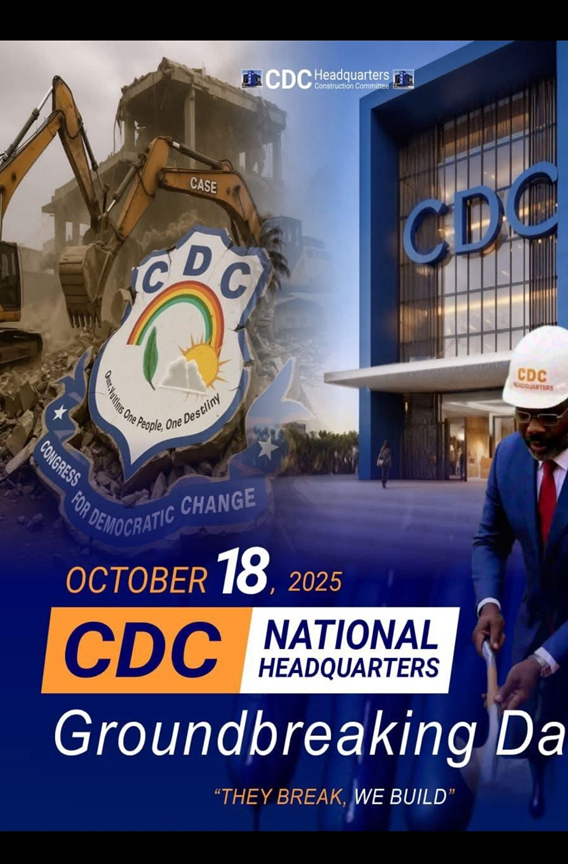
When members of the Congress for Democratic Change gather on October 18, the birth month of their inspiring political leader, George Weah, to break ground for their new party headquarters, they will be doing far more than mixing cement and sand. They will be rebuilding faith, reclaiming identity, and reviving a movement that has been bruised but not broken.
For a party that once transformed the slums and backstreets of Monrovia into a fortress of faith and populist pride, the loss of its old headquarters could have been the final nail in its political coffin. But rather than sink into despair, the CDC has chosen to rewrite its story, from defeat to renewal, from dispossession to determination.
The CDC’s “Blue Revolution” was never about buildings; it was about belief, about the power of ordinary people to rise above their struggles and shape their own destiny. Still, the old headquarters carried meaning beyond measure. It was where the spirit of resistance was born, where dreams were organized into slogans, and where hope found a home in a movement that promised dignity to the forgotten.
Losing that structure was not just a physical loss. It was emotional, a rupture in the bond between place and purpose. Yet by choosing to rebuild in October, the party is sending a message loud and clear; what was taken in structure will be rebuilt in strength.
This new beginning is not about a pile of concrete; it’s about continuity. It’s about a political family standing tall again, determined to prove that its foundation rests not on walls but on will.
Politically, this decision could not come at a better time. The CDC, now in opposition, faces the hardest question of its lifetime; can a movement that rose on the back of a single man grow into an enduring institution?
The rebuilding of the headquarters offers an answer in action. It reflects a willingness to organize again, to consolidate again, and to reimagine power from outside the state. It transforms the narrative of loss into one of resilience that even in defeat, there is dignity; and in rebuilding, there is renewal.
This is the politics of purpose, using what broke them to bind them together again. The groundbreaking becomes a declaration that the CDC is still alive, still present, and still capable of leading the nation again in a country where many parties vanish once they leave power.
Every political movement faces its test when the applause stops and power is gone. For the CDC, this is that moment, to rediscover its essence beyond chants, blue flags, red beret and campaign songs. The rebuilding should serve not only as a construction project but as a reflection point; what does the CDC stand for when not in power?
If it returns to the ideals that birthed it, the fight for economic development, youth empowerment, and social justice, this new chapter could become the beginning of something deeper. The loss of its fortress may turn out to be a blessing in disguise, clearing space for internal reforms, renewal of discipline, and a more grounded political culture that values people over position.
George Weah’s presence and influence remain the party’s heartbeat. His name is both its history and its challenge. For many supporters, he symbolizes the struggle of the common man and the triumph of resilience. But as the party rebuilds, it must also cultivate a broader leadership network, one capable of carrying that legacy forward with purpose, not personality.
To turn a bad situation into good means learning from what went wrong, rebuilding what was broken, and reaffirming what still binds the faithful together. The new structure, when completed, must serve not just as an office but as a center of political education and community renewal, a living reminder that strength is not measured by possession but by perseverance. And that while one man or a group of men can inspire a movement, no man should become the movement.
For in CDC each man is important, but no man gets bigger than the ultimate foundation on which the party stands now builds.
When that first shovel of dirt is lifted on October 18, it will mark not a return to the past but the beginning of a new journey. The CDC will be telling Liberia that even in loss, there is lesson; even in failure, there is faith.
If the party can translate this moment into action, focusing on service, integrity, and a genuine bond with the people, then history may remember this not as an act of rebuilding, but as a rebirth.
The fall of a fortress, after all, does not mean the end of a movement. Sometimes, it is how new foundations are laid, stronger, deeper, and more enduring.

