

Abstract
Maritime security has become a defining component of national security, economic resilience, and international legitimacy for coastal and flag states in the twenty-first century. Liberia, endowed with a strategic Atlantic coastline and recognized globally as one of the world’s largest maritime flag registries, occupies a critical position in both regional and international maritime security governance.
Central to this architecture is the National Port Authority (NPA), the statutory body responsible for the management and administration of Liberia’s public ports. Although the NPA is not a maritime law-enforcement agency, its institutional role directly influences port security, maritime trade facilitation, and national security outcomes.
This article examines the role of the National Port Authority in advancing maritime security in Liberia. It analyzes the conceptual foundations of maritime security, the legal and policy frameworks governing port security, the institutional relationships between the NPA and other security agencies, and the operational and structural challenges undermining effective maritime governance.
Drawing on international maritime law, regional security frameworks, and Liberia-specific case studies, the article argues that strengthening the NPA’s security coordination capacity is indispensable to Liberia’s economic development, sovereignty, and regional stability in the Gulf of Guinea.
The article concludes with strategic, legal, and institutional recommendations aimed at reforming port governance and enhancing Liberia’s maritime security posture.
Keywords: Maritime Security, National Port Authority, Liberia, Port Governance, ISPS Code, Gulf of Guinea, Maritime Law, Security Sector Reform
Introduction
Maritime spaces have historically served as conduits for commerce, cultural exchange, and geopolitical influence. In the contemporary global system, however, maritime domains have also become theaters of complex security threats, including piracy, armed robbery at sea, trafficking in persons and narcotics, illegal fishing, terrorism, cyber intrusion, and environmental crime. For coastal developing states such as Liberia, these threats pose existential risks to economic stability, national sovereignty, and post-conflict recovery.
Liberia’s economy is overwhelmingly dependent on maritime trade. The vast majority of imports—including fuel, food, medical supplies, and industrial goods—enter the country through seaports managed by the National Port Authority. At the same time, Liberia’s international image as a maritime nation is reinforced by its globally dominant ship registry, making maritime governance a matter of both domestic and international concern.
Despite this centrality, scholarly attention to Liberia’s port institutions—particularly the NPA—within maritime security discourse remains limited. Most analyses focus on naval capabilities, piracy suppression, or flag-state regulation, often overlooking the strategic importance of ports as security nodes. This article fills that gap by interrogating the role of the National Port Authority within Liberia’s maritime security architecture.
Liberia’s ports serve as the primary gateway for imports and exports, accounting for the majority of goods entering and leaving the country. The National Port Authority (NPA), established as the principal institution responsible for managing public ports, occupies a strategic position within this security ecosystem.
While maritime law enforcement falls largely under the Liberia Maritime Authority (LiMA), the Liberia Coast Guard, and the Armed Forces of Liberia (AFL), the NPA provides the physical, administrative, and operational environment within which maritime security is either strengthened or weakened.
This article is guided by three core assumptions:
Ports are strategic security infrastructures, not merely commercial facilities.
Maritime security is inherently inter-agency and multi-layered.
Weak port governance undermines national maritime security regardless of naval strength.
Conceptual and Theoretical Framework
Defining Maritime Security
Maritime security defies a single universal definition. Bueger (2015) conceptualizes maritime security as a “cluster concept” encompassing multiple overlapping security concerns, including national security, economic security, environmental protection, and human safety. The International Maritime Organization (IMO) frames maritime security primarily around the prevention of unlawful acts against ships and port facilities, while regional bodies such as ECOWAS adopt a broader human and economic security lens.
For the purpose of this study, maritime security is defined as:
The protection of maritime spaces, infrastructure, trade, and human activity from unlawful, destabilizing, or destructive acts through legal, institutional, and operational mechanisms.
This definition deliberately includes ports as critical security domains.
Port Security as a Subset of Maritime Security
Ports represent fixed, high-value targets within the maritime domain. They are simultaneously:
Economic gateways,
Border control points,
Critical infrastructure,
Potential points of criminal and terrorist exploitation.
The security of ports is therefore a prerequisite for effective maritime security. The NPA, as the custodian of Liberia’s ports, is inherently embedded in this security continuum.
Security Sector Governance Theory
This study draws on Security Sector Governance (SSG) theory, which emphasizes:
Civilian oversight,
Institutional accountability,
Inter-agency coordination,
Legal clarity of mandates.
From this perspective, maritime insecurity often stems not from lack of assets, but from institutional fragmentation—a recurring challenge in Liberia’s maritime sector.
Historical Evolution of the National Port Authority
The Freeport of Monrovia, Liberia’s main seaport, was not originally built by a Liberian government administration but by the United States military during World War II. It was constructed between the early 1940s and 1948 as part of a strategic Allied effort to secure shipping routes on the West African coast and ensure reliable access to rubber and other critical wartime materials.
During World War II, Liberia was a key strategic partner for the United States. The war heightened the need to safeguard Allied maritime logistics and access to natural resources, especially rubber — a material of strategic importance for wartime industries. As a result, the U.S. government and armed forces invested in the construction of a modern artificial harbor with protective breakwaters at Bushrod Island in Monrovia. The port opened for use in 1948.
After decades of operation under U.S. influence and management through a contracted port company, the Liberian government took over the port in the early 1970s. This included integrating it into the newly established National Port Authority (NPA), which was created by the Liberian Legislature in 1967 (amended in 1970) to manage, plan, develop, and build all public ports in Liberia.
The National Port Authority was established in 1967, during a period when Liberia sought to modernize its maritime infrastructure and consolidate state control over port operations. Prior to the NPA’s creation, port management was fragmented, inefficient, and poorly regulated.
The NPA’s mandate includes:
Construction and maintenance of port facilities,
Regulation of port operations,
Promotion of maritime commerce,
Revenue generation for the state.
Liberia’s civil war (1989–2003) severely damaged port infrastructure and institutional capacity. Post-war reconstruction efforts placed renewed emphasis on port rehabilitation, particularly the Freeport of Monrovia, with support from international partners.
However, post-conflict reconstruction prioritized economic recovery over security integration, resulting in ports that were operational but not fully secured under modern maritime security standards.
Legal and Policy Frameworks Governing Port and Maritime Security
Domestic Legal Framework
Liberia’s port and maritime security governance is shaped by several domestic statutes:
The National Port Authority Act (1967, amended 1970)
Establishes the NPA and defines its administrative authority.
Liberia Maritime Authority Act
Governs ship registration, maritime safety, and regulatory oversight.
National Defense Act
Provides the basis for maritime defense through the Armed Forces of Liberia.
Customs and Immigration Laws
Regulate border security within port environments.
A critical weakness in this framework is the absence of explicit statutory provisions defining the NPA’s security coordination role, resulting in ambiguity and reliance on ad hoc arrangements.
International Legal Obligations
Liberia is bound by numerous international maritime instruments, including:
UNCLOS (1982) – maritime jurisdiction and sovereignty;
SOLAS Convention – safety of life at sea;
ISPS Code – port and ship security;
AU AIMS 2050 – African maritime strategy.
Compliance with the ISPS Code obligates the NPA to implement port facility security plans, conduct risk assessments, and cooperate with designated national authorities.
Institutional Role of the NPA in Maritime Security
ISPS Code Compliance and Port Facility Security
The NPA is responsible for ensuring that Liberia’s ports meet ISPS Code requirements. This includes:
Physical security infrastructure (fencing, lighting, access control);
Appointment of Port Facility Security Officers (PFSOs);
Conduct of drills and audits;
Coordination with international inspectors.
Failure to comply exposes Liberia to port restrictions, increased insurance premiums, and reputational damage.
Port Security Operations and Internal Controls
The NPA’s Safety and Security Division provides:
Internal surveillance,
Emergency response coordination,
Support to the Liberia Seaport Police.
While these functions are largely preventive rather than coercive, they form the first line of defense against port-related security threats.
Infrastructure as Security
Modern port infrastructure enhances security by:
Reducing congestion,
Improving cargo traceability,
Limiting unauthorized access.
Investment decisions by the NPA therefore have direct security implications.
Inter-Agency Coordination and Governance Challenges
Maritime security in Liberia involves multiple actors:
Liberia Maritime Authority,
Liberia Coast Guard / AFL,
Liberia National Police,
Customs and Immigration,
National Security Agency.
Despite this multiplicity, coordination remains weak due to:
Overlapping mandates,
Information silos,
Absence of a permanent maritime security coordination body.
The NPA often functions as a host institution without decision-making authority in security matters, limiting its effectiveness.
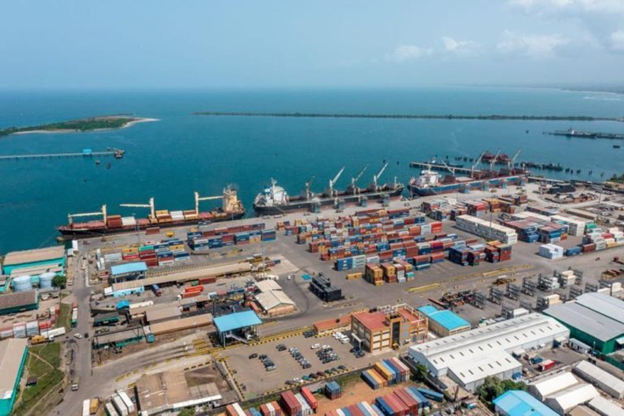
Case Study: The Freeport of Monrovia
The Freeport of Monrovia illustrates both progress and persistent challenges:
Upgraded terminals and ISPS compliance,
Persistent issues with congestion and informal access,
Dependence on external security agencies for enforcement.
This case demonstrates that infrastructure upgrades alone are insufficient without integrated governance.
Regional and International Context
Liberia’s ports are embedded in the Gulf of Guinea maritime security complex, historically affected by piracy and transnational crime. Regional frameworks such as the Yaoundé Architecture emphasize port security as a pillar of regional stability.
Liberia’s participation in EU-funded port security initiatives reflects growing international confidence but also highlights reliance on external support.
Emerging and Non-Traditional Maritime Security Threats
Modern port security must address:
Cyber threats to port management systems,
Environmental crimes and illegal dumping,
Human trafficking and stowaways,
Terrorism and sabotage risks.
These threats require advanced skills and technology beyond traditional policing.
Strategic Importance of the NPA to National Security and Development
Secure ports:
Attract foreign direct investment,
Facilitate AfCFTA trade,
Strengthen state authority,
Enhance Liberia’s diplomatic standing.
The NPA thus functions as both an economic and security institution.
Policy and Institutional Reform Recommendations
Legislative Reform to clarify the NPA’s security coordination mandate.
Creation of a National Maritime Security Council.
Capacity Building in port security intelligence and cyber resilience.
Sustainable Financing Models for security infrastructure.
Formalized Inter-Agency Protocols within port environments.
Conclusion
The National Port Authority is a foundational yet under-recognized pillar of Liberia’s maritime security architecture. Strengthening its legal authority, institutional capacity, and coordination mechanisms is essential for safeguarding Liberia’s maritime domain, promoting economic resilience, and contributing to regional stability in West Africa. Maritime security in Liberia cannot be achieved at sea alone; it must be anchored firmly at the ports.
The port was originally built by the United States military during World War II for strategic and logistical purposes. It later passed to Liberian control under the National Port Authority framework of the late 1960s and early 1970s so that Liberia could manage its own maritime infrastructure, support economic development, and strengthen national sovereignty over trade infrastructure.
About the Author
Professional Profile Summary
Tarpeh L. U-sayee, Jr. is a seasoned Liberian law enforcement professional, criminal justice professor, and police training expert with a solid foundation in international relations, theology, and public service. With over a decade of experience in both law enforcement and criminal justice education, he currently serves as a trainer of the Executive Protection Service (EPS), the Liberia National Police Training Academy and lecture at various private universities in Liberia.
He holds a Master’s Degree in Foreign Service Leadership (International Relations), a Master of Divinity, dual Bachelor’s Degrees in Sociology and Criminal Justice, and an Associate Degree in Management. He is also a prospective doctoral graduate in Church Growth and Ministry.
Mr. U-sayee is a graduate of the Liberia Police Academy, the Louisiana State Police Academy (USA), and the Lagos State Police Academy (Nigeria). As an Apostle and spiritual leader, he brings a unique combination of ethical leadership, academic excellence, and practical field experience. His lifelong mission is centered on peacebuilding, unity, and the advancement of the rule of law in Liberia.
References
Bueger, C. (2015). What is maritime security? Marine Policy.
International Maritime Organization. ISPS Code.
United Nations. UNCLOS (1982).
African Union. AIMS 2050.
ECOWAS. Integrated Maritime Strategy.
World Bank. Maritime Trade and Security in West Africa.
Liberia National Port Authority Act (1967).
Liberia Maritime Authority Act.

